
IPNA Fellowship 2027
Most fellowships reward the training you already have. This one rejects you for it.
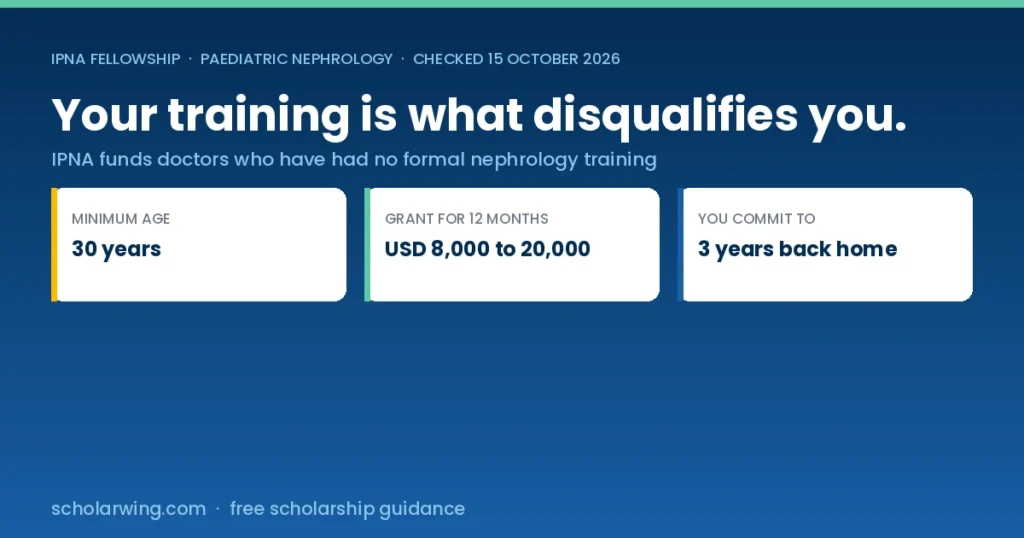
The International Pediatric Nephrology Association funds doctors from developing countries to train in paediatric nephrology abroad, and its eligibility list contains a line that stops almost everyone who reads it: you must have had no formal training in nephrology. Applicants who have already worked in paediatric nephrology outside their home country cannot apply at all.
That sounds backwards until you see what IPNA is buying. It does not want to polish a specialist. It wants to put paediatric nephrology into a hospital that currently has none, and then keep it there, which is why the rest of the rules all point homeward.
The programme has run since 2003 and has completed 340 fellowships, with past fellows from 71 countries.
What it pays
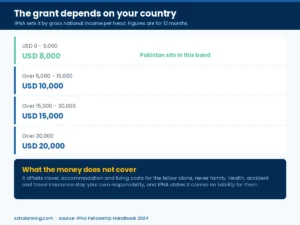
IPNA sets the grant by your home country’s gross national income per head, and it publishes the bands openly. These figures cover twelve months, and IPNA aligns the actual grant with the length of your training.
| Home country GNI per capita | Funding for 12 months |
|---|---|
| US$0 to 5,000 | US$8,000 |
| Over US$5,000 to 15,000 | US$10,000 |
| Over US$15,000 to 30,000 | US$15,000 |
| Over US$30,000 | US$20,000 |
Pakistan sits in the first band, so a Pakistani fellow should expect the US$8,000 figure for a full year. Read that number honestly: it offsets travel, accommodation and living costs for you alone, not your family, and health, accident and travel insurance remain your own responsibility. IPNA states plainly that it carries no liability for them.
Payment normally goes to the host institution rather than to you, unless the host asks otherwise and the training centre confirms it. The first half arrives within four weeks of the payment form, and the second half after your mid-term report.
Eligibility criteria
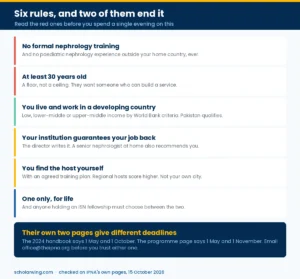
You must be at least 30 years old. Few medical awards set a floor rather than a ceiling. This one does, and it tells you who IPNA wants: a doctor already established enough to build a service, not a fresh graduate.
You must have no formal training in nephrology, and no previous paediatric nephrology experience outside your home country.
You must live and work in a developing country, defined by World Bank criteria as a low, lower-middle or upper-middle income economy. Pakistan qualifies.
Your home institution must guarantee your re-employment. A Home Mentor and your institution nominate you, and the director writes a letter guaranteeing a job when you return. A senior nephrologist in Pakistan must also recommend you.
You must find a host before you apply, with an agreed training plan. IPNA prefers a host in your own region, and generally refuses training in the same city as your home institution.
You must speak the host country’s language, and you need a host medical licence that permits direct patient care, because IPNA prioritises hands-on training over observation.
One more rule catches people. You may hold only one IPNA fellowship in your life, and anyone who already received an ISN fellowship must choose between the two.
What you commit to afterwards
This is the part most applicants skip, and it binds you for years.
You must return home within three months of finishing. You must then work at your home institution for at least three years, in a long-term post that matches what you trained for. And You submit a final training report and a budget report within three months, and your supervisor files a training center report.
Miss that final report deadline and you lose your eligibility for IPNA benefits entirely.
What you get beyond the money
Once IPNA verifies your final report: a year of IPNA membership with online access to the journal Pediatric Nephrology and the eighth edition textbook, free trainee membership during training plus two further years of graduate membership, free congress benefits at the next IPNA Congress including registration and travel funding at hybrid congresses, and an official IPNA training certificate.
For a doctor in a hospital with no nephrology service, the textbook and journal access alone change what you can do on a ward round.
Training levels
IPNA runs two levels, and your application names which you want. Level 1 builds basic competence. Level 2 covers clinical skills including supervised procedures such as renal biopsies. Where two applications score equally, local and regional training centers take priority over distant ones.
The deadline problem, stated plainly
IPNA’s own two pages disagree. The 2024 Fellowship Handbook gives the rounds as 1 May and 1 October. The programme page gives them as 1 May and 1 November. We have printed both rather than pick one, because we cannot verify which governs this year.
If the handbook is right, the October round has closed and your date is 1 May 2027. If the programme page is right, 1 November 2026 is days away. Either way, email office@theipna.org this week and ask which applies. Late applications are not accepted under either reading.
Results arrive by email about a month after each deadline, with announcements in June or July and in November or December. Your training must then start within six months of your acceptance letter, and any delay needs justifying in advance or the grant may be withdrawn.
Step-by-step application process
Step 1 — Check the two disqualifying rules first. Formal nephrology training, or pediatric nephrology experience abroad, ends it. Confirm you are 30 or over.
Step 2 — Find your host, early. Write to pediatric nephrology units in your region first, since IPNA prefers regional hosts and scores them higher when applications tie. Ask whether the unit can issue an acceptance letter and work with you on a joint training plan.
Step 3 — Secure three letters from home. Your Home Mentor’s nomination, a recommendation from another nephrologist, and your director’s letter guaranteeing re-employment. Add a letter from your local or regional society. All on official letterhead, all signed, all in English.
Step 4 — Write the applicant’s letter. IPNA asks for at least 500 words covering what your home institution can currently do, naming renal biopsy, CRRT, peritoneal dialysis, haemodialysis and transplantation, and which new techniques you plan to bring back. Write this about your hospital’s gaps rather than your own ambitions.
Step 5 — Complete the Facilities and Resources Table. A PDF listing what your institution has. Fill it honestly; the gaps are the argument for funding you.
Step 6 — Submit on Jotform in English. The application runs through IPNA’s online form, and every document must be in English. Declare any other funding you have applied for.
Step 7 — Plan the money before you accept. US$8,000 across twelve months, with insurance on top and nothing for family, needs a real budget. Ask your host about accommodation, and check tax, housing, transport and security in the host city, which IPNA itself advises before you apply.
If IPNA does not fit, look at ISN
The International Society of Nephrology runs a larger fellowship programme, and two of its routes suit Pakistani applicants directly.
ISN-Heartlands Hospital, Birmingham runs six to twelve months and carries a South Asia designation. Few funders name our region that specifically.
The Muhammad Magdi Yaqoob Fellowship at the Royal London Hospital runs six months, and CVs go in at any time of year rather than against a deadline.
ISN also runs a general fellowship for members from low, lower-middle and upper-middle income countries, with a deadline of 1 October, plus the Ravi Mehta ISN AKI Fellowship, ISN-TTS transplantation fellowships of six to twelve months or three to six months, and a paediatric nephrology route run jointly with IPNA through the same general portal. ISN publishes no amounts on the page we read. Applications go through fellowship.theisn.org, and questions to fellowship@theisn.org.
Remember the overlap rule: hold an ISN fellowship already and you must choose between it and IPNA.
FAQ
I did a nephrology rotation during my paediatrics residency. Am I disqualified?
IPNA’s words are “no formal training in nephrology.” A rotation inside a general paediatrics programme is not usually formal specialty training, but this is exactly the question to put to office@theipna.org before you spend weeks on an application. Get the answer in writing.
Can I apply while still a resident?
The minimum age of 30 and the requirement that your institution guarantee re-employment both point at someone already in a post, not in training.
Is US$8,000 enough to live on abroad for a year?
It offsets costs rather than covering them. IPNA says so itself. Most fellows need their home salary to continue, which is one more reason the home institution’s commitment matters, and one more thing to settle with your director before you apply.
Does it pay for my family to come?
No. IPNA states the grant covers the fellow only.
Can I train in a rich country?
You may, but IPNA prefers a host in your own region and gives regional centres priority when scores tie. A strong unit in your own region may genuinely be the better application as well as the better training.
Is there an English test?
No. IPNA asks that you understand and communicate in the host country’s language and that every document be in English. There is no IELTS or TOEFL requirement on the pages we read. Our medical scholarships without IELTS guide explains how funders assess language without a test.
What if I cannot find a host?
Then you cannot apply yet, because IPNA requires both the host acceptance letter and a joint training plan. Treat host-finding as the first six months of the project, not the last step. Our microbiology guide sets out how to write a first email to a unit abroad.