
Open Society Scholarships Ended in 2021. What Replaced Them Pays $120,000 and Excludes Pakistan.
Open Society Foundations scholarships were, for two decades, one of the few genuinely open doors for students from countries like Pakistan who wanted to study abroad and come back to change something.
They closed five years ago.
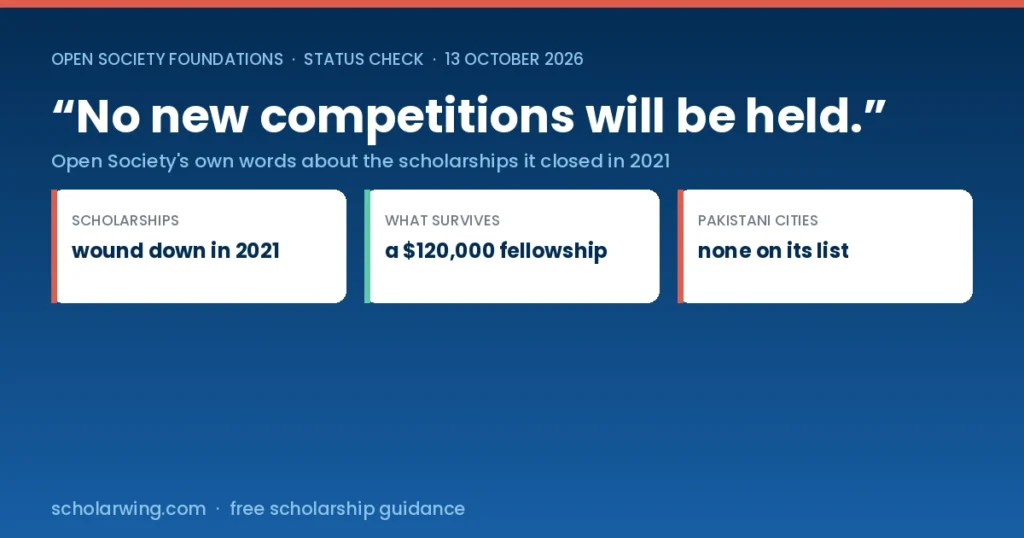
Open Society says so on its own grants page, in its own words: it “took the difficult decision to wind down our Scholarship Programs in 2021”, and “No new competitions will be held.”
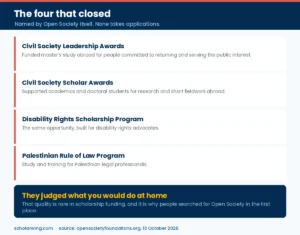
It names the four programmes directly: the Civil Society Leadership Awards, the Civil Society Scholar Awards, the Disability Rights Scholarship Program, and the Palestinian Rule of Law Program.
Scholarship websites are still publishing Civil Society Leadership Awards listings for 2026-2027.
What closed, and what it used to be
Those four programmes were the reason people searched for Open Society in the first place.
The Civil Society Leadership Awards funded master’s study abroad for people committed to returning and working in the public interest. The Civil Society Scholar Awards supported academics and doctoral students for research and short fieldwork. The Disability Rights Scholarship Program did the same for disability rights advocates, and the Palestinian Rule of Law Program for Palestinian legal professionals.
Each one shared a quality that is rare in scholarship funding: it judged you on what you intended to do at home, rather than on test scores and grades.
All four stopped taking applications in 2021. Open Society made no promise of a successor, and five years later it has not announced one.
What actually survives
Here is where this page becomes useful rather than only disappointing.
Open Society still gives money to individuals. Its own FAQ says it “awards a limited number of grants to individuals, primarily through fellowships”.
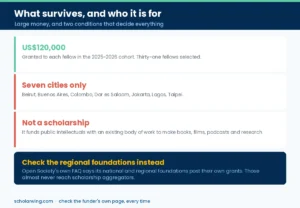
The flagship is the Open Society Fellowship, and the numbers are substantial. In the 2025-2026 year it selected 31 public intellectuals, each receiving a grant of US$120,000. Fellows produce books, documentaries, podcasts and research, and a panel of external reviewers selects them for what Open Society describes as heterodoxy and openness to new approaches. Fellows meet in person several times and join a network built around collaboration and debate.
Now the two conditions that decide whether this applies to you.
It runs in seven cities only: Beirut, Buenos Aires, Colombo, Dar es Salaam, Jakarta, Lagos and Taipei. No Pakistani city appears on that list. Colombo is the closest to our region, and it is in Sri Lanka.
And it is not a scholarship. It funds public intellectuals who already have a body of work and a platform, to make something. A student cannot apply to it in any meaningful sense, because the fellowship asks what you have already built.
So the honest summary is this. The thing that was open to students is closed. The thing that is open is large, and it is not for students, and it is not for Pakistan.
The one route still worth checking
Open Society’s FAQ makes a point most people miss. It tells readers to check the national and regional foundations’ own websites, because those post their own grants and fellowships separately from the global organization.
That is a real lead rather than a brush-off. Open Society’s regional entities run their own programmes on their own timetables, and those never reach international scholarship aggregators at all.
Separately, the Open Society University Network, a partnership of universities built around Bard College, runs student mobility and academy fellowship programmes. We could not verify its current terms or whether Pakistani students qualify, so we are naming it as a lead rather than a recommendation. If you want to pursue it, write to the network directly and ask.
Why sites still advertise it
This is the second time this month we have written this paragraph, and that is the point.
A closed programme with a famous name keeps earning traffic. Someone copies an old description, adds a plausible future year, and publishes. The next site copies that one. Within a few cycles, several sites agree on a deadline nobody at the funder has ever seen.
It costs the site nothing. It costs you a month.
Four checks, before you build anything. Open the founder’s own website, not a blog. Find the application portal rather than the description page. Look for the marks of an ending, a wind-down statement, an archive, a university office marking it discontinued. And email the founder, because one line from them beats every article on the internet, this one included.
In this case the first check alone settles it. Open Society’s own FAQ states the wind-down in plain language, and it takes four minutes to find.
Frequently asked questions
Is the Civil Society Leadership Award open for 2027?
No. Open Society states that it wound down its scholarship programmes in 2021 and that no new competitions will be held. It names the Civil Society Leadership Awards specifically.
Will Open Society scholarships come back?
Open Society has announced no successor in five years. Its own wording describes a wind-down rather than a pause.
Can a Pakistani apply for the Open Society Fellowship?
Not in practice. It runs in seven cities, Beirut, Buenos Aires, Colombo, Dar es Salaam, Jakarta, Lagos and Taipei and none is in Pakistan. It also targets established public intellectuals rather than students.
What is the Open Society Fellowship worth?
Each fellow in the 2025-2026 cohort received a grant of US$120,000. Open Society selected 31 fellows that year.
Does Open Society fund individuals at all any more?
Yes, but it describes this as a limited number of grants, primarily through fellowships, rather than an open scholarship competition.
Where should I look for Open Society money that is not on the main site?
Its national and regional foundations publish their own grants and fellowships on their own websites. Open Society’s FAQ points readers there directly, and those opportunities rarely reach scholarship aggregators.
What about the Open Society University Network?
It exists and runs student programmes through a network of universities. We could not verify its current terms, so treat it as a lead and write to the network before you plan around it.
Then where do I actually go for a funded master’s?
See the alternatives below, all of which we have checked this month.
What to do instead
If you wanted Open Society because you wanted funding that cares what you will do at home, those routes still exist.
For a funded master’s, Türkiye Bursları needs no language test and no admission letter to apply, and the CSC scholarship covers a wide range of fields.
public health, policy and development, our public health guide lists what genuinely accepts Pakistani applicants, with verified deadlines.
For a doctorate, stop looking for scholarships. Across Europe a PhD is salaried employment with no tuition fee and no nationality restriction our DTU Denmark post, ORFeus guide and Örebro guide explain that market.
And if you keep finding closed programmes, read our Ford Foundation guide, which documents the same pattern with an invented December deadline.
We checked every claim on this page on 13 October 2026, and we will update it the day Open Society announces anything new.