
ICO-NEI Ocular Genetics Fellowship:
Most guides to this fellowship tell you how to apply. This one starts somewhere else, because the first thing you need is the status.

What ICO lists, and what NEI says
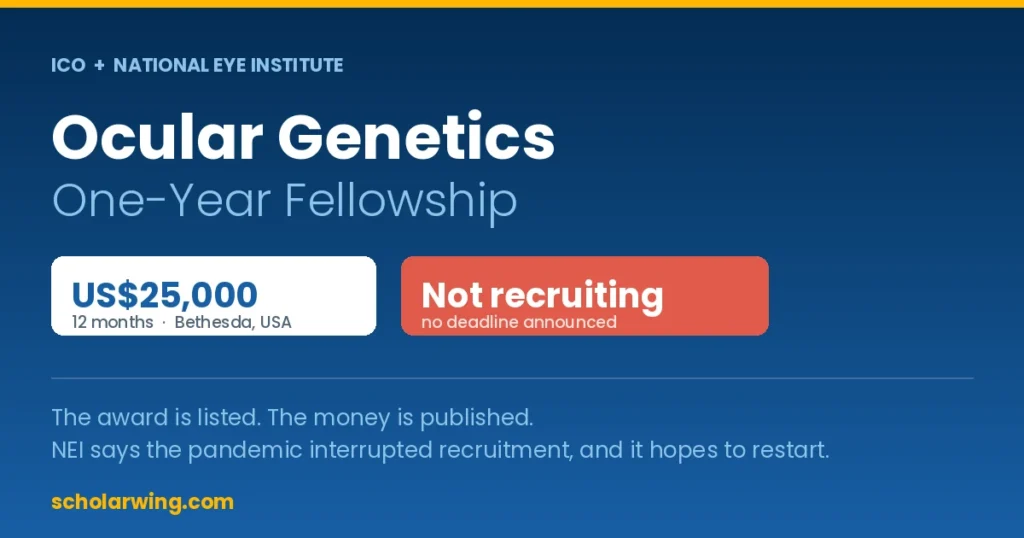
The International Council of Ophthalmology lists the ICO-National Eye Institute One-Year Fellowship in Ocular Genetics at US$25,000 for living expenses and return travel, covering twelve months of training at the NEI, part of the NIH, in Bethesda, Maryland. Against the deadline, ICO’s page carries no announcement.
NEI’s own reporting fills in the rest. Its news page on the programme states that no new fellows are currently being recruited, because the pandemic interrupted the programme, and that NEI hopes to restart it in the future.
Put the two together and the position is clear. Nobody cancelled the fellowship, nobody renamed it quietly, and the published amount still stands. It is simply dormant, with no date attached.
That is worth saying plainly, because the alternative is what most sites do: republish the US$25,000 figure beside an invented deadline and let readers spend a month preparing for a call that does not exist.
What the fellowship actually involved
This is not an abstract programme, and the detail is unusually well documented because NEI wrote about its first graduate.
Dr Fulya Yaylacıoğlu Tuncay, from Türkiye, arrived at the NEI in September 2021 and spent her year in the Ophthalmic Genomics Laboratory. She analyzed data from the eyeGENE network to study the genetic causes of familial exudative vitreoretinopathy, a rare inherited retinal disorder, and she used a zebrafish model to investigate the disease’s vascular origins, learning to prepare zebrafish retina for blood vessel imaging.
NEI describes the programme as combining clinical and bench research, with the stated aim of training future global leaders in vision and expanding the worldwide pool of clinician-scientists.
Note what that first fellowship tells a Pakistani reader. Türkiye is not a low-income country, the fellow already held both an M.D. and a Ph.D., and she returned home to continue the work and build patient registries. This is a research fellowship for somebody mid-career with a laboratory future, not an entry point into American ophthalmology.

The second door, and the requirement nobody mentions
While the ICO route sits paused, the NEI runs its own Ophthalmic Genetics Fellowship, and the two are not the same thing.
NEI’s own page describes a one-year clinical fellowship, with the possibility of extension, in which the fellow helps care for and study children and adults with inherited eye disorders — inherited retinal degenerations, congenital ocular malformations, genetic syndromes and metabolic diseases affecting the eye. The training covers patient and family approaches, molecular diagnosis, genetic counselling, visual electrophysiology and psychophysics, and fellows who stay a second year may add laboratory research. NEI offers a competitive salary and benefits package rather than a fixed stipend.
Now the requirement that decides who can realistically use this door:
An M.D. or equivalent. At least three years of ophthalmology training. And USMLE Steps I, II and III completed.
All three steps. For a Pakistani ophthalmologist, that is a multi-year project in its own right, and it is the single most important line on either page. It also explains the design of the ICO route, which exists precisely so that ophthalmologists from low-resource countries can train at the NEI without first clearing the American licensing pathway.
On applying to NEI’s own fellowship: there is no listed deadline, fellowships begin on 1 July, and the file is a CV with a bibliography in month/year format, a personal statement, and three original letters of reference. Enquiries go to the programme’s named contact.
So what should you actually do
Three honest answers, depending on who you are.
If you want the ICO route, there is nothing to apply to today. Watch ICO’s fellowship page, and use the waiting time for the two things that take longest anyway: publications in ocular genetics, and a relationship with a laboratory that works on inherited eye disease.
If you hold USMLE Steps I to III, NEI’s own fellowship has no deadline to miss, so the limiting factor is your file rather than the calendar. Three original letters of reference is the slow part, and our guide on asking a professor for a reference letter covers briefing them properly. Build the CV with a bibliography in month/year format, which our free CV builder handles.
If you want an ICO fellowship this cycle, look at the ones ICO has open. Our guide to the ICO-AbbVie Advanced Research Fellowship covers the US$50,000 research award that closes on 31 March each year and accepts candidates from all countries, and it sets out the rest of ICO’s ladder, including the three-month fellowships that most ophthalmologists can realistically win.

One thing to be honest about before you plan a year
Read the ICO figure again: US$25,000 for twelve months, covering living expenses and return travel.
Bethesda, Maryland sits beside Washington DC and is among the more expensive places to live in the United States. After a return airfare, that stipend leaves roughly two thousand dollars a month for everything else, in that housing market.
The fellowship is a serious scientific opportunity and the figure is what ICO publishes. Both things are true, and anyone planning around it should budget honestly rather than assume a US fellowship pays like a US salary. NEI’s own fellowship, which pays an NIH salary, is the better-paid route — and it is the one gated behind USMLE.
Eligibility criteria
For the ICO-NEI fellowship, ICO’s general conditions apply: a completed ophthalmology residency with the specialist exam passed, permanent basing and work in an eligible country, reasonable fluency in English, no previous ICO Fellowship, no application in your own country, and agreement to return home and resume your position. The specific call’s criteria will come with the call, which ICO has not announced.
For NEI’s own Ophthalmic Genetics Fellowship:
1. An M.D. or equivalent.
2. At least three years of ophthalmology training.
3. USMLE Steps I, II and III completed.
4. A CV with a bibliography in month/year format.
5. A personal statement.
6. Three original letters of reference.
Step-by-step application process
Step 1, today: decide which door you are standing at. ICO’s route is paused. NEI’s own route needs USMLE. Everything else follows from that.
Step 2, today: write to ICO at icofellowship@icoph.org and ask whether the ICO-NEI fellowship will run in the next cycle, and if so when the call appears. That answer is not published anywhere.
Step 3, this week: write to NEI’s ophthalmic genetics programme and ask whether it considers international applicants without USMLE under any route, and whether the ICO partnership will resume.
Step 4, November: audit your publication record in ocular genetics. Both doors reward it and neither opens quickly without it.
Step 5, November: identify the laboratory, not just the institution. The first fellow worked in NEI’s Ophthalmic Genomics Laboratory on eyeGENE data. Knowing which group does what makes your personal statement specific rather than admiring.
Step 6, December: ask for three original letters of reference if you are going the NEI route. Original means original, so give referees months rather than weeks.
Step 7, December: build the CV with a month/year bibliography, which is the format NEI names.
Step 8, if USMLE is your barrier: price it properly. Three steps, and the timeline runs in years, not months. Decide whether that serves your career independently of this fellowship.
Step 9, every few months: recheck ICO’s fellowship page for a restarted call, and in the meantime apply to the ICO fellowships that are open.
FAQ
Is the ICO-NEI ocular genetics fellowship currently open?
No. ICO lists it without an announced deadline, and NEI’s own reporting says recruitment stopped because the pandemic interrupted the programme, though NEI hopes to restart it.
How much does it pay?
ICO lists US$25,000 for living expenses and return travel, across twelve months at the NEI in Bethesda.
Where does it take place?
At the National Eye Institute, part of the NIH, in Bethesda, Maryland.
What did fellows actually do?
NEI’s first fellow worked in the Ophthalmic Genomics Laboratory, analyzing eyeGENE network data on familial exudative vitreoretinopathy and using a zebrafish model to study its vascular origins.
Is there another way into ocular genetics at the NEI?
Yes. NEI runs its own Ophthalmic Genetics Fellowship, a one-year clinical fellowship with an NIH salary.
What does that one require?
An M.D. or equivalent, at least three years of ophthalmology training, and USMLE Steps I, II and III completed.
When does the NEI fellowship start?
Fellowships begin 1 July, and the page lists no application deadline.
What documents does it need?
A CV with a bibliography in month/year format, a personal statement, and three original letters of reference.
Is US$25,000 enough to live on in Bethesda?
Tight. The figure covers living expenses and return travel for a full year, in an expensive area beside Washington DC. Budget honestly.
What should I apply for instead right now?
The ICO-AbbVie Advanced Research Fellowship closes 31 March and accepts candidates from all countries, and ICO’s three-month fellowships run on 31 March and 30 September.