
ICO Three-Month Fellowship:
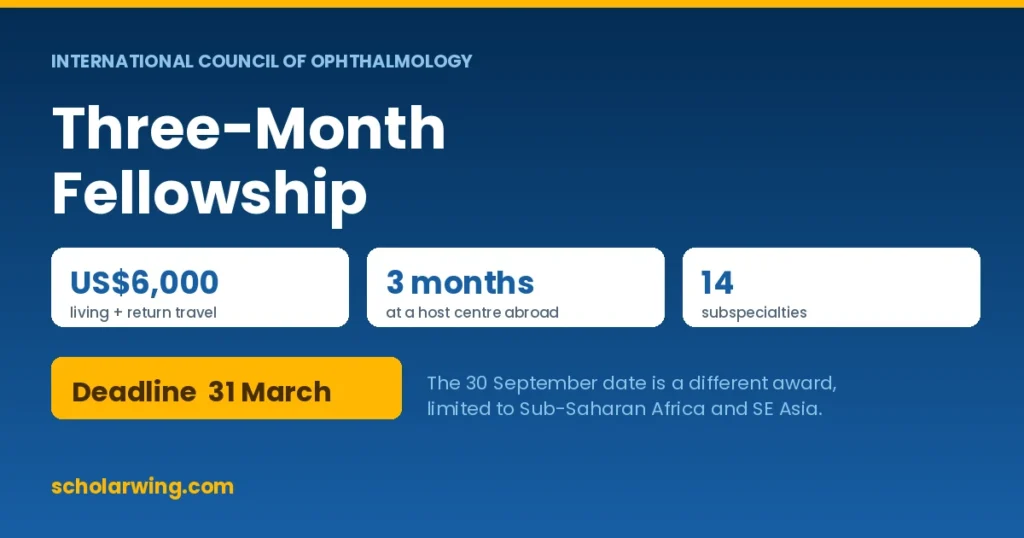
Three months abroad, in your own subspecialty, with US$6,000 to cover it. No research proposal, no PhD, no entrance test.

What the award covers
The International Council of Ophthalmology runs the ICO Three-Month Fellowship at US$6,000, which ICO describes as help toward living expenses and return travel.
The training lasts three months at a host institution abroad. ICO lists the fellowship across fourteen subspecialties: General Ophthalmology, Pediatric Ophthalmology and Strabismus, Uveitis, Glaucoma, Cornea and External Diseases excluding refractive surgery, Medical Retina, Vitreo-Retinal Surgery, Oculoplastic, Cataract Surgery, Ocular Oncology, Neuro-Ophthalmology, Ocular Pathology, Community Eye Health, and Trauma.
That breadth matters. Most ophthalmology funding abroad targets one field at a time. This one takes almost the whole specialty.
The country question nobody answers
Start with the honest part, because it changes your first action.
ICO publishes no list of eligible countries. Its application page says you log in to the fellowship portal, enter your home country, and the portal then shows the fellowships you qualify for. You may choose only one.
So the first step is a login, not a document hunt. Ten minutes in the portal tells you what no guide on the internet can, including this one.
ICO does state two things that shape your chances. Applicants from countries with an ICO Member Society receive special consideration. And passing one or more ICO Examinations counts in the assessment, which ICO recommends rather than requires.
The two deadlines, and why one is not yours
ICO runs two three-month fellowships, and the dates belong to different people.
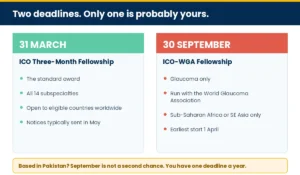
31 March closes the standard ICO Three-Month Fellowship. Awards and notices typically go out in May.
30 September closes the ICO-WGA fellowship, run with the World Glaucoma Association. ICO restricts it to glaucoma specialists permanently based in Sub-Saharan Africa or Southeast Asia. Notices go out in January, with the earliest start on 1 April of the same year.
Read that geography carefully. A glaucoma specialist in Pakistan sits outside both named regions, so the September date is not a second chance at the same award. For most readers of this site there is one deadline a year, and it falls on 31 March.
Eligibility criteria
1. Completed residency training, with the specialist ophthalmology exam passed.
2. Permanently based and working in an eligible country, which the portal confirms.
3. Not applying for a fellowship in your own country. ICO allows the home country only for the AbbVie research award.
4. Reasonable fluency in the language of the training center. Not English in every case — the host’s language.
5. A written agreement to return home, resume your previous position and apply the training there.
6. No previous ICO Fellowship, and no combining this award with another fellowship.
7. ICO Examinations recommended, and counted in the assessment.
8. Special consideration for applicants from countries with an ICO Member Society.
The documents
ICO’s eligibility stage asks for five uploads: your passport photo page, your ophthalmology specialization certificate, your ICO Examination certificate or certificates where you hold them, a recommendation from your Department of Ophthalmology Chair, and a reference letter from a current or former supervisor.
Files must be JPG, PDF or PNG, under 20MB each, and not zipped. Any document not in English needs a certified English translation alongside the original.
Two of those five are signatures you cannot write yourself, and in a hospital department that is the slow part. Our guide on asking a professor or supervisor for a reference letter covers how to brief them so the letter says something specific.
Step-by-step application process
Step 1, now: log in to the ICO Fellowship portal and enter your home country. The portal shows what you qualify for. Everything else depends on this answer, so do it before you prepare anything.
Step 2, November: ask your Chair and your supervisor. Give them months, not weeks. These two letters decide your timeline.
Step 3, November: gather the certificates and scan them properly. Passport page, specialization certificate, ICO Examination certificates. Check the 20MB limit and the file types, and arrange certified translations where a document is not in English.
Step 4, December: upload and submit for the eligibility check. ICO says it confirms or rejects eligibility within ten days by email. If rejected, write to icofellowship@icoph.org and ask what blocked it.
Step 5, January: study the Host Directory properly. ICO lists hosts by name, medical center, subspecialty, city and country. This is the real decision in the whole application, and it deserves a week.
Step 6, January: approach one host, and only one. ICO states clearly that contacting two or more hosts at the same time violates its policy and can lead to exclusion from the programme. Write to the host explaining why that Centre and how you will use the training at home.
Step 7: wait two weeks before following up. ICO’s own guidance sets that period. If the host declines or stays silent, tell the ICO Fellowship team and pick another host.
Step 8: agree a start date, then complete the Fellowship Host Acceptance Form. The host signs it, you upload it to your profile and send it to the ICO team.
Step 9: submit before 31 March. Expect notices around May.
Step 10, after an award: assemble the practical file. ICO asks for proof of visa, health and liability insurance, housing confirmation and banking details.

Two rules that quietly disqualify people
The fellowship must start after the date on your award letter. ICO will not fund training already under way or already finished. Doctors who arrange an observer ship first and look for money afterwards fail here, every time.
The award stays valid for twelve months. So the three months sit anywhere inside the year after your award letter, which gives you room to negotiate a start date with your host and your own department.
Is US$6,000 enough
For three months, that is around two thousand dollars a month, before you subtract a return airfare.
In much of Europe, India, Thailand or Latin America, that works for a single person living modestly. In London, Zurich or a major US city, it does not stretch far, and the Host Directory spans all of these. Pick the host for the training first, then check what three months there actually costs. A center with a world name and an impossible rent helps nobody.
FAQ
How much is the ICO Three-Month Fellowship?
US$6,000, toward living expenses and return travel.
How long is it?
Three months at a host institution abroad.
When is the deadline?
31 March for the standard fellowship. The 30 September date belongs to the ICO-WGA glaucoma fellowship, which is limited to Sub-Saharan Africa and Southeast Asia.
Which subspecialties does it cover?
Fourteen, from general ophthalmology and cataract surgery through glaucoma, retina, oculoplastic, neuro-ophthalmology, ocular pathology, community eye health and trauma.
Is Pakistan eligible?
ICO publishes no country list. The portal shows your eligible fellowships once you enter your home country, so check there first.
Do I need to pass an ICO Examination?
ICO recommends it rather than requiring it, and counts it in the assessment.
Can I do the fellowship in my own country?
No. Only the ICO-AbbVie Advanced Research Fellowship allows that.
Can I write to several hosts to save time?
No. ICO calls that a policy violation that can lead to exclusion. One host at a time, with a two-week wait.
What if the host never replies?
Tell the ICO Fellowship team after two weeks and choose another host.
Can I apply if my training already started?
No. The fellowship must begin after your award letter is issued.
Which documents do I upload first?
Passport photo page, specialization certificate, ICO Examination certificates, your Chair’s recommendation and a supervisor’s reference, in JPG, PDF or PNG under 20MB each.
Can I hold this with another fellowship?
No, and a previous ICO Fellowship also rules you out.
Where this sits among the ICO awards
If you want research money rather than clinical training, the ICO-AbbVie Advanced Research Fellowship pays US$50,000 for one award a year, open to candidates from all countries, closing 31 March. If ocular genetics is your direction, read our note on the ICO-NEI fellowship first, because that programme currently recruits nobody.
For everything else in the field, our medical and health sciences scholarships page carries the rest.