
Study in Mexico Free:
Mexico runs one of the larger government scholarship programmes in the Americas, and it behaves differently from everything else in this series.
It pays a real monthly stipend rather than waiving a fee. It reaches an unusually wide set of countries. And it asks for something before you apply that most readers cannot produce in a hurry.
What the programme is
The Becas de Excelencia del Gobierno de México para Extranjeros comes from Mexico’s foreign ministry through AMEXCID, the Mexican Agency for International Development Cooperation.
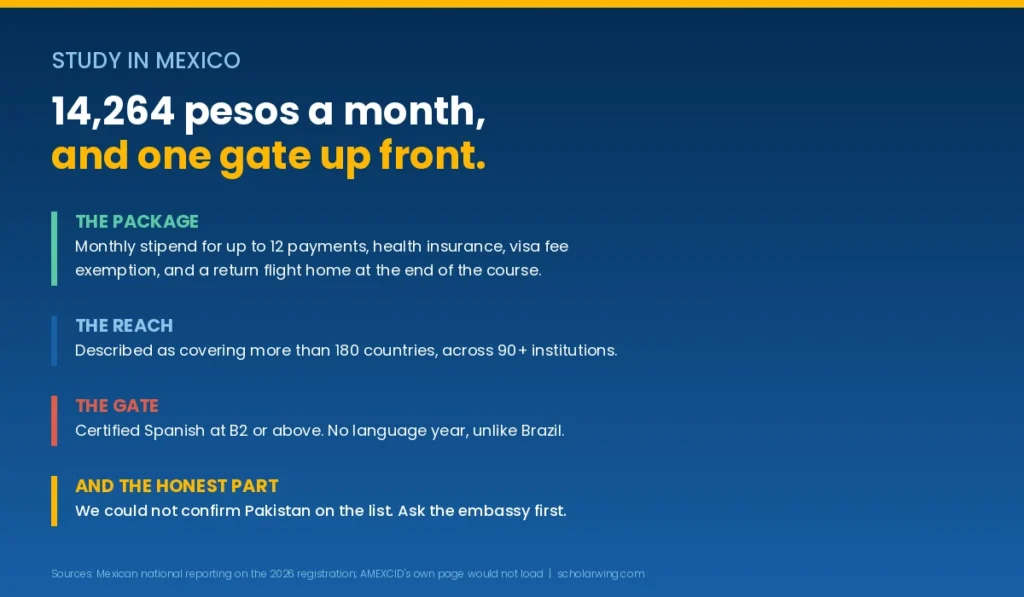
One description of the programme puts its reach at more than 180 countries, through bilateral agreements, multilateral mechanisms and special agreements, with more than 90 Mexican higher education institutions taking part and their postgraduate programmes registered in the national quality programme for postgraduate study.
That breadth is the reason to take Mexico seriously. Across this series, most national scholarships name a short list of partner countries and Pakistan sits outside it. A programme designed around 180 countries is a different proposition — though, as the last section of this post explains, we could not confirm the list itself.
What the 2026 cycle paid
Mexican reporting on the June 2026 registration sets out the package, and it is substantial.
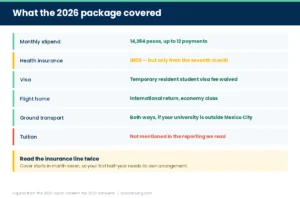
14,264 pesos a month, for up to 12 payments. IMSS health insurance, active from the seventh month of the scholarship. Exemption from the cost of the temporary resident student visa at Mexican consulates. And an international return flight in economy class when your programme finishes, with ground transport both ways if your university is outside Mexico City.
Note what that list does and does not say. It is a maintenance package built around a monthly payment and the journey home. The reporting we read does not mention tuition, which is the question to put to the embassy before you plan around it.
Note too the insurance clause. Health cover begins in the seventh month, so your first half-year needs its own arrangement, and that is a real cost in a country you have just moved to.
The requirement that decides everything
Here is the sentence that will end this post for many readers, and it is better to meet it now than in June.
A Spanish certificate at B2 or above is required if Spanish is not your mother tongue. On top of that, all supporting information must be submitted in Spanish.
B2 is not a beginner’s level. It is comfortable academic reading and sustained conversation, and it takes most people a year of serious study from nothing.
Compare that with Brazil, which asks for Portuguese but builds a route for people who have none — a free language year in Brazil before the degree begins. Mexico’s published package contains no such bridge. You arrive able to study in Spanish, or you do not arrive.
So if Mexico attracts you, the honest plan is two years long. One for Spanish, one for the application.
Who cannot apply
The 2026 exclusions are specific, and several of them catch people who assume a head start helps.
Accredited foreign diplomats and their direct family members cannot apply. Neither can anyone already in Mexico without a valid Temporary Resident Student card, nor Mexican citizens, nor active beneficiaries of other federal scholarships. Former scholarship holders with withdrawals or breaches on their record are excluded, as is anyone under 18, and anyone without permanent residence in their country of nationality.
That last condition is worth reading twice if you currently live and work outside Pakistan, because it can disqualify an applicant who assumed international experience would help.
How the application works
Registration is personal, free and digital, through Mexico’s Sistema de Gestión de Cooperación Académica, the SIGCA platform, with one registration per person.
The documents are short by the standards of this series: a colour copy of a valid passport; a signed declaration letter and a CV, both prepared in advance in a word processor; a medical certificate less than three months old; the Spanish B2 certificate if Spanish is not your first language; and official academic documents from your previous studies.
The 2026 calendar ran as follows. Registration closed on Monday 22 June 2026 at 15:00 Mexico City time. Results appeared between 6 and 10 July. Payments ran from August to November 2026.
So expect the next registration around the middle of 2027, and treat that as the date your Spanish certificate must already exist by, not the date you start thinking about it.
Our free CV builder handles the CV, and our personal statement guide covers the declaration letter, though remember that both go in in Spanish.

The honest warning this post has to carry
We could not confirm that Pakistan appears on the eligible list.
The programme is described as reaching more than 180 countries, which makes inclusion plausible. But no source we could read names the countries, and AMEXCID’s own page would not load for us today. We are not going to tell you that you qualify on the strength of a round number.
So the first action in this guide is not an application. It is an email to the Mexican embassy asking one question: may a Pakistani national apply to the Becas de Excelencia, and under which agreement. A yes makes this one of the better-paid routes in the series. A no saves you a year of Spanish.
While you wait for that answer, the routes we have confirmed for Pakistani applicants are in our guides to Brazil, where Pakistan is named in the edital itself, Thailand, where one scholarship lists its nationality as simply Pakistan, Qatar and Brunei.
Eligibility criteria
1. Foreign nationality, with permanent residence in your country of nationality.
2. At least 18 years old.
3. Spanish at B2 or above, certified, if Spanish is not your mother tongue.
4. Official academic documents from your previous studies, with supporting information in Spanish.
5. A medical certificate issued within the last three months.
6. No active federal Mexican scholarship, and no record of withdrawal or breach as a former scholarship holder.
Step-by-step application process
Step 1, today: email the Mexican embassy and ask whether Pakistani nationals may apply, and under which agreement. Everything else in this list depends on that answer.
Step 2, this week: start Spanish if the answer is likely to be yes. B2 by mid-2027 means beginning now, not next summer.
Step 3, November: identify where you can certify Spanish at B2 and what that certificate costs. The scholarship needs the certificate, not the ability.
Step 4, December: shortlist programmes among the participating Mexican institutions, and note that postgraduate programmes sit in the national quality register.
Step 5, January: prepare your academic documents and arrange Spanish translations, since supporting information goes in in Spanish.
Step 6, March: draft the declaration letter and CV in Spanish, in a word processor, as the instructions require.
Step 7, April: ask the embassy about tuition. The published package covers maintenance, insurance, the visa fee and the flight home. Confirm what happens to fees.
Step 8, May: obtain the medical certificate, timed so it is less than three months old at registration.
Step 9, around mid-2027: register on SIGCA. One registration per person, and the 2026 window closed at 15:00 Mexico City time, which is three hours behind Pakistan’s afternoon.
FAQ
Can Pakistani students apply for the Mexican government scholarship?
We could not confirm it. The programme is described as reaching more than 180 countries, but no source we could read lists them and AMEXCID’s own page would not load. Ask the Mexican embassy before committing time to it.
How much does it pay?
On the 2026 cycle, 14,264 pesos a month for up to 12 payments.
What else does it cover?
IMSS health insurance from the seventh month, exemption from the temporary resident student visa fee, and an economy return flight at the end of the programme, with ground transport if your university sits outside Mexico City.
Does it cover tuition?
The reporting we read does not say. Confirm this with the embassy rather than assuming.
Do I need Spanish?
Yes. A certificate at B2 or above is required if Spanish is not your mother tongue, and supporting information must be in Spanish.
Is there a Spanish course first, like Brazil’s?
Not in the published package. Mexico expects you to arrive ready.
What study levels does it cover?
Descriptions differ between sources. One names specialty, master’s, doctoral and postgraduate research alongside mobility programmes; the 2026 reporting names undergraduate, engineering and master’s study. Check the current call.
Who cannot apply?
Accredited foreign diplomats and their families, Mexican citizens, anyone in Mexico without a valid Temporary Resident Student card, active holders of other federal scholarships, former scholars with breaches, under-18s, and anyone without permanent residence in their country of nationality.
When does it open?
The 2026 registration closed on 22 June. Expect the next cycle around mid-2027.
How do I register?
Personally and free of charge on the SIGCA platform, with one registration per person.