
How to Study in Qatar Free:
Most readers arrive at Qatar expecting one of two things: a country that shuts them out, or one that pays everybody equally. Neither holds, and the detail that decides it sits in plain sight on two official pages.
Start with the undergraduate side, where the obvious route is not the best one.

Two scholarships, and the harder one pays less
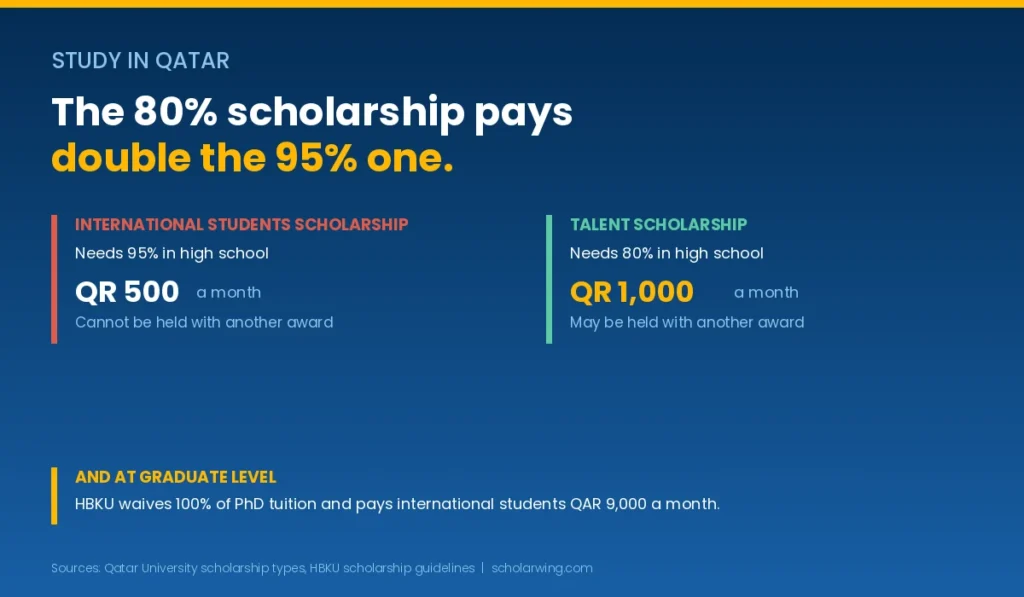
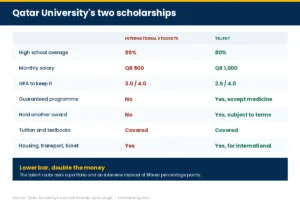
Qatar University publishes an International Students Scholarship for undergraduates, and it is the one every list mentions. What it covers is substantial: tuition, textbook fees, QR 500 a month, shared housing at two students per room with transport to campus, an annual round-trip air ticket, and a residence permit under the university’s own sponsorship.
The gate is the problem. It wants a high school certificate with an average of at least 95%, plus final admission and the college’s own requirements. Transfer, visiting, non-degree and second-bachelor’s applicants cannot apply at all. Once you hold it you must keep a GPA of 3.0, take at least 12 credit hours a semester, register continuously and finish inside the study plan. And you cannot hold it alongside any other scholarship or sponsorship.
Now read the one underneath it.
The Talent Scholarship takes non-Qatari students, international applicants included, and it asks for demonstrated talent in scientific research, technology and innovation, literature, media, male acting or athletics. Its academic bar is 80% in high school, with at least 80% in grade 11 and the first semester of grade 12. You supply two recommendation letters, a portfolio and an interview, and sports applicants add a medical and fitness review.
What it pays is where the comparison turns. QR 1,000 a month, which is double the academic scholarship, plus tuition and textbook fees, plus a guarantee of admission to the programme you want — medicine and dental medicine excepted. International holders also receive the shared housing with transport, the annual round-trip ticket and the residence permit, exactly as the other scholarship provides.
Its conditions are lighter too. A GPA of 2.5 rather than 3.0, the same 12 credit hours, a commitment to represent the university and to keep practicing your talent. And the clause that almost nobody notices: international students may hold another scholarship at the same time, subject to terms.
So a student with an 88% average and a serious portfolio is better served by the route nobody writes about than by the one everybody chases.
The graduate side, where the numbers get large
Hamad Bin Khalifa University, inside Qatar Foundation’s Education City, publishes its funding openly, and the first thing to understand is that it is not uniform.
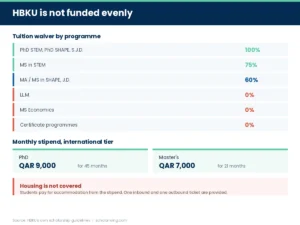
Tuition waivers run by programme. A PhD in STEM and a PhD in the SHAPE disciplines, along with the S.J.D., carry a 100% waiver. A STEM master’s carries 75% and a SHAPE master’s or MA 60%, with the J.D. also at 60%.
Then the part to read before you plan anything. The LL.M. carries 0%. The MS in Economics carries 0%. Certificate programmes carry 0%. Self-sponsored students may reach a discounted rate of QAR 2,000 per credit hour on the basis of financial need, but that is a discount rather than a waiver.
HBKU publishes its stipends by nationality tier, and the international tier is the one that concerns your readers. An international PhD student receives QAR 9,000 a month for 45 months. An international master’s student receives QAR 7,000 a month for 21 months. Qatari students receive more and local students less, and the page states the figures without euphemism.
On top of the stipend, international students receive one round-trip airfare — an inbound ticket when the programme starts and an outbound ticket on graduation.
Housing is not covered. HBKU states it directly: students pay for accommodation, on campus or off, out of the stipend or their own funds, and the stipend does not change with marital status or the number of dependents. For a reader budgeting a move to Doha, that is the single most important sentence on the page.
What you give in return, and who cannot take it
The stipend is not a gift. It goes to full-time students serving as research assistants or teaching assistants, funds permitting. Research assistant work with your primary supervisor runs 10 hours a week. Teaching assistant work runs up to 10 hours a week at QAR 50 an hour. A student employment programme can add another 10, with total work capped at 20 hours a week.
Two exclusions matter. Full-time professionals cannot receive a stipend, and neither can part-time workers employed above 40% of full-time hours, though discounted tuition may still reach them on the basis of need. And scholarships face annual review against academic progress and available funds.
One piece of good news sits in the process itself. No separate scholarship application exists. The university considers you during admissions and emails you if you win something. Our personal statement guide therefore matters more here than usual, because your admission file is also your funding application.
How Qatar compares with the rest of this series
Across nine countries, the pattern has held: national scholarships follow agreements between governments, while institutional scholarships follow the institution’s own interests. Qatar sits firmly in the second group, and its institutions are unusually well funded.
Set the figures beside the others. Brunei covers tuition with bursaries but publishes no monthly figure at all and offers no PhD. Thailand’s Chulalongkorn pays 16,000 Baht a month. Lithuania’s state-funded doctoral place pays from €1,406 a month with no tuition, which was the best in the European group.
HBKU’s QAR 9,000 for a doctorate sits comfortably above all of them in cash terms, with the housing caveat attached. The honest comparison is not scholarship against scholarship but package against cost of living, and Doha is not Vilnius.
Eligibility criteria
1. For QU’s International Students Scholarship: a 95% high school average, final admission, and the college’s own requirements. Transfer, visiting, non-degree and second-bachelor’s applicants fall outside it.
2. For QU’s Talent Scholarship: 80% in high school, at least 80% in grade 11 and the first semester of grade 12, two recommendation letters, a portfolio and an interview.
3. For HBKU funding: admission to a programme that carries a waiver. Check your programme’s percentage before you apply, because three of them carry none.
4. For an HBKU stipend: full-time study, and availability to work as a research or teaching assistant. Full-time professionals fall outside it.
5. GPA upkeep. QU asks 3.0 on the academic scholarship and 2.5 on the talent route, with 12 credit hours a semester on both.
6. Budget for housing at HBKU, which the stipend does not cover.
Step-by-step application process
Step 1, today: work out which scholarship your marks actually fit. If your high school average sits between 80% and 94%, the talent route is your route, and the academic one is not.
Step 2, this week, for the talent route: build the portfolio. Scientific research, technology and innovation, literature, media, acting or athletics. The decision rests on this document, and nobody assembles one in a weekend.
Step 3, this week: ask two referees and brief them on which talent the application claims. Our guide on asking a professor for a reference letter covers that conversation.
Step 4, this week, for graduate applicants: check your programme’s waiver percentage on HBKU’s own scholarship page. If it reads 0%, price the degree before going further.
Step 5, November: prepare for the interview. The talent scholarship requires one, and sports applicants also face a medical and fitness review.
Step 6, November: assemble transcripts and certified translations, including grade 11 and the first semester of grade 12 for the talent route, which most applicants forget.
Step 7, December: write the admission file as a funding application, since at HBKU it is exactly that. Our free CV builder handles the format.
Step 8: price your year honestly. QU provides shared housing; HBKU does not. That difference is larger than most stipend gaps.
Step 9: write to both universities for the current cycle’s dates. Neither published a deadline on the pages we read, and in HBKU’s case the admission deadline is the only one that exists.
FAQ
Can Pakistani students study in Qatar on a scholarship?
Yes. Qatar University’s International Students Scholarship and its Talent Scholarship both reach non-Qatari applicants, and HBKU publishes an international stipend tier for graduate study.
Which Qatar University scholarship is easier to get?
The Talent Scholarship asks 80% rather than 95%, and it pays QR 1,000 a month rather than QR 500. It also guarantees admission to your chosen programme, apart from medicine and dental medicine.
Can I hold two scholarships at once?
On the International Students Scholarship, no. On the Talent Scholarship, international students may hold another award at the same time, subject to terms.
What does Qatar University’s scholarship cover?
Tuition, textbook fees, a monthly salary, shared housing at two per room with transport to campus, an annual round-trip air ticket and a residence permit under university sponsorship.
How much does HBKU pay?
International students receive QAR 9,000 a month for 45 months at PhD level and QAR 7,000 a month for 21 months at master’s level, plus one inbound and one outbound air ticket.
Does HBKU cover housing?
No. Students pay for accommodation from the stipend or their own funds, and the stipend does not vary with dependents.
Is every HBKU programme funded?
No. PhDs and the S.J.D. carry a 100% tuition waiver, a STEM master’s 75% and a SHAPE master’s 60%, but the LL.M., the MS in Economics and the certificate programmes carry 0%.
Do I apply separately for the HBKU scholarship?
No. The university considers you during admissions and emails you the result. Your admission file is your funding application.
What work does it ask in return?
Research assistant work of 10 hours a week with your supervisor, teaching assistant work of up to 10 hours a week at QAR 50 an hour, and a cap of 20 hours a week in total.
Who cannot receive an HBKU stipend?
Full-time professionals, and part-time workers employed above 40% of full-time hours. Discounted tuition may still be available to them on the basis of need.