
How to Study in Thailand Free:
Six countries into this series, Thailand is the one that finally feels like somebody wanted you to apply.
Poland, Slovenia, Latvia and Lithuania each publish a national scholarship with an eligible-country list, and Pakistan sits on none of them. Türkiye opened two doors. Thailand opens four, and one of them has Pakistan’s name written on it in the funder’s own listing.
Start with the deadline that matters in the next seven weeks.
The one closing in December
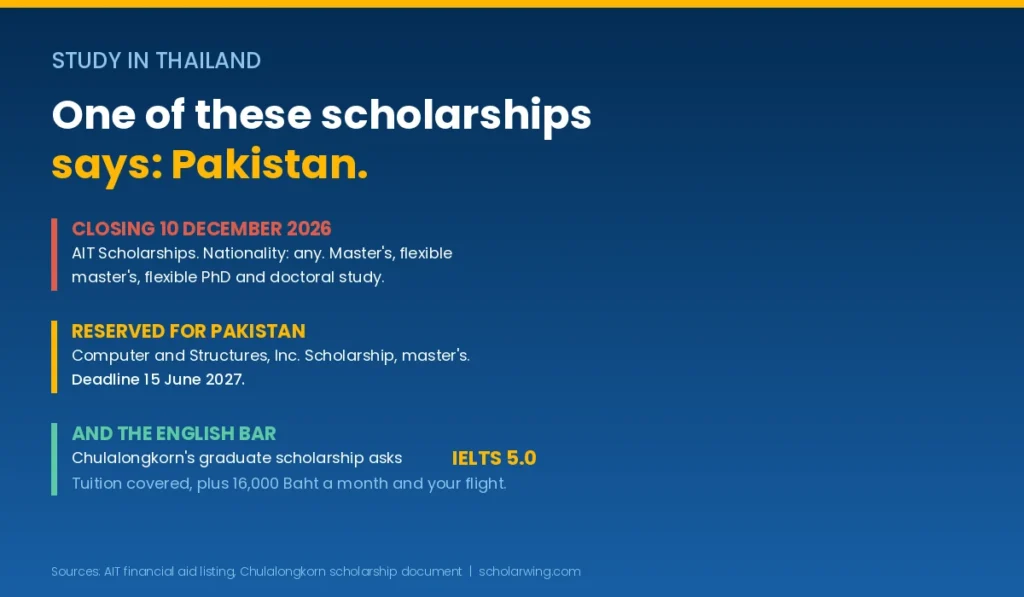
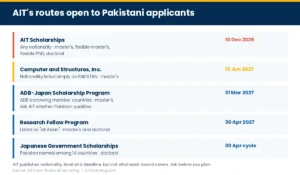
The Asian Institute of Technology in Bangkok lists its own AIT Scholarships as open to any nationality, across master’s, flexible master’s, flexible PhD and doctoral study, with a deadline of 10 December 2026.
No country list. No cooperation agreement. And no nomination. After four European countries that each required a treaty between governments, that phrase, any nationality, is worth reading twice.
AIT publishes the deadline and the eligibility on its financial aid page but not what each award covers, so the amount is the question to put to them directly rather than to any blog. Our PhD scholarships guide covers how to frame that email when you write.
The one reserved for Pakistan
Further down the same listing sits something you will not find on a single Pakistani scholarship site: the Computer and Structures, Inc. Scholarship, for master’s study, with nationality listed simply as Pakistan. Its deadline is 15 June 2027.
One country. Ours. Published openly, on an institution’s own page, with eight months to prepare.
Two more AIT awards name Pakistan or reach it. The Japanese Government Scholarships at AIT list Pakistan among fourteen eligible countries for doctoral study, with a 30 April cycle. And the Research Fellow Program for Public Policy and Asian Study is listed for “all Asian” applicants at master’s and doctoral level, closing 30 April 2027. A fourth, the ADB-Japan Scholarship Program, covers Asian Development Bank borrowing member countries for master’s study and closes 31 March 2027 — ask AIT whether Pakistan qualifies, because the listing names the category rather than the countries.
The English requirement that changes who can apply
Now the finding that matters most to readers who have been held back by a test score.
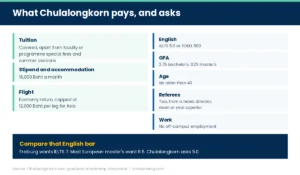
Chulalongkorn University’s Graduate Scholarship Programme for ASEAN or Non-ASEAN Countries asks for TOEFL 500 or IELTS 5.0.
Compare that with the rest of this series. Germany’s environmental governance route wants IELTS 7. Most European master’s programmes want 6.5 with no band below 6. Chulalongkorn asks 5.0, and Pakistan sits in the non-ASEAN category the programme exists to serve.
What it pays is not small either. Tuition is covered, apart from faculty or programme special fees and summer sessions, which you must settle with your faculty in advance. On top of that comes 16,000 Baht a month for your stipend and accommodation, and an economy return air ticket capped at 12,000 Baht per leg for Asian countries.
Additional:
The rest of its gate is ordinary rather than brutal. A master’s runs two years and a doctorate three. You need a GPA of at least 2.75 at bachelor’s level and 3.25 at master’s level, you must be no older than 40, and you must not already have studied at Chulalongkorn for more than one semester. The university states a preference for faculty, researchers and academic staff who will return to their home universities, so a lecturer at a Pakistani university reads as an ideal candidate here rather than an unusual one.
Two conditions deserve attention before you commit. The term cannot be extended and deferral is not allowed once granted. And off-campus employment in Thailand is prohibited while you hold the scholarship, so the 16,000 Baht is your whole income.
The documents are lighter than Europe asks for: an application form with a photo, a CV, your transcript, a graduation certificate where you have one, a passport copy, two recommendation letters from a head, director, dean or your superior, and a medical certificate. Note that those letters come from senior people rather than from any teacher, and our guide on asking a professor for a reference letter covers approaching them properly.
The application runs through the university’s grant gateway, your chosen faculty screens you, and the screened file then reaches the Office of Academic Affairs. On the cycle document we read, that final date fell in mid-November, so treat November as the pattern and confirm the exact date with the faculty you are applying to.
Why Thailand behaves so differently
Across six countries now, one rule has explained almost everything. National scholarships follow diplomacy. Institutional scholarships follow the institution’s own interests.
In Poland, Slovenia, Latvia and Lithuania, the money sits with a government agency, which means it sits behind a treaty, which means a Pakistani applicant cannot argue their way in. The workarounds we found in those countries all came from outside the national scheme: a free doctorate, a European consortium, a well-paid doctoral place.
Thailand’s money in this post sits with universities. AIT recruits across Asia because that is its purpose, and a company funds a scholarship for Pakistani engineers because that serves the company. Neither needs a treaty. Our guide on studying in Türkiye free found the same thing from the other direction: where the gate is a price list rather than a country list, you can walk through it.
Eligibility criteria
1. For the AIT Scholarships: any nationality. Master’s, flexible master’s, flexible PhD and doctoral study all qualify, closing 10 December 2026.
2. For the Computer and Structures, Inc. Scholarship: Pakistani nationality, for master’s study, closing 15 June 2027.
3. For Chulalongkorn: a bachelor’s or master’s in a related field, GPA 2.75 at undergraduate level or 3.25 at graduate level, under 40, IELTS 5.0 or TOEFL 500, good health, and no more than one previous semester at Chulalongkorn.
4. Two recommendation letters from senior figures. Chulalongkorn specifies a head, director, dean or your superior rather than any academic referee.
5. A medical certificate, which Chulalongkorn lists as a required document rather than a formality.
6. No outside employment. Chulalongkorn prohibits off-campus work in Thailand during the scholarship, so budget on the stipend alone.
Step-by-step application process
Step 1, today: open AIT’s financial aid listing and decide whether the 10 December deadline is reachable for you. Seven weeks is tight but workable if your transcripts already exist.
Step 2, today: email AIT admissions and ask one question in writing: what do the AIT Scholarships actually cover for a Pakistani master’s or doctoral applicant in 2027. The listing publishes eligibility and dates without amounts.
Step 3, this week: ask AIT about the Computer and Structures, Inc. Scholarship — what it covers, how many awards it carries, and whether the June 2027 cycle is open for expressions of interest now.
Step 4, this week: ask AIT whether Pakistan counts as an ADB borrowing member country for the ADB-Japan programme.
5, November: request transcripts and your grading-scale explanation, which every route here wants and which Pakistani universities are slow to issue.
Step 6, November, for Chulalongkorn: approach your dean or head of department, not a teacher. Their letters are the ones the programme asks for.
Step 7, November: book the medical certificate. It is a listed document and people leave it to the end.
Step 8, December: build the CV and statement. Our free CV builder handles the format and our personal statement guide covers building an argument around a problem you have worked on.
Step 9: if your IELTS is the thing holding you back, note that Chulalongkorn asks 5.0. Our scholarships without IELTS page covers the wider set of routes with low or no test requirements.
FAQ
Is there a scholarship in Thailand only for Pakistani students?
Yes. AIT’s own financial aid listing shows the Computer and Structures, Inc. Scholarship with nationality given as Pakistan, for master’s study, closing 15 June 2027.
What is the nearest deadline? The AIT Scholarships, open to any nationality, closing 10 December 2026.
What English score do I need?
Chulalongkorn’s graduate scholarship asks for IELTS 5.0 or TOEFL 500, which is far below what the European routes in this series demand. AIT sets its own requirements by programme.
How much does Chulalongkorn pay?
Tuition, apart from faculty or programme special fees and summer sessions, plus 16,000 Baht a month for stipend and accommodation, plus an economy return ticket capped at 12,000 Baht per leg for Asian countries.
Is there an age limit?
Chulalongkorn sets it at 40.
What GPA do I need?
At least 2.75 for your bachelor’s and 3.25 for your master’s, on Chulalongkorn’s own criteria.
Can I work while studying?
Not on the Chulalongkorn scholarship. It prohibits off-campus employment in Thailand during the award.
Who should write my recommendation letters?
For Chulalongkorn, a head, director, dean or your superior. Two of them. This differs from the European routes, which usually want academic teachers.
Can I defer my place?
No. Chulalongkorn states that deferral is not allowed once the scholarship is granted and the term cannot be extended.
Why does Thailand have more open routes than Europe?
Because this money sits with universities rather than with government agencies. Institutional scholarships follow the institution’s own interests, and they do not need a treaty between two countries.