
AIPS Fellowships:
The name suggests a scholarship for Pakistanis. It is not one, and the misunderstanding costs people weeks every year.
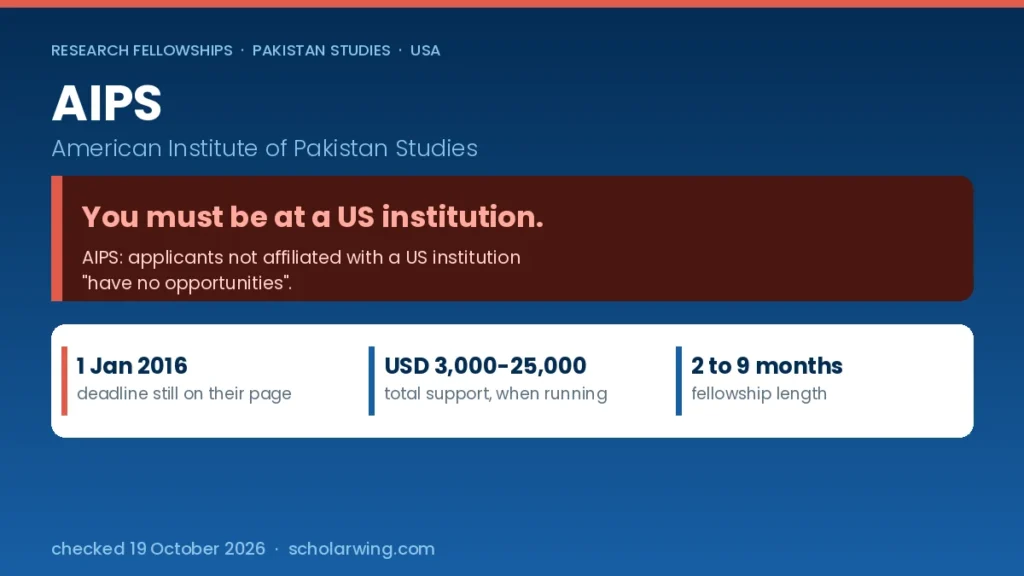
The American Institute of Pakistan Studies requires applicants to be enrolled or employed full time at a US academic institution. Its own wording is blunt: applicants not affiliated with a US institution have no opportunities.
So a graduate in Lahore with a first-class degree and a serious research idea cannot apply. Neither can a lecturer at a Pakistani university. The institute funds research about Pakistan, carried out by people based in the American academic system.
There is a second thing worth knowing before you spend any time on it. AIPS’s own fellowships page says it is no longer accepting applications, and gives a deadline of 1 January 2016. That page has sat unchanged for a decade. Its FAQ page describes a working process with no dates attached. The two pages disagree, and nobody has resolved it publicly.
What the rules actually say
For anyone who does hold that US affiliation, the structure runs like this.
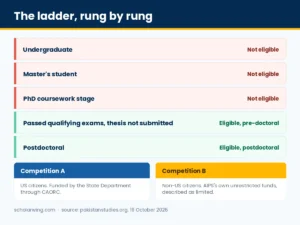
Two competitions. Competition A for US citizens, funded by the US Department of State through a Council of American Overseas Research Centers grant. Competition B for non-US citizens, funded from AIPS’s own unrestricted funds, which AIPS describes as limited.
Two levels inside each. Postdoctoral, and pre-doctoral for those who have finished everything except the dissertation.
The academic gate. You must have passed your PhD qualifying exams and not yet submitted the thesis. Students still taking coursework are not eligible. Nor is anyone who has not reached that stage.
Membership. Applicants must hold AIPS individual membership.
| Item | Detail |
|---|---|
| Award | US$3,000 to US$25,000 total support |
| Stipend level | Comparable to Fulbright, depending on funds and State Department rates |
| Duration | Two to nine months |
| References | Two letters for pre-doctoral applicants, one from the dissertation advisor |
| Affiliation letter | Required from a host institution in the research country before funds are released |
| Decisions | Two to three months after the deadline |
| Priority | Applicants who have not held an AIPS fellowship in the previous two years |
Three conditions people miss
Spouses and dependents cannot travel with fellows to Pakistan. That is AIPS’s own sentence, and for a married researcher it decides whether the fellowship is usable at all. In other countries they may come, but the fellow pays for them.
The money is taxable, and AIPS issues no W-2. Foreign fellows may have tax withheld and should cite the relevant tax treaty to reclaim any excess.
The affiliation letter comes before the money. You need a host institution in the country where you will do the research to write one, and no funds move until it exists.
What a proposal has to contain
A clear research question. A methodology with a tentative timeline. Expected results. A statement of intellectual merit and of broader impact, both for your own field and for Pakistan Studies as a discipline. And for pre-doctoral applicants, how the work relates to the dissertation and when the dissertation will finish.
That last requirement is the one to take seriously. AIPS is funding a stage of a doctorate, not a standalone project, and a proposal that does not show where it sits in the thesis reads as unfocused.
The route that does work
If you are in Pakistan now and this field is yours, the path has three steps and AIPS sits at the end of it, not the start.
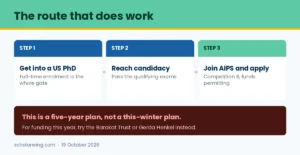
Step one: get into a US PhD programme. This is the whole gate. Once you hold full-time enrolment at a US institution, Competition B opens to you as a non-US citizen, funds permitting. Our Chevening, DAAD and Erasmus Mundus comparison covers the main funded routes out of Pakistan, though none of those three go to the US.
Step two: reach candidacy. Pass the qualifying exams and get to the dissertation stage, because coursework students are not eligible.
Step three: join AIPS and apply, with a host-institution affiliation lined up.
That is a five-year plan, not a this-winter plan. Say so to yourself honestly rather than treating AIPS as a near-term option.
What to do instead, this year
Two funders in the same field take applicants regardless of where they sit.
The Barakat Trust runs seven grants for Islamic art, architecture, archaeology and heritage, four of them reserved for applicants from the Islamic world, including one paying up to £25,000 to a single master’s student. Its 2027 cycle opens on 1 January.
The Gerda Henkel Foundation funds historical humanities research with no deadline and no nationality requirement, though it needs a completed doctorate.
For degree funding across the humanities, start with our arts and humanities scholarships page.
FAQ
Can I apply from Pakistan? No, unless you are enrolled or employed full time at a US academic institution.
Does AIPS say that explicitly?
Yes. It states that applicants not affiliated with a US institution have no opportunities.
Can non-US citizens apply at all?
Yes, under Competition B, funded from AIPS’s unrestricted funds, which AIPS describes as limited. The US affiliation requirement still applies.
Is the fellowship currently open?
AIPS’s fellowships page says applications closed, with a deadline of 1 January 2016. Its FAQ describes an undated live process. Write and ask before planning anything.
How much does it pay?
US$3,000 to US$25,000 in total support, at stipend levels comparable to Fulbright.
How long are the fellowships?
Two to nine months.
Can a master’s student apply?
No. You need to have passed PhD qualifying exams without having submitted the thesis.
Can undergraduates apply?
No.
Do I need to be an AIPS member?
Yes. AIPS requires individual membership.
Can my family come with me to Pakistan?
No. AIPS states that spouses and dependents cannot travel with fellows to Pakistan.
Is the money taxable?
Generally yes, and AIPS issues no W-2. Foreign fellows should check the relevant tax treaty.
What should I apply for instead?
The Barakat Trust and the Gerda Henkel Foundation both take applicants without a US affiliation.