
Erasmus Mundus IDOH 2027:
If you went looking for a One Health master’s and found ITM Antwerp’s programme closed, this is the one that is open.
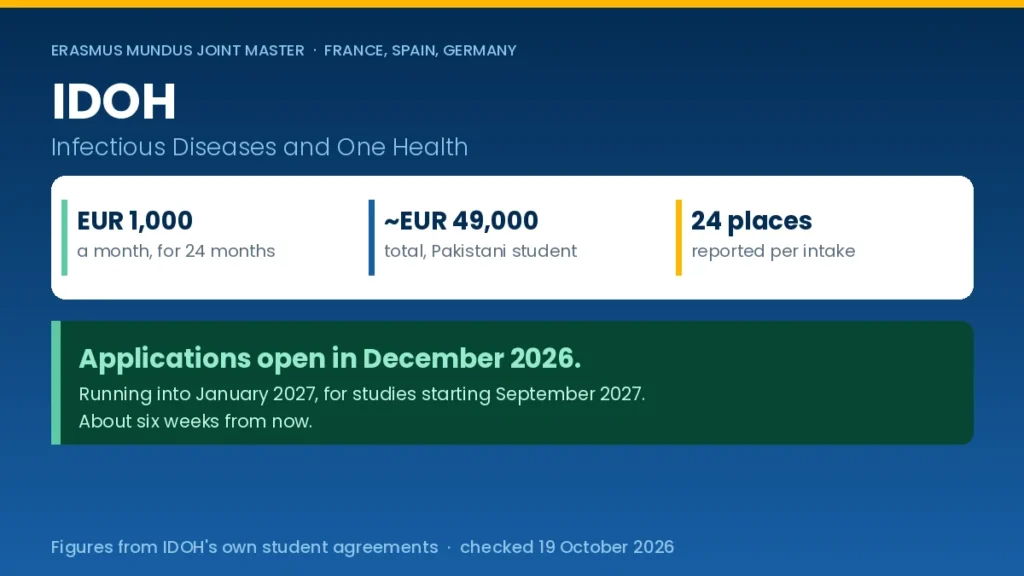
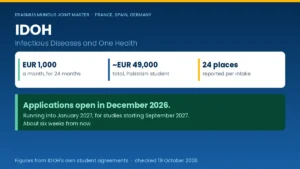
IDOH is an Erasmus Mundus joint master in Infectious Diseases and One Health, run across Tours in France, Barcelona in Spain and Hannover in Germany. It is recruiting now for the 2027–2029 cohort, with applications in December 2026 and January 2027 and studies starting in September 2027.
That window opens in about six weeks.
What the scholarship is actually worth
Most sites say “fully funded” and stop. IDOH publishes its numbers in the student agreements it asks scholars to sign, so here they are.
| Item | Partner Country student, such as Pakistan |
|---|---|
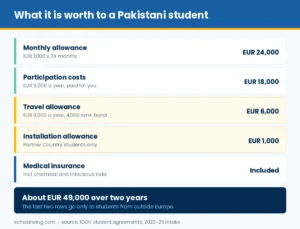
| Monthly allowance | €1,000 a month, for 24 months = €24,000 |
| Participation costs | €9,000 a year covered, deducted at source = €18,000 |
| Travel allowance | €3,000 a year if you live 4,000 km or more from Tours = €6,000 |
| Installation allowance | €1,000, for Partner Country students only |
| Medical insurance | Included at no extra cost |
| Rough total | About €49,000 over two years |
Pakistan sits well beyond 4,000 km from Tours, so the top travel band applies, and the installation allowance exists for Partner Country students alone. Those two lines are worth €7,000 and almost nobody mentions them.
Without the scholarship, a Partner Country student pays €9,000 a year, which is €18,000 over the two years. Programme Country students pay €4,500 a year.
What the fee covers, and what it does not
Covered: teaching, insurance, welcome days, the summer school, the workshop, and bench fees or UAB registration during the internship where they apply.
Not covered: travel to the workshop, and anything the agreement does not name, which includes your living costs beyond the allowance.
The insurance is better than most. It meets the European Commission’s minimum and adds cover for chemical and infectious risks, which matters in a programme that puts you in laboratories handling pathogens. Cover starts up to two months before the programme and runs to three months after it ends.
One clause worth acting on
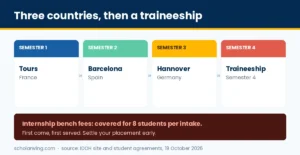
For the fourth-semester internship, the consortium pays bench fees or registration costs for a maximum of eight students per intake, capped at €25,200, allocated first come, first served.
Read that twice. If your internship host charges a bench fee and you are the ninth student to ask, the agreement does not say who pays. So settle your internship placement early rather than in your second year, and ask the consortium in writing where you stand on that list.
Where you study
Semester 1 in Tours, France. Semester 2 in Barcelona, Spain. 3rd Semester in Hannover, Germany. Semester 4 is a traineeship.
Three countries, three residence permits, three housing searches in two years. The travel allowance exists because this is genuinely expensive to move through, and the installation allowance exists because arriving in France from Pakistan costs money before any teaching starts.
Eligibility criteria
Treat this section as provisional. IDOH’s own public pages did not give us the requirements, so the detail below comes from a secondary listing. Confirm every line with the consortium before you build an application on it.
1. A bachelor’s of 180 ECTS, at least three years, in biological sciences — ideally with immunology, infectious diseases or microbiology — or in veterinary, medical or pharmaceutical sciences.
2. English, reported as IELTS 6.5 overall with at least 6.0 in each module, TOEFL iBT 92 with at least 20 per section, PTE Academic 61, or Cambridge 176. A degree taught and assessed in English in an approved country may also count.
3. Around 24 places per intake.
Two of those matter for a Pakistani reader. A 180 ECTS bachelor’s of three years or more is a lower bar than the 240 ECTS that programmes like MIPLC demand. And IELTS 6.5 with 6.0 in every module is a band above the German forestry routes but below Freiburg’s 7.0, so check your weakest module rather than your overall score.
Step-by-step application process
Step 1, this week: email the consortium for the 2027–2029 requirements, the exact deadline and the current fee. Everything in the section above needs confirming, and six weeks is enough time to get an answer.
Step 2, this week: check your English certificate against the per-module minimum. An overall 6.5 with a 5.5 in writing fails this. If you need to retest, booking now still works for a January deadline.
Step 3, November: request transcripts with your grading scale, which Pakistani universities are slow to issue and European admissions offices require.
Step 4, November: build the CV properly. Our free CV builder handles the European format these consortia expect.
Step 5, November and December: write the motivation. Build it on a zoonotic problem you have actually met — brucellosis in dairy herds, rabies control, avian influenza surveillance, antimicrobial resistance moving between poultry and people. Our personal statement guide covers turning that into an argument.
Step 6, December: apply as soon as the window opens. Do not wait for January. The internship bench-fee clause is first come, first served, and early files tend to be read more carefully everywhere.
Step 7: ask about the internship list in your first exchange with the consortium.
Our wider Erasmus Mundus scholarships page covers the other joint masters on this funding model, and GroundwatCH shows how differently two Erasmus Mundus programmes can set their deadlines.
FAQ
When do applications open?
December 2026, running into January 2027, for studies starting September 2027.
How much does the scholarship pay?
€1,000 a month for 24 months, plus participation costs, travel and an installation allowance.
What is it worth in total for a Pakistani student?
Roughly €49,000 over two years, on the 2023–25 figures.
What is the travel allowance?
€3,000 a year for Partner Country students living 4,000 km or more from Tours. Pakistan qualifies.
What is the installation allowance?
€1,000 per intake, for Partner Country students only, paid on arrival in Tours.
What does it cost without a scholarship?
€9,000 a year for Partner Country students, €4,500 for Programme Country students.
Is insurance included?
Yes, at no extra cost, including cover for chemical and infectious risks.
Where do I study?
Tours, then Barcelona, then Hannover, then a traineeship.
What degree do I need?
Reported as a 180 ECTS bachelor’s in biological, veterinary, medical or pharmaceutical sciences. Confirm with the consortium.
What English score?
Reported as IELTS 6.5 with 6.0 per module, or equivalent. Check your weakest module.
How many places are there?
Reported as around 24 per intake.
What is the internship bench-fee limit?
The consortium covers bench fees for up to eight students per intake, first come, first served.