
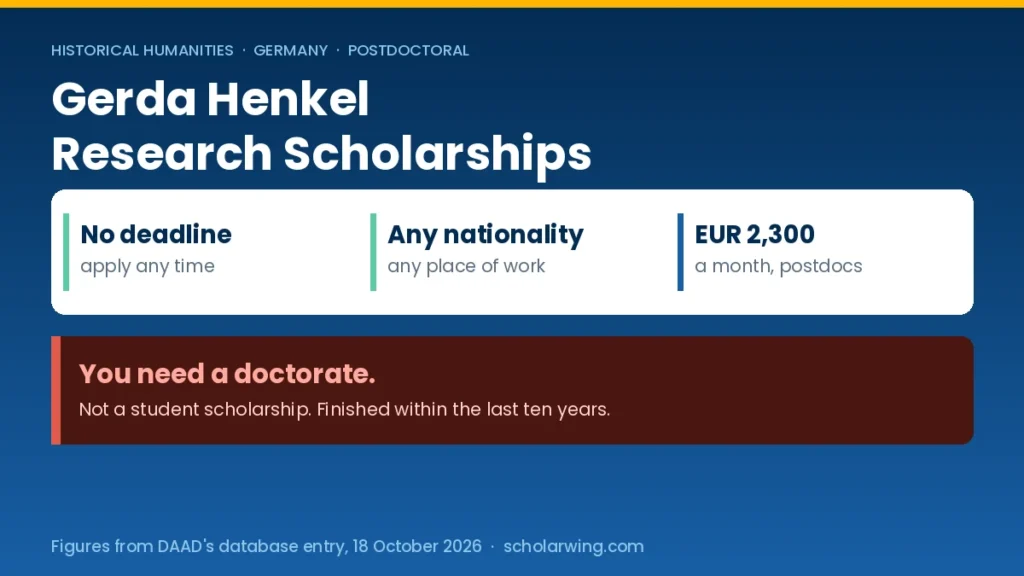
Gerda Henkel Research Scholarships:
Start with who this is not for, because that is where most readers lose a month.
You cannot apply for this as a BA or MA student. Gerda Henkel funds researchers who already hold a doctorate, or a post-doctoral lecturer qualification, or who qualify as junior professors. If you have not finished a PhD, this page is for later, and our arts and humanities scholarships page covers the degree routes that are open to you now.
For everyone who does hold that doctorate, two sentences make this one of the most accessible research grants in the world.
It is open “independent of nationality or place of work.” And there is no deadline.
No deadline, in two senses
The foundation accepts applications all year, with committees deciding twice a year.
And for smaller projects there is a faster door: grants of up to €25,000 can be applied for at any time, outside the committee cycle.
Think about what that removes. No waiting until October. No missing a window by four days, which has happened twice in our guides this month alone. A researcher in Lahore who finds this page tonight can begin an application tonight.
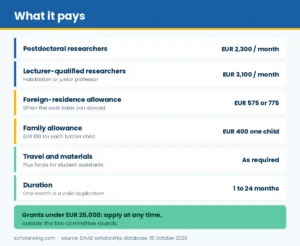
What it pays
| Item | Amount |
|---|---|
| Postdoctoral researchers | €2,300 a month |
| Lecturer-qualified researchers | €3,100 a month |
| Foreign-residence allowance | €575 or €775 a month |
| Family allowance | €400 for one child, €100 for each additional child |
| Travel and material costs | Covered as required |
| Student assistants | Funds available |
| Duration | 1 to 24 months |
Two rows deserve attention. The foreign-residence allowance sits on top of the monthly rate when the research takes you abroad, which for a Pakistani researcher working in German or British archives is the difference between a tight year and a workable one. And travel and material costs covered as required is unusually open wording for a research grant, which usually itemizes every line.
The duration is worth planning around too. One month is a valid application. A short archive trip, a season on a dig, a manuscript consultation — these fit the scheme as legitimately as a two-year project.
Who qualifies
1. A doctorate, or a post-doctoral lecturer qualification, or eligibility as a junior professor.
2. For postdocs, a PhD completed within the last ten years. This is the quiet gate. A doctorate finished in 2014 falls outside the window in 2027, and nothing else in the criteria rescues that.
3. No nationality requirement, and no requirement about where you work.
4. A project inside the foundation’s priority subjects.
That third line is rarer than it sounds. Most German research funding expects a German host institution or a German supervisor. Gerda Henkel states plainly that neither your passport nor your employer’s address decides your eligibility.
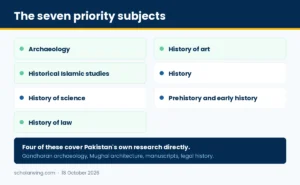
The seven subjects
Archaeology. History of art. Historical Islamic studies. History. History of science. Prehistory and early history. History of law.
Pakistan’s own research sits inside at least four of those. Gandharan archaeology, Mughal and colonial architectural history, manuscript traditions and historical Islamic studies, and the legal history of the subcontinent are all squarely within the foundation’s stated priorities rather than at their edges.
That matters for how you write. You are not asking a European funder to make an exception for a regional topic. You are proposing work in a field they named.
Step-by-step application process
Step 1: check the ten-year rule first. Find your PhD award date. If it falls outside ten years, write to the foundation before doing anything else.
Step 2: decide which door you are using. A project under €25,000 can go in at any time. A larger one waits for a committee round, of which there are two a year.
Step 3: define a project, not a position. This funds research with a question, a method and an output, over one to twenty-four months. A proposal that reads like a request for salary support will not survive.
Step 4: build the budget honestly. Travel, materials and student assistants are all fundable, and the foreign-residence allowance applies if you will work abroad. Ask for what the work costs.
Step 5: write the proposal around the sources. In historical disciplines the convincing detail is which archive, which site, which collection, and why it has to be you and now. Our personal statement guide covers the argument structure, though a research proposal is a different document from a motivation letter.
Step 6: confirm the current forms and figures with the foundation before you submit. See the note below.
Step 7: apply. There is no date to wait for, which means the only thing standing between you and a submitted application is the writing.
If you do not have a doctorate yet
Three honest paths, in order of usefulness.
Finish the PhD first, on one of the general routes. Our Chevening, DAAD and Erasmus Mundus comparison covers how those three differ and which suits a humanities applicant.
If you are working and have two years of experience after your bachelor’s, our DAAD EPOS guide covers a German scheme built for professionals rather than students.
And keep this page bookmarked. A grant with no deadline waits for you until the month you graduate.
FAQ
Can a master’s student apply?
No. You need a doctorate, a post-doctoral lecturer qualification, or eligibility as a junior professor.
Is there a deadline?
No. Applications run all year, committees decide twice a year, and you may submit grants under €25,000 at any time.
Does nationality matter?
No. The foundation states that funding is open independent of nationality or place of work.
Do I need to work at a German institution?
No. Place of work does not decide eligibility.
How much does it pay?
€2,300 a month for postdocs and €3,100 for lecturer-qualified researchers, plus allowances.
What is the foreign-residence allowance?
€575 or €775 a month, on top of the monthly rate.
Is there family support?
Yes. €400 for one child and €100 for each additional child.
How long can funding run?
One to twenty-four months.
Are travel costs covered?
The foundation covers travel and material costs as required, and funds student assistants.
Which subjects?
Archaeology, history of art, historical Islamic studies, history, history of science, prehistory and early history, and history of law.
How recent must my PhD be?
Within the last ten years, for postdoctoral applicants.