
TIF Göttingen 2027:
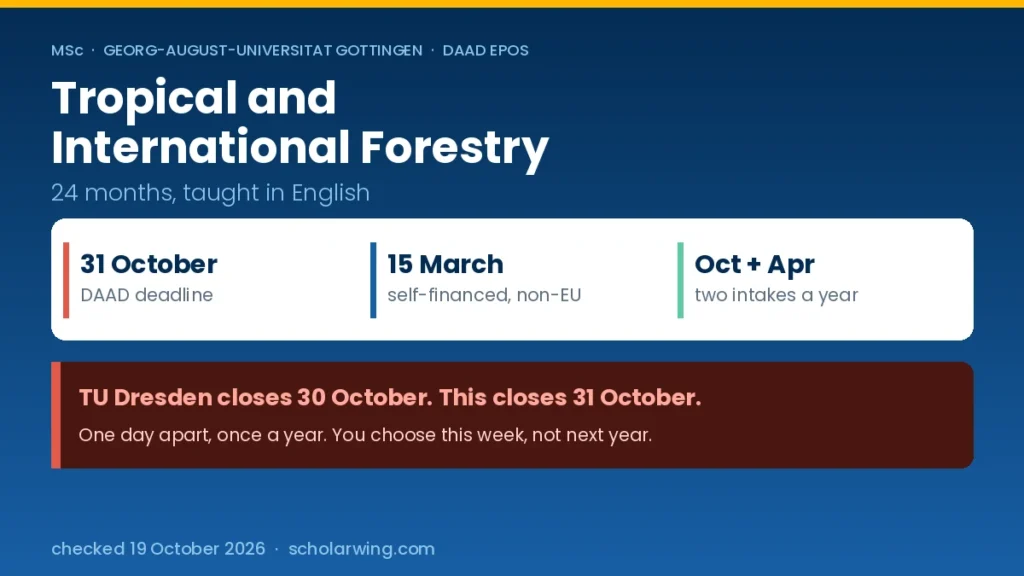
Germany runs two forestry master’s courses on DAAD money. Their deadlines fall one day apart.
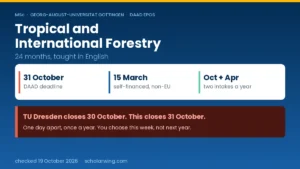
TU Dresden’s Tropical Forestry closes on 30 October. Göttingen’s Tropical and International Forestry closes on 31 October. Both are for a start the following year.
So this is not a case of trying one now and the other later. You get one week, once a year, to decide which German forestry scholarship you are chasing. Both close before most people have even heard of either. Twelve days remain.
Dresden or Göttingen
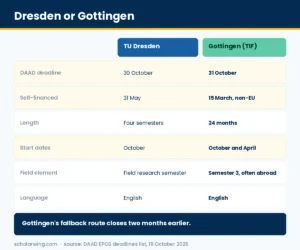
| TU Dresden | Göttingen (TIF) | |
|---|---|---|
| DAAD deadline | 30 October | 31 October |
| Self-financed deadline | 31 May | 15 March for non-EU applicants |
| Length | Four semesters | 24 months |
| Language | English | English |
| Start dates | October | October and April |
| Field element | Field research semester | Semester 3 student project, often abroad |
| Non-forestry degree | Accepted for the self-financed route with forestry work experience | A BSc in forestry or a relevant related subject |
Two differences matter in practice. Göttingen’s self-financed deadline is 15 March, over two months earlier than Dresden’s, so the fallback route closes sooner here. And Göttingen runs two intakes a year, October and April, which Dresden does not.
What you actually study
Management and conservation of tropical and sub-tropical forests, built around sound management of forest resources and tree-based land use.
The modules run through tropical silviculture, forest ecology, tropical soil science, forest resource assessment, bioclimatology, international forest policy and project planning, and electives may come from outside the forestry faculty.
That combination suits a reader who works where forestry meets policy. Watershed plantation under a provincial department, mangrove work on the coast, agroforestry on smallholder land. The programme assumes the forest sits inside a political and economic system rather than treating it as a laboratory.
Four semesters, and a field project abroad
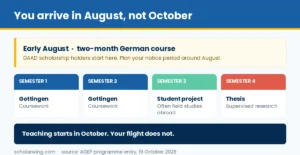
Semesters 1 and 2 are coursework in Göttingen.
Semester 3 is a student project, often with interdisciplinary field studies abroad. This is the part worth planning early, because it is where your thesis topic usually comes from.
Semester 4 is the master’s thesis, based on supervised research.
The detail that changes your departure date
DAAD scholarship holders take a two-month German course starting in early August.
Read that carefully. The teaching begins in October, but as a DAAD scholar you land in Germany in August. Two extra months of notice to your employer, two more months of accommodation, and a visa timeline that starts earlier than you would guess from the course calendar.
Nobody mentions this, and it catches people who have already resigned from a job in September.
Eligibility criteria
1. A BSc in forestry or a relevant related subject. Göttingen’s wording is broader than the course title suggests.
2. English: TOEFL 80 internet-based, 215 computer-based or 550 paper-based, or IELTS band 6. Several EPOS courses also accept a medium-of-instruction certificate, and our MOI certificate generator produces one in the format universities expect. Confirm with Göttingen before relying on it.
3. Professional experience is welcome for the programme itself, and mandatory for DAAD — at least two years after your bachelor’s. Our DAAD EPOS guide covers the scheme’s rules in full, including the rule that your degree should normally be no more than six years old.
4. Applications must be submitted in English.
5. For DAAD: nationality of an eligible developing country, defined by DAAD rather than by Göttingen.
Step-by-step application process
Step 1, today: decide between Dresden and Göttingen. You have twelve days and they close a day apart. Pick on the field element and the start date rather than on prestige.
Step 2, today: write to the programme coordinator at goeforestry@gwdg.de and confirm this cycle’s exact deadline and document list. Göttingen’s own page does not print the deadlines, which is precisely why people miss them.
Step 3, today: request your medium-of-instruction certificate if you hold no English test, since registrar offices take days.
4, this week: collect employment certificates covering two full years after your bachelor’s, stating your dates and your actual duties.
Step 5, this week: build the Europass CV and the motivation letter, both in English. Our free CV builder handles the Europass format, and our personal statement guide covers writing the motivation around your institution rather than yourself.
Step 6, this week: ask your referee for a letter on letterhead, signed, stamped and currently dated.
Step 7: submit the DAAD form with the university application, not separately. DAAD takes no direct applications.
Step 8: plan for August, not October, if you win the scholarship. The German course starts then.
Step 9, if 31 October beats you: the self-financed route closes 15 March for non-EU applicants, and Göttingen’s April intake gives you a second entry point that Dresden does not offer.
FAQ
When is the DAAD deadline?
31 October, for a start the following year.
How does that compare with TU Dresden?
Dresden closes 30 October, one day earlier. Both run once a year.
When is the self-financed deadline?
15 March for non-EU applicants.
How long is the programme?
24 months, four semesters.
What language is it taught in?
English. Applications must also be in English.
When does it start?
October and April. Göttingen runs two intakes a year.
What English score do I need?
TOEFL 80 internet-based or IELTS band 6.
Do I need a forestry degree?
A BSc in forestry or a relevant related subject.
Do I need work experience?
Göttingen says professional experience is welcome. DAAD requires at least two years after the bachelor’s.
When do I actually arrive in Germany?
DAAD scholarship holders begin a two-month German course in early August.
Where is semester three?
A student project, often with interdisciplinary field studies abroad.
Who do I contact?
Prof. Dr. Ralph Mitlöhner, programme coordinator, at goeforestry@gwdg.de.