
MEG Freiburg:
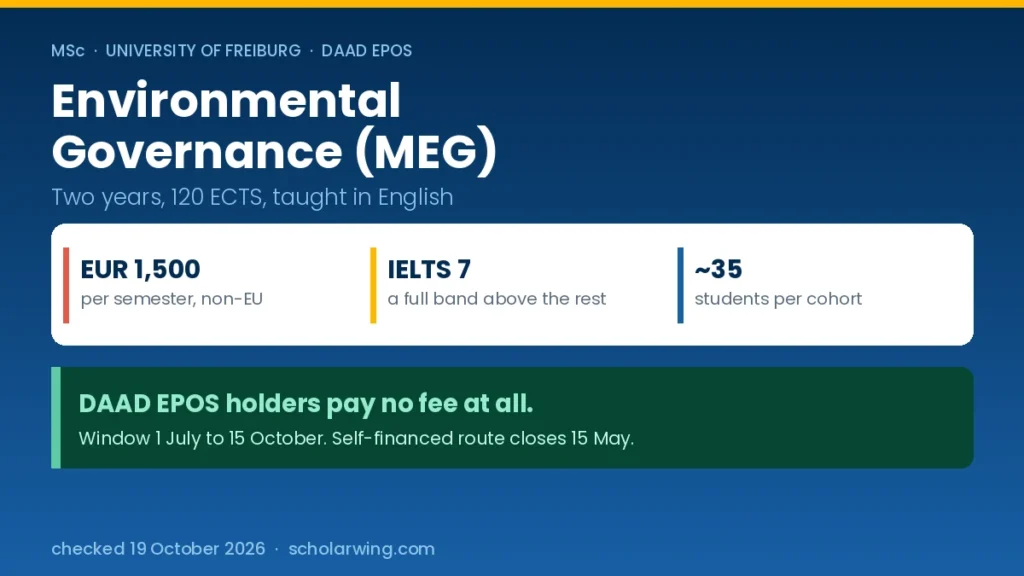
Two things make this programme different from every other German course we have covered, and both of them cost money.
It is not free. Non-EU students pay €1,500 per semester, which is €6,000 across the two years. EU citizens pay nothing. DAAD EPOS holders are exempt.
Its English bar is high. IELTS band 7, or TOEFL iBT 95, or Cambridge C1, or PTE Academic 76. Compare that with TU Dresden and Göttingen, where IELTS 6 clears the gate. A whole band separates them.
Put the two together and the scholarship matters more here than anywhere else in this cluster. Without EPOS you are paying €6,000; with it you pay nothing.
The two dates, and where you stand today
| Route | Window | For a start in |
|---|---|---|
| DAAD EPOS | 1 July to 15 October, each year | October of the following year |
| Self-financed | Up to 15 May, each year | October of that year |
The EPOS window for the October 2027 intake closed on 15 October 2026. If you are reading this in late October, that door shut days ago, and the next one opens on 1 July 2027 for an October 2028 start.
The self-financed route for October 2027 remains open until 15 May 2027. That is a real option, at €1,500 a semester, and the English certificate must be in by the same date.
So there are two honest plans here. Pay and start in 2027, or wait and apply free from 1 July 2027 for 2028. Our DAAD EPOS guide covers what the scholarship pays and the two-year work experience rule that comes with it.
How this differs from the other two
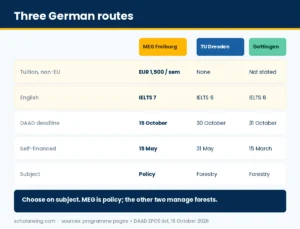
| MEG Freiburg | TU Dresden | Göttingen | |
|---|---|---|---|
| Tuition, non-EU | €1,500 per semester | None | Not stated on the pages we read |
| English | IELTS 7 | IELTS 6 | IELTS 6 |
| DAAD deadline | 15 October | 30 October | 31 October |
| Self-financed deadline | 15 May | 31 May | 15 March, non-EU |
| Subject | Policy and governance | Silviculture and forest management | Tropical forest management |
| Cohort | About 35 | Not stated | Not stated |
Choose on subject first. MEG is for someone heading into a ministry, a donor agency, an NGO or a regulator, where the work is policy, institutions and negotiation. The other two are for someone who will manage forests. A reader who wants both should read the subject lists, not the rankings.
The admission rule worth knowing
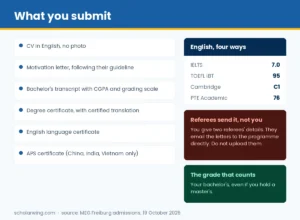
Only your bachelor’s grade is assessed, even if you already hold a master’s.
That is unusual and it cuts both ways. A strong master’s does not rescue a weak bachelor’s here. And a strong bachelor’s carries you even if you never did a master’s.
Your transcript has to show a final weighted average and a grading scale, in numeric grades. If your university’s transcript omits the scale, attach an annex or a link to the official scale. Pakistani transcripts frequently lack it, and this is a standard reason for an application to stall.
You may apply before finishing your bachelor’s, giving your current average and grading scale, provided you show the completed degree by the end of September.
Work experience here is optional, and small
Freiburg counts work or practical experience of at least six weeks as something that improves your standing. Not two years. Six weeks.
It must carry clear start and end dates and relate to your degree or to environmental governance. Full-time employment counts, and so do internships, paid or unpaid. A career-related stay abroad of six months counts, and a semester abroad of four months is enough.
Three things do not count: voluntary work, internships that formed part of your bachelor’s curriculum, and internships completed before your bachelor’s degree.
Note the split. Freiburg itself wants six weeks. DAAD EPOS still wants two years after the bachelor’s. So the self-financed route is open to a recent graduate; the funded route is not.
What you submit
A CV in English with no photo. A motivation letter in English following the programme’s own guideline. Your bachelor’s transcript and degree certificate, with certified translations where needed. Your English certificate. And an APS certificate if you are from China, India or Vietnam — Pakistan is not on that list.
Referees work differently here, so read this twice. You supply two referees’ details — name, affiliation, email and postal address — on separate blank documents, and the referees email their letters directly to the programme. You do not upload them yourself. One should ideally be academic and one professional. Our guide on asking a professor for a reference letter covers briefing them, and here they need the programme’s email address as well.
The motivation letter follows Freiburg’s own guideline rather than a free format, so read that guideline before writing. Our personal statement guide covers the argument underneath it.
One useful escape clause on English
Certificates are due by 15 May. If your result will arrive late, Freiburg allows it only if you show proof of registration for a test taken on or before 15 May and submit the result by 1 June.
That is narrower than the Erasmus Mundus programmes allow, and it means booking the test in April rather than hoping.
Exemptions exist for native speakers and for applicants who completed all their university studies in English in the US, Canada, Australia, New Zealand or another country where English is official. Note the wording carefully: this is narrower than the medium-of-instruction certificate that Dresden accepts, and a Pakistani English-medium degree does not appear to qualify. Confirm before you skip the test.
Eligibility criteria
1. A bachelor’s degree, whose grade is the one assessed.
2. A transcript showing a numeric weighted average and a grading scale, with an annex if the scale is missing.
3. English: IELTS 7, TOEFL iBT 95, Cambridge C1 or PTE Academic 76. TOEFL results must be under two years old.
4. Two referees who email their letters directly to the programme.
5. For DAAD EPOS: two years of work experience after the bachelor’s, plus DAAD’s own country eligibility.
6. For the self-financed route: €1,500 per semester as a non-EU student.
Step-by-step application process
Step 1: decide which plan you are on. Self-financed for October 2027 by 15 May, or EPOS from 1 July 2027 for October 2028.
Step 2, now: book an English test if your band is below 7. This is the single biggest gap between MEG and the other German courses in this field, and closing a band takes months rather than weeks.
Step 3: request your transcript with the grading scale on it. If your university will not add it, get the official scale as a separate document.
Step 4: line up two referees and give them the programme’s email address, because they send the letters themselves.
5: read Freiburg’s motivation letter guideline before you write a word of it.
Step 6, if you are on the EPOS plan: start collecting employment certificates now. Two years is the bar, and July 2027 is closer than it looks.
Step 7: submit everything by 15 May, including the English certificate.
FAQ
Is this programme free? No. Non-EU students pay €1,500 per semester. EU citizens pay nothing, and DAAD EPOS holders are exempt.
When is the DAAD deadline? 15 October each year, with the window opening 1 July, for a start the following October.
When is the self-financed deadline?
15 May each year, for that October.
What English score do I need?
IELTS band 7, TOEFL iBT 95, Cambridge C1 or PTE Academic 76.
Can I use a medium-of-instruction certificate?
Freiburg’s exemption covers degrees completed in English in the US, Canada, Australia, New Zealand or a country where English is official. Confirm your own case before relying on it.
Which grade is assessed?
Your bachelor’s, even if you hold a master’s.
Can I apply before finishing my bachelor’s?
Yes, with your current average and grading scale, and the completed degree by the end of September.
How much work experience do I need?
Six weeks improves your standing with Freiburg. DAAD EPOS requires two years after the bachelor’s.
Does my university internship count?
No. Internships that formed part of your curriculum, voluntary work, and internships before your bachelor’s are all excluded.
How do reference letters work?
You give two referees’ details. They email their letters to the programme directly.
How long is the programme?
Two years, four semesters, 120 ECTS, taught in English.
How big is the cohort?
About 35 students.