
Tropical Forestry at TU Dresden:
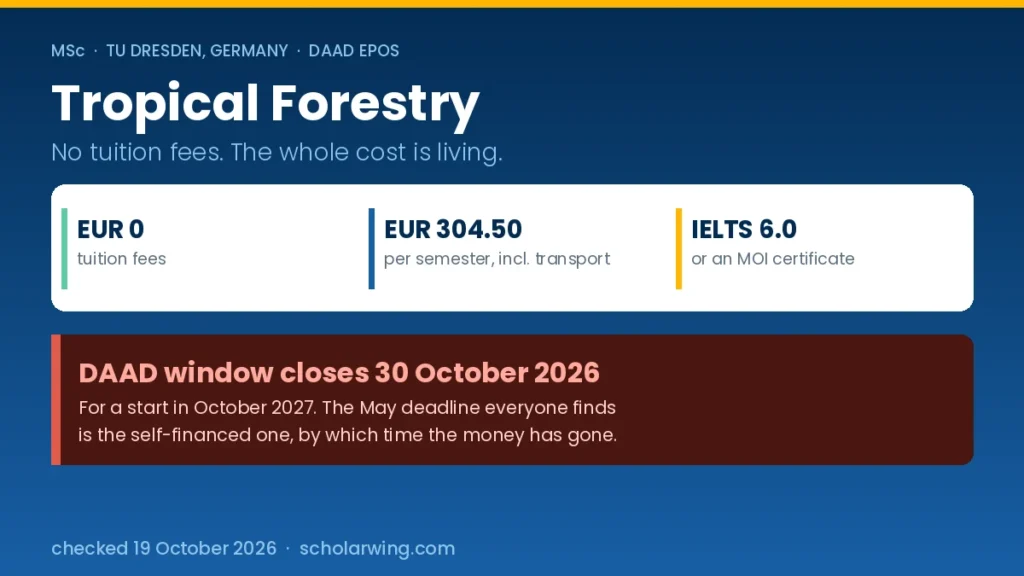
Start with the number that changes the conversation. TU Dresden charges no tuition fees. Not a reduced fee, not a waiver you compete for. None.
What you pay instead is a semester contribution of roughly €304.50, which covers student services and a public transport ticket for the whole of Saxony. The rest of your cost is living, and that is the part a scholarship covers.
Now the part that catches people. The DAAD scholarship window closes on 30 October 2026, and it is for an October 2027 start. Self-financed applicants apply between 1 April and 31 May. So a reader who finds this programme in March sees “deadline 31 May”, applies, gets admitted, and discovers that the funding closed the previous October. Eleven days remain.
Three doors, three calendars
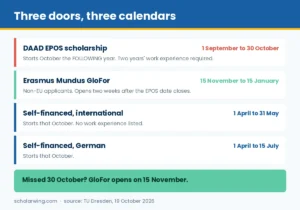
| Route | Window | For a start in |
|---|---|---|
| DAAD EPOS scholarship | 1 September to 30 October | October of the following year |
| Erasmus Mundus GloFor | 15 November to 15 January for non-EU applicants | Check with the GloFor consortium |
| Self-financed, international | 1 April to 31 May | October of that year |
| Self-financed, German applicants | 1 April to 15 July | October of that year |
If 30 October is too soon for you, the GloFor window opens on 15 November, two weeks later. That is the genuinely useful sentence in this post, because most readers who miss the EPOS date assume they wait a full year. Our Erasmus Mundus scholarships page covers how that funding model works.
Who can apply
A university degree of at least a BSc or equivalent in forestry or a related field, plus English.
And one rule that opens the door wider than the title suggests: applicants without a forestry degree may apply for the self-financed option if they have relevant forestry-sector work experience. A development worker, a project officer, a plantation manager with a different degree is not automatically shut out. Note the limit, though. TU Dresden states that scholarship selection follows the formal eligibility criteria strictly, so that flexibility belongs to the self-financed route.
For EPOS, add at least two years of relevant work experience after your bachelor’s, documented with employment certificates, and eligibility as a national of a developing country.
The English requirement is lower than you expect
TOEFL iBT 80, or IELTS overall band 6.0. That is below what most German master’s programmes ask, and far below what the Erasmus Mundus programmes in the same field demand.
Better still, TU Dresden accepts a certificate stating that English was the medium of instruction in your bachelor’s, issued and stamped by your university. For most Pakistani graduates that replaces the test entirely, and our MOI certificate generator produces the document in the format universities expect.
One more relief: the APS certificate requirement names China, Vietnam and India. Pakistan does not appear on that list.
What everyone submits
The signed online application form generated after SELMA registration, a Europass CV in English of two pages, signed, a motivation letter in English of two pages, signed, your degree certificate and transcripts with a grading-scale explanation, your secondary school certificate and transcripts, your English proficiency evidence, your passport, and a recent photo.
Two pages of motivation is generous by Erasmus Mundus standards and tight by essay standards. Our personal statement guide covers the structure, and our free CV builder handles the Europass format, which trips people up because it is not an ordinary CV layout.
What DAAD applicants submit on top
Four extra items, and one of them takes real thought.
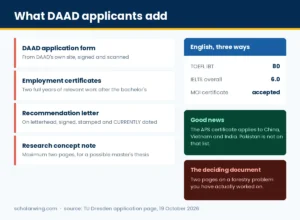
The DAAD application form from DAAD’s own site, signed and scanned. Employment certificates proving two years of relevant experience. A letter of recommendation on official letterhead, signed, stamped and currently dated — note “currently dated”, which kills an old letter. And a research concept note for a possible master’s thesis, maximum two pages.
That concept note is where this application is won or lost. Two pages on a forestry problem you have actually worked on, with a question you could answer in a field semester. Not a literature review, not a statement of passion. If you have spent two years on watershed plantations in Khyber Pakhtunkhwa or mangrove restoration near Karachi, that is your concept note.
Your referee needs lead time too, and our guide on asking a professor for a reference letter covers the brief to give them. With eleven days left, that conversation happens today.
Eligibility criteria
1. A BSc or equivalent in forestry or a related field.
2. English: TOEFL iBT 80, IELTS 6.0, or a stamped medium-of-instruction certificate from your university.
3. For DAAD EPOS: two years of relevant work experience after the bachelor’s, up to the application date, with employment certificates.
4. For DAAD EPOS: nationality of an eligible developing country.
5. For the self-financed route: a non-forestry degree works if you hold relevant forestry-sector work experience.
6. Proof of sufficient funds for the visa, if you self-finance.
Step-by-step application process
Step 1, today: register on SELMA and generate the application form. Everything else follows from having the form in front of you.
Step 2, today: request your medium-of-instruction certificate if you have no English test. It must come on university letterhead with a stamp, and Pakistani registrar offices take days rather than hours.
Step 3, today: ask your referee. The letter must be currently dated, on letterhead, signed and stamped. Tell them the deadline is 30 October.
Step 4, this week: collect employment certificates covering two full years. Letters that state your dates and your actual duties, not just a confirmation of service.
Step 5, this week: write the two-page concept note. One forestry problem, one answerable question, one method. Write it about work you have done.
Step 6, this week: build the Europass CV and the two-page motivation letter, both signed.
Step 7, before 30 October: submit. Not on 30 October.
Step 8, if the date beats you: switch to GloFor, whose non-EU window opens on 15 November. Most of what you have just prepared carries straight across.
FAQ
How much is the tuition? Nothing. TU Dresden charges no tuition fees. You pay a semester contribution of about €304.50, which includes a Saxony transport ticket.
When is the DAAD deadline?
30 October, for an October start the following year. The window opens on 1 September.
When is the self-financed deadline?
31 May for international applicants, 15 July for German applicants, with applications opening 1 April.
What English score do I need?
TOEFL iBT 80 or IELTS 6.0. A stamped medium-of-instruction certificate from your university also works.
Do I need work experience?
Two years after your bachelor’s for DAAD EPOS. TU Dresden lists none for the self-financed route.
Can I apply without a forestry degree?
For the self-financed option, yes, with relevant forestry-sector work experience. Scholarship selection follows the formal criteria strictly.
Do Pakistani applicants need an APS certificate?
TU Dresden names China, Vietnam and India. Pakistan is not on that list.
What extra documents does DAAD want?
The DAAD form, employment certificates, a currently dated recommendation letter on letterhead, and a two-page research concept note.
Is there another funded route?
Yes. Erasmus Mundus GloFor, whose non-EU window runs 15 November to 15 January.
Can I apply if I already hold a master’s?
Yes, though TU Dresden states you will not be offered a student dormitory place.