
DAAD EPOS 2027:
Most people lose this scholarship before they start, because they look for it in the wrong place.
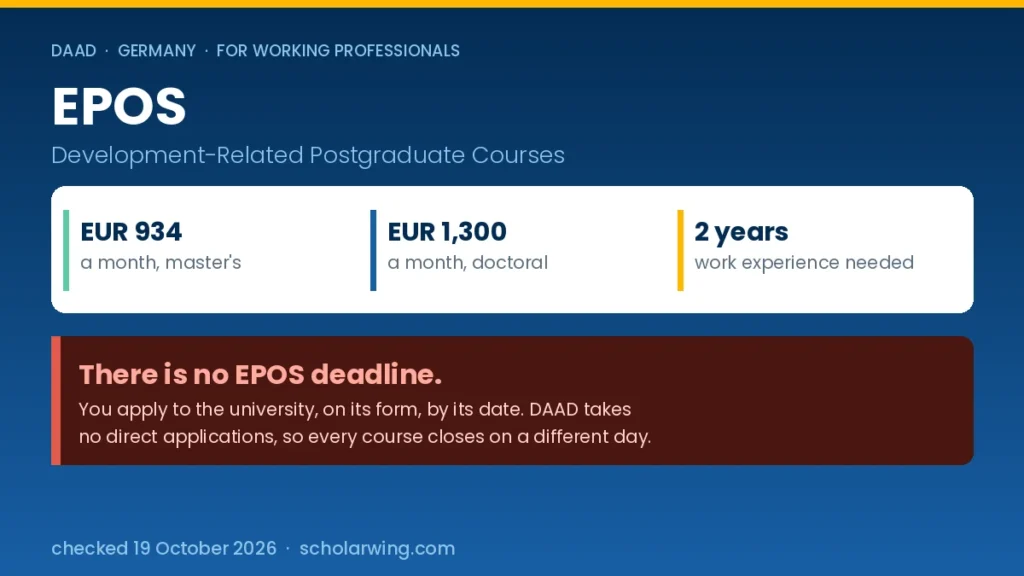
There is no EPOS application form. There is no EPOS deadline. You never write to DAAD at all.
EPOS funds a list of selected master’s and doctoral courses at German universities. You apply to one of those universities, on that university’s form, by that university’s deadline, and you attach DAAD’s scholarship paperwork to the same file. DAAD then decides who among the university’s applicants gets funded.
That one structural fact explains why EPOS deadlines look chaotic. Tropical Forestry at TU Dresden closes on 30 October, a full year before the course begins. Another EPOS course closes in March. A third in August. They are not DAAD’s dates. They are the universities’ dates, and nobody publishes them in one place.
So the question is never “when is the EPOS deadline”. It is “which EPOS course do I want, and what is its deadline”.
What the money actually is
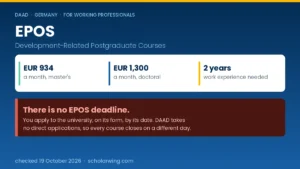
| Item | Detail |
|---|---|
| Monthly scholarship, master’s | €934 |
| Monthly scholarship, doctoral | €1,300 |
| Travel allowance | Paid, unless your home country or another funder covers it |
| Insurance | Payments toward health, accident and personal liability cover |
| Rent subsidy | A monthly subsidy on top of the scholarship |
| Family allowance | A monthly allowance for accompanying family members |
| Duration | 12 to 42 months, depending on the course |
Those last two rows deserve their own paragraph, because almost nobody writing about EPOS mentions them. DAAD adds a monthly rent subsidy and a monthly allowance for family members who come with you. For a thirty-year-old professional with a spouse and a child, that is the difference between a scholarship that works and one that does not. DAAD publishes no amounts for either, so write and ask before you plan around them.
Also note the duration. Up to 42 months covers doctoral routes, not just a two-year master’s.
Six gates, and one of them surprises everybody
1. A bachelor’s degree in a subject related to the course.
2. At least two years of professional experience after that bachelor’s, up to the time you apply. Not during the degree. After it.
3. Nationality of an eligible developing or newly industrialized country.
4. Your degree should normally be no more than six years old.
5. English: IELTS band 6, or TOEFL 80 internet-based, 213 computer-based or 550 paper-based. Individual courses may set higher levels.
6. For German-taught courses: DSH 2 or TestDaF 4 before you start, with at least B1 German at the time you apply. The scholarship then includes a six-month German course in Germany.
Rule four is the one that ends applications quietly. A bachelor’s finished in 2018 is already outside the normal window in 2027, however strong the rest of the file. If your degree is older than six years, write to the course and ask whether they will consider you before you spend weeks on documents.
Rule two decides your timeline in the other direction. A fresh graduate is not eligible, and a reader who finishes a BS in 2027 should diary EPOS for 2029 rather than giving up on it. Our free CV builder handles the Europass format most EPOS courses demand, and the work experience section is the part that matters here.

Who DAAD is actually looking for
DAAD describes the target group as “professionals and managerial staff from developing countries and emerging economies”, selected as people expected to become future decision-makers working on development challenges.
Read that as an instruction rather than a description. EPOS is not funding the best student. It is funding the person most likely to go home and change something. Your motivation letter and your work experience should answer one question: what will you do differently in your own institution with this training.
The programme’s record supports the seriousness. Since 1987, DAAD has awarded more than 7,000 EPOS scholarships, currently around 50 per cent to women, and well over 90 per cent of scholars finish their studies. A completion rate that high says something about how carefully they select.
Where the English rule helps Pakistani applicants
IELTS band 6 is the floor, which is lower than most European master’s programmes ask. Several EPOS courses also accept a medium-of-instruction certificate from your university in place of a test, and our MOI certificate generator produces it in the format they expect. Check the specific course, because this varies.
Step-by-step application process
Step 1: pick the course first, not the scholarship. Open DAAD’s EPOS course overview and find the master’s that matches your work. Everything else depends on this choice.
Step 2: find that course’s own deadline on the university’s page. Write it down. It may be a year ahead of the course start.
Step 3: check the six-year rule against your degree date. If you are outside it, email the course before doing anything else.
Step 4: collect employment certificates covering two full years. Letters that state your dates and your actual duties, not a bare confirmation of service.
Step 5: sort your English evidence. IELTS 6, TOEFL 80, or an MOI certificate where the course accepts one.
Step 6: write the motivation around your institution, not yourself. What problem does your employer have, and what will you bring back. Our personal statement guide covers the structure.
Step 7: get a recommendation letter on letterhead, signed, stamped and currently dated. Several EPOS courses reject old letters outright, and our guide on asking a professor for a reference letter covers the brief.
Step 8: download DAAD’s own application form from DAAD’s site and submit it with the university’s application, not separately.
Step 9: watch for a research concept note. Several EPOS courses ask for one, usually two pages. It is often the document that decides the outcome.
FAQ
How much does EPOS pay? €934 a month for master’s students, €1,300 for doctoral candidates, plus travel, insurance contributions, a rent subsidy and a family allowance.
Where do I apply?
To the university running the EPOS course. DAAD takes no direct applications.
When is the deadline?
Every course sets its own. Some close a year before the course starts.
Do I need work experience?
Yes, at least two years after your bachelor’s, up to the date you apply.
Does experience during my degree count?
No. It must come after the bachelor’s.
How old can my degree be?
Normally no more than six years.
What English score do I need?
IELTS 6, or TOEFL 80 internet-based. Individual courses may ask for more.
Do I need German?
Only for German-taught courses, where you need B1 at application and DSH 2 or TestDaF 4 before starting. Those scholarships include a six-month German course.
How long is the funding?
12 to 42 months, depending on the course.
Can my family come?
DAAD includes a monthly allowance for accompanying family members. Ask the course for the amount.
Is it only for master’s?
No. Doctoral routes exist under EPOS, funded at €1,300 a month.
How competitive is it?
DAAD has awarded over 7,000 since 1987 and describes selection as rigorous.