
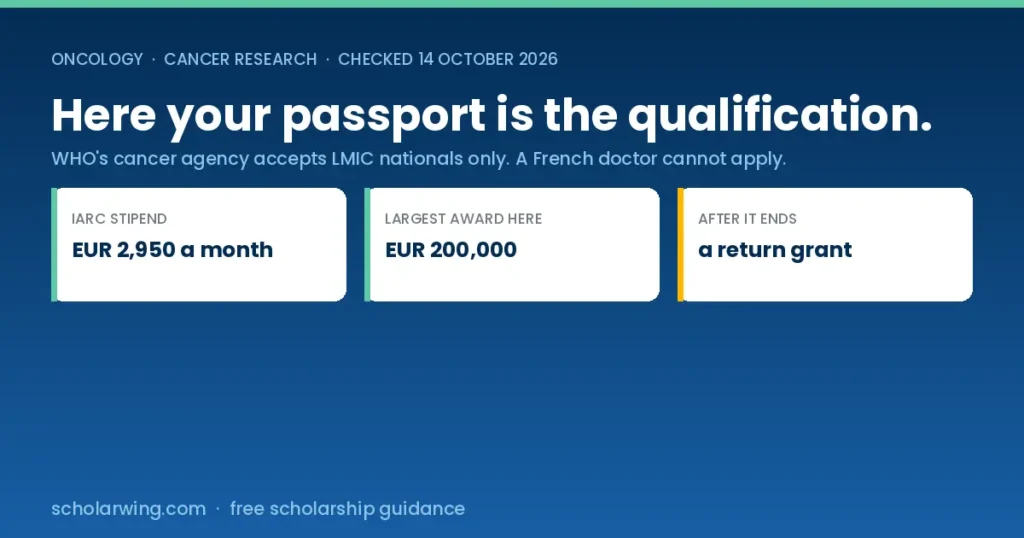
Almost every scholarship guide treats a Pakistani passport as a problem to work around. Cancer research turns that upside down. The World Health Organization’s cancer agency runs a two-year fellowship in Lyon that pays €2,950 a month, and it accepts nationals of low- and middle-income countries only. A French or German applicant cannot apply. You can.
Two more funders in this guide work the same way. The Union for International Cancer Control built its fellowship programme around professionals in your part of the world, and ASCO’s international award requires you to live in a low-, lower-middle- or upper-middle-income country before it will consider you.
That makes oncology unusual. We checked ten funders this week, and the money here runs far larger than in the neighboring specialties. One fellowship carries €200,000.
The IARC route
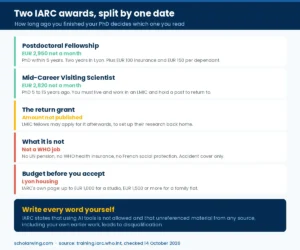
The International Agency for Research on Cancer sits in Lyon and belongs to the WHO. It runs two fellowships, and the difference between them is simply how long ago you finished your PhD.
The Postdoctoral Fellowship runs two years at IARC and pays €2,950 net per month, plus €100 a month toward health insurance and return travel to Lyon. If your spouse or children under 18 come with you and stay for at least half the contract without income of their own, IARC adds €150 a month for each of them.
Eligibility sets two rules. You must come from a low- or middle-income country, and your PhD must fall within five years of the deadline or arrive by the start date. Holders of an MD may apply if they also hold an MPH or similar training alongside research experience and publications.
One benefit deserves more attention than it gets. Fellows from LMICs can apply for a return grant after the fellowship ends, to help establish their research once they go home. Most funders fly you out and lose interest; this one budgets for your return.
Additional:
The Mid-Career Visiting Scientist Award pays €2,820 net per month plus return travel, with no insurance or dependent allowance. It takes nationals of an LMIC who also live and work in one, with a PhD obtained more than five and less than fifteen years before the deadline. You must work at a university, research or public institution and show written assurance of a post to return to.
Two practical warnings. IARC fellows sit outside WHO staff status, so no UN pension, no WHO health insurance and no French social protection apply, though IARC covers accident and emergency illness during your stay. And housing is yours to find: IARC’s own page puts a studio or small flat in Lyon at up to €1,000 a month and a family apartment at €1,500 or more. Against a €2,950 stipend, that arithmetic matters before you accept.
IARC also states plainly that applications must be your own work and that using AI tools is not allowed, with unreferenced material leading to disqualification. Write it yourself.
The ASCO route: a meeting, a mentor and a visit
The Conquer Cancer International Development and Education Award sends about 30 people a year to the ASCO Annual Meeting, which falls in Chicago on 4–8 June 2027. It then pairs each recipient with an experienced ASCO member and funds a visit to that mentor’s institution in the United States or Canada afterwards. Recipients also get three years of complimentary ASCO membership with a Journal of Clinical Oncology subscription.
Eligibility asks you to live in a country the World Bank classifies as low-, lower-middle- or upper-middle-income, to sit within ten years of completing your oncology training, to hold limited financial resources for attending, and to write and speak English fluently. A separate stream, IDEA in Palliative Care, asks additionally for a demonstrated interest in building palliative and supportive care at your institution.
The 2027 round opened on 1 July 2026 and closed on 1 October 2026, two weeks before this guide published. Applications run through asco.smapply.org, and ASCO accepts nothing by email, fax or post. Expect the next window to open around July 2027, and start collecting the recommendation, bios ketch, institutional approval and personal statement in spring, since each uses an official template.
The UICC route: short, practical, skills-based
The Union for International Cancer Control runs Technical Fellowships of two weeks to two months, designed to move a specific skill from one institution to another. Public health professionals, cancer researchers, clinicians, nurses and pathologists all qualify.
The bar sits at five years of work in the cancer field plus a master’s degree at minimum. UICC makes one exception: a qualified medical doctor may apply without a higher degree if they hold, or sit within a year of, a cancer-related board certification. Registered nurses qualify on their RN. The page states one firm exclusion: “Medical and PhD Students are not eligible to apply.”
UICC calculates each award from the fellowship length, published living-cost scales and economy flight estimates between your country and the host’s, so it publishes no single figure and we print none.
You normally find your own host supervisor, and UICC names partners including the National Cancer Centre Korea and Princess Margaret Cancer Center. If you work at a UICC member organisation, you can email fellows@uicc.org with your CV and a description of the skills you want, and UICC will help find a host. The 2026 call ran 3 April to 4 June, with that member support request due by 22 May. UICC says the 2027 dates will appear soon.
The ESMO ladder
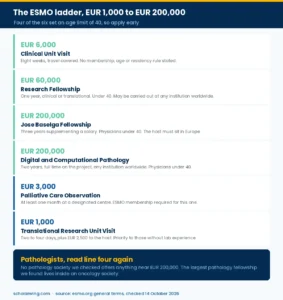
The European Society for Medical Oncology runs six awards, and they climb from a short visit to a six-figure salary supplement. Its general terms set an age limit of 40 on most of them, so this ladder rewards applying early.
Clinical Unit Visit — €6,000 for eight weeks. The International Cancer Foundation organizes it and covers economy travel to and from the host country on top of the grant. The terms ask only that you currently work in cancer research or clinical oncology and hold adequate fluency in English or the local language. They state no membership requirement, no age limit and no residency rule, which makes this the most open award in the guide. You may choose a host from ESMO’s list or propose your own.
Research Fellowship — €60,000 for one year. Open to oncologists aged 40 or under, with a clinical or translational focus, and the terms say it “may be carried out at any institution, worldwide.”
José Baselga Fellowship for Clinician Scientists — €200,000 over three years. It supplements one fellow’s salary, asks physicians under 40 who want to build a clinician-scientist career, and requires a European host institution. The age limit stretches by one year per child for parental leave taken during training.
Additional:
Digital and Computational Pathology Fellowship — €200,000 over two years. Also for physicians under 40, with 100% of time on the project, at any institution worldwide. Pathologists should note this carefully: our pathology guide found no pathology society offering anything near this amount. The largest pathology money sits inside an oncology society.
Palliative Care Observation Fellowship — €3,000 for at least one month. It covers travel, living, accommodation and visa costs at an ESMO Designated Centre of Integrated Oncology and Palliative Care. This one does require ESMO membership.
Translational Research Unit Visits — €1,000 to you, €2,500 to the host. A short visit of two, three or four days, for ESMO members aged 40 or under who work or train in medical, radiation or surgical oncology. ESMO gives priority to applicants who do not already work at an institute of excellence and who lack laboratory experience, which favors exactly the people most guides ignore. Nobody may take a second one.
Eligibility criteria: the four gates in oncology
Income classification, in your favor. IARC takes LMIC nationals only. ASCO IDEA asks where you live. UICC builds its programme around LMIC professionals. Name your institution and country plainly in your application rather than treating them as a weakness.
Age 40, almost everywhere at ESMO. Four of the six ESMO awards set it. Parental leave extends it by a year per child on two of them. If you are over 40, IARC’s mid-career award and UICC’s fellowships carry no age limit at all.
Experience measured from your degree. IARC postdoctoral wants a PhD within five years. IARC mid-career wants five to fifteen years. UICC wants five years in the cancer field plus a master’s. ASCO wants you within ten years of finishing oncology training. Work out which window you sit in before you read any further, because it eliminates most of this list instantly.
A host, found by you. UICC expects you to find your own supervisor. ESMO lets you propose your own host. IARC asks for a research proposal aligned to a specific host branch. In every case the host conversation takes longer than the form.
Step-by-step application process
Step 1 — Place yourself on the timeline. PhD within five years means IARC postdoctoral. PhD five to fifteen years ago with a job to return to means IARC mid-career. Five years of cancer work and a master’s, no PhD, means UICC. Within ten years of oncology training means ASCO IDEA. Under 40 and clinically active means ESMO.
Step 2 — Write to a host before you write anything else. Identify three groups whose published work sits close to yours, and send each a short email: who you are, what you want to learn in those weeks or years, and what you will take home. Most applications fail here rather than at the review stage.
Step 3 — Build the proposal around feasibility. IARC asks for a proposal that is feasible and aligned with a host branch, not an ambitious one. A narrow question you can finish beats a broad one you cannot.
Step 4 — Get two reference letters early. IARC requires two for both awards, ESMO wants a recommendation from your home institution, and ASCO wants a recommendation plus institutional approval on official templates. Ask now, not in the final week.
Step 5 — Prepare the money conversation. For IARC, price Lyon housing against the stipend before you accept. For UICC, your award depends on living-cost scales and flight estimates, so an honest cost breakdown helps you.
Step 6 — Write every word yourself. IARC disqualifies applications that use AI tools or carry unreferenced material from any source, including your own earlier work. Treat this as a rule across all five funders.
Step 7 — Diary the four windows. Spring for IARC, April to June for UICC, July to October for ASCO IDEA, and ESMO’s own calls through the year.
FAQ
Can an MBBS doctor without a PhD apply to IARC?
Yes, with conditions. IARC accepts an MD if you also hold an MPH or similar training, plus research experience and publications. Without those, UICC’s technical fellowships suit you better, since a board-certified doctor qualifies there without a higher degree.
Is the IARC fellowship a job?
No, and this matters. Fellows are not IARC or WHO employees and fall outside the UN pension fund, WHO staff health insurance and French social protection. IARC covers accident and emergency illness during the stay only.
I am a pathologist, not an oncologist. Which of these fits?
The ESMO Digital and Computational Pathology Fellowship at €200,000, and UICC names pathologists among its eligible professions outright. Both pay far more than anything we found inside pathology’s own societies.
Do any of these pay for a master’s or a PhD in oncology?
None of the ten. They fund research positions, training visits and congress attendance. For a funded doctorate, look at salaried European PhD positions, which our biomedical sciences guide explains.
Do I need IELTS?
No funder here listed an English test. IARC asks for English sufficient for scientific work, ESMO asks for fluency in English or the host’s language, and ASCO asks for written and spoken fluency. Each judges that from your application and interview. See our medical scholarships without IELTS guide for how that assessment works.
Why does being from Pakistan help here and nowhere else?
Because cancer research funders target the places where cancer outcomes lag hardest, and that targeting is written into their eligibility rules. The same logic drives infectious disease funding, which our microbiology guide covers, including a €7 membership that unlocks a €1,300 grant.