
Dentistry Scholarships: Why You Keep Getting Rejected, and the Two June Deadlines That Matter
If you are a dentist who has applied to scholarship after scholarship and heard nothing, start here, because the problem is probably not your application.
Dentistry sits on the exclusion list of most large scholarships. King Abdulaziz University excludes Health Sciences outright, which covers Dentistry by name. Chevening excludes medical degrees. Many government schemes fund research degrees but not clinical training, and a BDS or a clinical master’s in dentistry reads to them as clinical training.
The reason is the same one that blocks medicine. Funders pay for research that produces knowledge, not for professional qualifications that produce a licensed practitioner in their country. Add the fact that clinical dentistry needs chairs, materials and patients, and the cost per student climbs far above a seat in a lecture hall.
So the big names are mostly closed, and no amount of searching changes that.
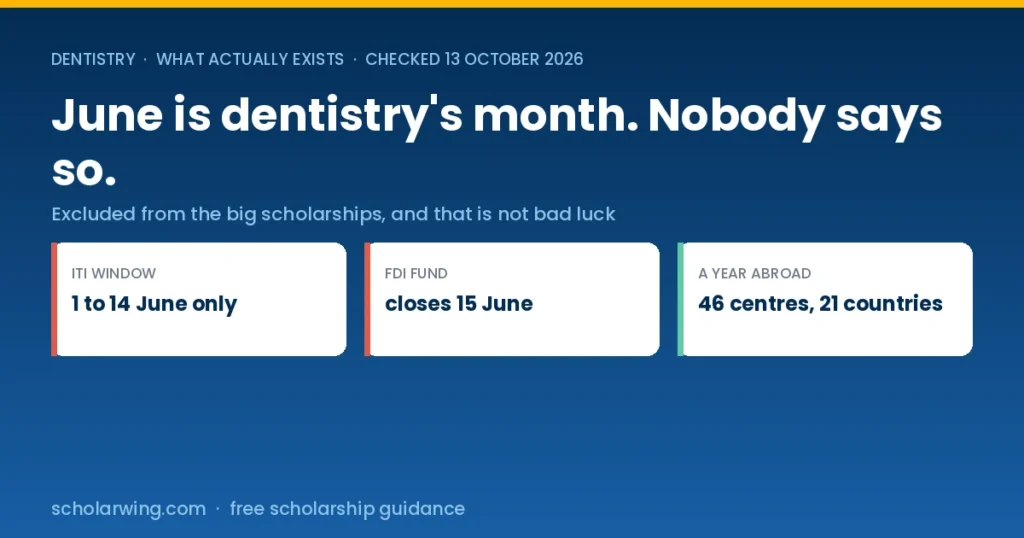
What does exist is narrower, more specialized, and almost completely uncontested, because it lives inside dental organizations rather than governments. We found two we could verify properly, and both close in June.
Route one: the ITI Scholarship, a funded year abroad
This is the largest thing in dentistry that almost nobody in our market has heard of.
The International Team for Implantology places dentists at an ITI Scholarship Center for one full year of on-site clinical and research training, led by an experienced ITI Fellow. There are 46 Scholarship Centers across 21 countries.
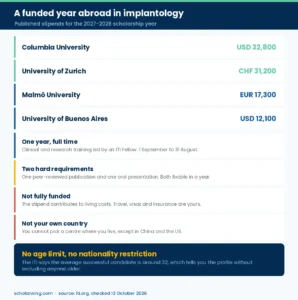
The scholarship year runs 1 September to 31 August.
The stipend varies by center, set against living costs in each city. Published figures for the 2027-2028 year include USD 12,100 at the University of Buenos Aires, EUR 17,300 at Malmö University, CHF 31,200 at the University of Zurich and USD 32,800 at Columbia University.
Be clear about what that stipend does. The ITI states it contributes toward living costs and accommodation without covering them fully, and that travel, visas, health insurance and professional liability insurance are the Scholar’s own responsibility, with no extra ITI funding available.
Payment arrives in two parts: the first after your Center Chair confirms you have arrived, the second after six months, once your intermediate report reaches them.
You cannot choose a center in your own country of residence, except in China and the United States, which run several. Nationality carries no restriction at all, and there is no age limit — the average successful candidate is around 32.
Route two: the World Dental Development Fund
The FDI World Dental Federation runs a fund for oral health projects rather than degrees, and it is the right route for a dentist who wants to change something at home rather than train abroad.
Each project can receive a maximum of CHF 10,000, and FDI supports three to five projects each year. The submission deadline is 15 June.
Projects must address at least one of five areas: oral health education, oral health promotion, oral disease prevention, oral healthcare delivery, or integrating oral health into primary healthcare. They must benefit disadvantaged individuals or communities, connect to local, regional or national health aims, and be developed with local authorities and stakeholders rather than designed alone. Projects with a strong educational component and real sustainability get priority.
Three to five projects a year, worldwide, for a sum most clinics spend on a single chair. Those odds are better than they look, because so few dentists know the fund exists.
Route three: dental research awards
The International Association for Dental, Oral and Craniofacial Research runs a set of awards including a Young Investigator Award, and research routes into dentistry sit alongside them. These fund research recognition and projects rather than degrees, and terms differ by award, so read each one’s own page.
And for a full research degree, remember that a doctorate across Europe is salaried employment with no tuition fee and no nationality restriction. Oral biology, dental materials, craniofacial research and dental public health all run doctoral positions on exactly that model. Our DTU Denmark post, Örebro guide and ORFeus guide explain that market.
Eligibility criteria, route by route
ITI Scholarship
- A BDS, DDS or equivalent degree.
- Either at least two years of postgraduate specialty training, finished before the scholarship year starts, or at least three years of clinical experience as a qualified dentist including implant-related experience. You may apply while still in training.
- At least one peer-reviewed publication.
- At least one oral presentation, such as a lecture or a poster.
- Active ITI membership, which the ITI requires and does not refund.
- No age limit, and no nationality restriction.
That publication requirement is the one that stops most Pakistani applicants, and it is also the most fixable. One peer-reviewed paper and one conference poster are achievable inside a year if you start now.
World Dental Development Fund
- A project benefiting disadvantaged individuals or communities.
- Alignment with local, regional or national health aims.
- Development with local authorities and stakeholders, which means partnership letters rather than a solo plan.
- At least one of the five listed topic areas.
European doctoral positions
- A master’s degree in dentistry, oral biology, dental materials or a related field.
- Research fit with the advertised position, which decides more than grades.
The application process, step by step
For the ITI Scholarship
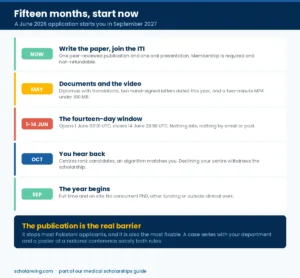
Step one. Understand the timeline, because it is long. A June 2026 application leads to a scholarship year running September 2027 to August 2028. You are applying roughly fifteen months ahead. That is good news: it gives you a year to fix the publication requirement.
Step two. Join the ITI. Active membership is required, and the fee is non-refundable. Do this well before June.
Step three. Get one peer-reviewed publication and one oral presentation. Both are hard requirements. A case series with your department, and a poster at a national conference, satisfy them.
Step four. Prepare your documents. Your dental diploma and postgraduate certificate with certified English translations where available, two recent hand-signed letters of recommendation dated in the application year, a passport copy and passport-format photo, and a language certificate where your chosen center requires one.
Step five. Record a two-minute video. The ITI asks for a motivational video of up to two minutes, in English, in MP4 format, under 100 MB, answering two to four questions set in the portal. Almost no other dental award asks for this, and a weak video undoes a strong file.
Step six. Apply inside the fourteen-day window. The portal opens 1 June at 00:01 UTC and closes 14 June at 23:59 UTC. The ITI accepts nothing late, and nothing by email or post. You may edit a saved application until you submit it, and nothing after.
Step seven. Rank your centers carefully. You list preferred centers in order, centers rank candidates, some hold online interviews, and ITI headquarters matches candidates to places by algorithm. A preferred center is not guaranteed.
Step eight. Wait until the end of October, when the ITI notifies applicants. It does not process status enquiries before then.
For the World Dental Development Fund
Read FDI’s application guidelines, build the project with local authorities and stakeholders rather than presenting it to them afterwards, and submit through the application form by 15 June.
Frequently asked questions
Why do so many scholarships exclude dentistry?
Funders pay for research degrees rather than clinical qualifications, and clinical dentistry costs far more per student because it needs chairs, materials and patients. It is a budget and purpose decision rather than a judgement on the profession.
Is the ITI Scholarship fully funded?
No, and we would rather say so. The stipend contributes toward living costs and accommodation without covering them fully, and travel, visas, health insurance and professional liability insurance are yours to pay. Budget for them before you apply.
Can I pick the center I want?
You rank your preferences, but centers rank candidates too and an algorithm makes the final match. A preferred center is not guaranteed, and declining the center you are assigned withdraws your scholarship. There is no deferral to the following year.
Can I apply to a center in Pakistan?
You cannot choose a center in your own country of residence, except in China and the United States, which operate several each.
Do I need to be an ITI member before applying?
Yes. Active membership is required and the fee is non-refundable, so join in good time rather than during the fourteen-day window.
What if I have no publications?
Then this year is for fixing that, not for applying. One peer-reviewed paper and one oral presentation are the two hard requirements, and both are achievable within a year through your own department.
Can I do a PhD at the same time?
No. The ITI requires full-time, on-site participation with no conflicting commitments, naming concurrent PhD work, other funding and outside clinical duties.
Is there an age limit?
None. The ITI states the average successful candidate is around 32, which tells you the profile without excluding anyone older.
How competitive is the FDI fund?
Three to five projects a year worldwide, at up to CHF 10,000 each. The number sounds brutal, but very few dentists apply because very few know it exists.
When should I start?
Now, if you intend to apply next June. The publication, the ITI membership, the recommendations and the video all take months, and the window is only fourteen days long.
Who should pursue what
If you are a dentist with some implant experience and at least one publication, the ITI Scholarship is the strongest route in this profession and the June window is your target.
If you want to change oral health in your own community rather than train abroad, the World Dental Development Fund funds exactly that, and the deadline is the day after the ITI window closes.
And If you want an academic career, look at European doctoral positions in oral biology, dental materials or dental public health, since those are jobs rather than scholarships.
And if you want to practice dentistry abroad, that runs through registration with the dental regulator in your target country, with its own examinations and requirements. No scholarship on this page substitutes for it, and we would rather tell you in one line than let you spend a year finding out.
This guide is part of our complete guide to scholarships for medical students.
We checked every claim on this page on 13 October 2026.