
Biomedical Research PhDs: Where the Money Actually Is, and Two Routes That Need No IELTS
Across this series we keep arriving at the same sentence, so this page is the one that proves it.
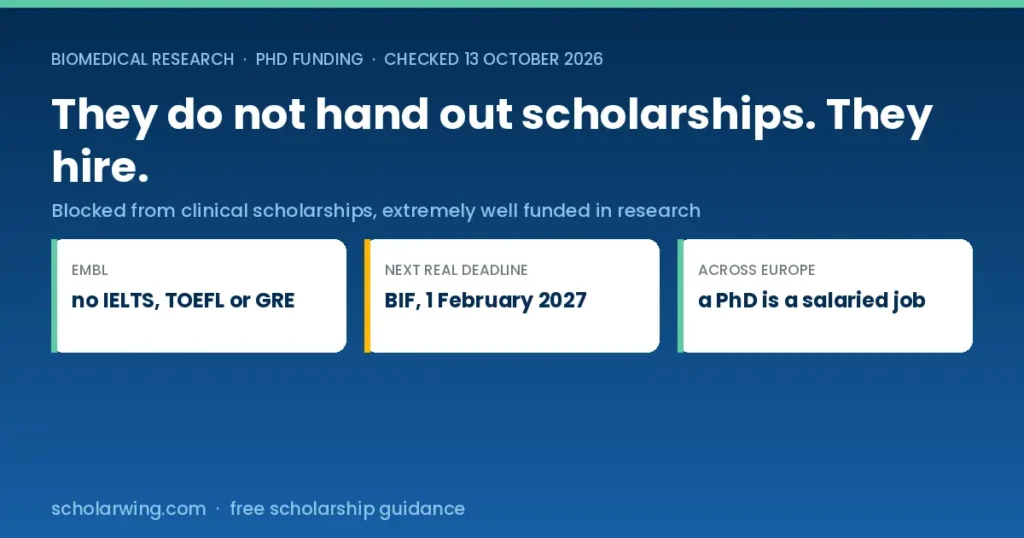
Medical and health graduates are blocked from most clinical scholarships and extremely well funded in biomedical research. Not slightly better funded. A different world.
The reason is simple once you see it. A clinical degree produces a licensed practitioner in somebody else’s country. A biomedical doctorate produces research, publications and a trained scientist, and research institutes compete for those people. They do not hand out scholarships. They hire.
This page covers the two strongest named routes we could verify, and the broader market behind them.
Route one: the EMBL International PhD Programme
The European Molecular Biology Laboratory runs one of the best regarded doctoral programmes in the life sciences, across six sites: Heidelberg, EMBL-EBI near Cambridge, Barcelona, Hamburg, Grenoble and Rome.
Four of its rules matter enormously to a Pakistani applicant.
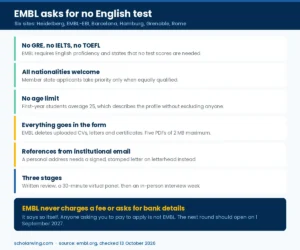
No GRE, no IELTS, no TOEFL. EMBL states that it requires English proficiency, written and verbal, and that no GRE, IELTS or TOEFL scores are needed. For students who have delayed applications for a year over a language test, read that twice.
Applications are welcome from all nationalities. EMBL adds one qualifier: as a general rule, applicants from its member states receive priority if equally qualified. So nationality does not bar you, though it is a factor at the margin.
No age limit. EMBL publishes that its first-year students average 25, which describes the typical profile without excluding anyone.
Evaluation on qualification and scientific potential alone. And having your own funding does not secure a place — every invited candidate goes through the same interviews.
The selection runs in three stages. EMBL faculty read the written applications and the Graduate Committee approves a shortlist. Shortlisted candidates face a 30-minute Virtual Panel Assessment, with no presentation required. Recruiting group leaders then select up to two candidates per open position for an in-person interview week, after which you submit your preferred research groups.
Dates for the round just closed: applications opened 1 September 2026 and closed 12 October 2026 at 23:59 CET, with references due 14 October. Panel assessments run on 1 December 2026 and in-person interviews in late January and early February 2027, for a start by October 2027 at the latest.
The next round should open on 1 September 2027. Mark it now.
One line from EMBL deserves repeating, because it protects you from something else entirely: EMBL charges no fees at any stage and will never ask for your bank details. Anyone asking you to pay to apply is not EMBL.
Route two: the Boehringer Ingelheim Fonds fellowship
This is the one almost nobody in our market knows, and its next deadline is close.
The Boehringer Ingelheim Fonds funds outstanding junior scientists worldwide to do a PhD in basic biomedical research at an internationally leading laboratory. It is a foundation award rather than a university place, which means you choose the lab and the fellowship follows you.
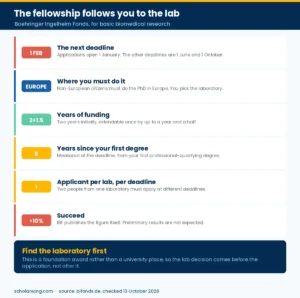
It runs for two years initially, extendable once by up to 1.5 years, giving two to three and a half years in total.
A UK university listing describes the stipend as approximately £2,200 a month, along with travel allowances for conferences, tailored seminars for fellows and alumni, and access to a worldwide network. BIF’s own page describes the stipend without publishing a figure, so treat that number as indicative and confirm it with BIF.
For a Pakistani applicant the key rule is this: non-European citizens must do the PhD in Europe. European citizens may work in Europe or overseas. So the fellowship is open to you, and it takes you to a European laboratory.
Three deadlines a year: 1 February, 1 June and 1 October. Applications open one month before each, so the next window opens 1 January 2027 and closes 1 February 2027.
And the honest number: fewer than 10% of applicants receive a fellowship.
Route three: the salaried doctoral position
Behind both of those sits the market that funds most biomedical doctorates in Europe, and it is not a scholarship market at all.
A PhD across Denmark, Sweden, the Netherlands, Norway, Germany and Switzerland is employment. You answer an advertised vacancy, you are interviewed for a job, and if you win it the university employs you with a salary, a pension and holiday. No tuition fee. No scholarship form. Usually no nationality restriction and no age limit.
For a medical or biomedical graduate this is the single largest source of funded doctorates in the world, and almost nobody in Pakistan applies to it because it does not look like a scholarship.
Our DTU Denmark post, Örebro guide, ORFeus guide and TU Delft guide each cover a real position and explain how that market works.
Eligibility criteria, route by route
EMBL International PhD Programme
- A university degree that formally qualifies you for a PhD in the country where you earned it, held or expected before you start.
- Two academic reference letters, sent from institutional email accounts.
- English proficiency, with no GRE, IELTS or TOEFL required.
- No age limit. First-year students average 25.
- All nationalities welcome, with member state applicants prioritised when equally qualified.
- Prior association with EMBL in the twelve months before the deadline triggers a specific review by the Graduate Committee.
Boehringer Ingelheim Fonds
- An experimental basic biomedical research project at an internationally leading laboratory.
- Non-European citizens must do the PhD in Europe. European citizens may be in Europe or overseas.
- Your first professional-qualifying degree must be no more than eight years old at the deadline.
- Natural scientists should hold their last degree before starting the PhD, though a pending MSc certificate may follow within four months.
- Physicians, veterinary surgeons and pharmacists must have passed their state examinations.
- Applicants about to begin a PhD are preferred, and preliminary results are not expected.
- Only one applicant per laboratory per deadline may receive a fellowship, so two people from the same lab should apply at different deadlines.
- The fellowship cannot supplement inadequate funding, bridge a financial gap, or finish work already funded elsewhere.
The application process, step by step
For EMBL
Step one. Create an account on EMBL’s online recruitment portal. Applications by email are not considered.
Step two. Put everything in the form fields. EMBL removes uploaded CVs, recommendation letters and certificates. Information belongs in the form itself. Uploads are capped at five PDFs of 2 MB each.
Step three. Brief your referees early. They must write from institutional email accounts. If a referee has only a personal address, EMBL accepts a signed, stamped letter on institutional letterhead sent to the Graduate Office with your eight-digit application ID.
Step four. Prepare for a 30-minute panel, not a presentation. The Virtual Panel Assessment is a conversation with group leaders about your science.
Step five. Prepare a short talk for the interview week. EMBL recommends one even though the panel stage does not require it.
Step six. Rank your research groups after the interview week.
For Boehringer Ingelheim Fonds
Step one. Find the laboratory first. The fellowship follows you to a lab you have chosen, so the lab decision comes before the application.
Step two. Check the eight-year rule against your first qualifying degree, and the one-applicant-per-lab rule with your prospective supervisor.
Step three. Write the application yourself, in English. BIF requires this.
Step four. Prepare the PDF of documents and the recommendation letters, and apply through the BIF portal inside the one-month window.
Step five. Apply before you start, if you can. BIF states a preference for applicants about to begin a PhD, and does not expect preliminary results.
Frequently asked questions
Is it true I need no IELTS for EMBL?
EMBL states that no GRE, IELTS or TOEFL scores are needed, while requiring written and verbal English proficiency. The interviews are where your English shows.
Can a Pakistani student apply to EMBL?
Yes. EMBL welcomes all nationalities, and notes that member state applicants receive priority if equally qualified.
Is BIF open to Pakistanis?
Yes, with one condition: non-European citizens must do the PhD in Europe. You choose the European laboratory.
What are the odds at BIF?
BIF publishes that fewer than 10% of applicants receive a fellowship.
I have an MBBS. Do these count as my field?
For BIF, physicians must have passed their state examinations, and the project must be experimental basic biomedical research. A medical graduate moving into laboratory research fits, provided the project is genuinely experimental.
My degree is nine years old. Can I still apply to BIF?
Not on the eight-year rule, measured from your first professional-qualifying degree at the deadline. EMBL sets no such limit.
Can I apply to both?
Yes, though BIF states its fellowship cannot supplement funding you already hold. Read that rule carefully before holding two awards.
Do I need publications?
BIF says preliminary results are not expected and prefers applicants about to begin. EMBL evaluates qualification and scientific potential rather than a publication count.
What if someone asks me to pay an application fee?
Walk away. EMBL states it charges no fees at any stage and never asks for bank details. That is true of every legitimate programme in this guide.
When is the next real deadline?
Boehringer Ingelheim Fonds on 1 February 2027, with applications opening 1 January. EMBL’s next round opens 1 September 2027.
Who should pursue what
If you are finishing a BS, MBBS, BDS, Pharm-D or an MPhil and want research, EMBL is the most prestigious entry point in Europe and asks for no English test. Prepare through 2027 and apply in September.
If you already have a laboratory in mind, Boehringer Ingelheim Fonds lets the money follow you there, and the next window opens in January.
If you want the widest set of options, apply for advertised salaried positions across Europe all year round. That market never closes, and it is far larger than both programmes combined.
And if you are still deciding between clinical practice and research, read our complete guide to scholarships for medical students, which explains why that single decision determines everything else about your funding.
We checked every claim on this page on 13 October 2026.