
Ford Foundation Fellowship: Both Programmes Are Gone, and Sites Are Advertising a December Deadline
If you are preparing a Ford Foundation fellowship application, stop and read this first.
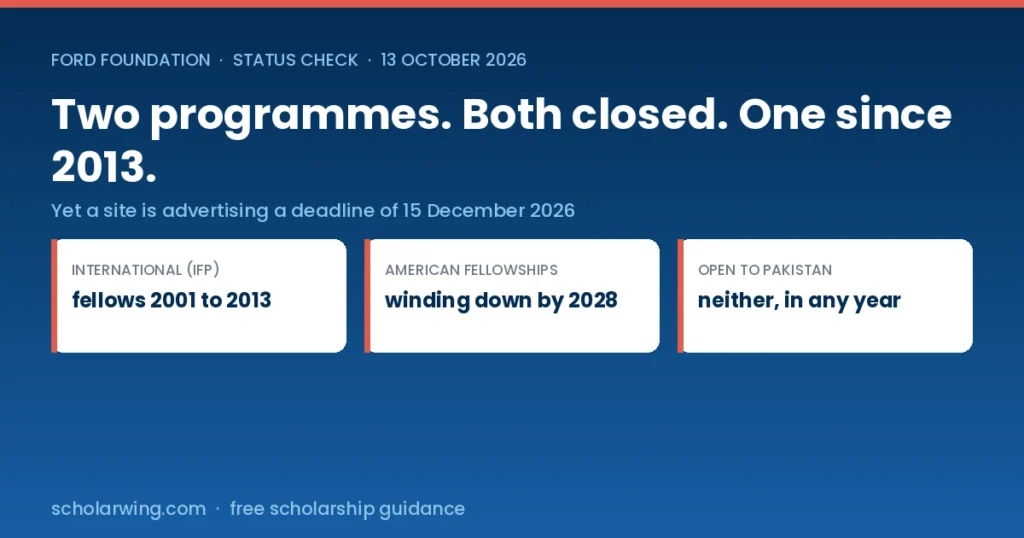
Ford ran two fellowship programmes with similar names, which is where the confusion starts. Both have closed. One of them closed thirteen years ago.
And right now, at least one scholarship website is advertising a Ford Foundation International Fellowship Program 2026-2027 with a deadline of 15 December 2026 and results promised on 31 May 2027.
That round does not exist. We checked, and this page explains exactly how we know.
The two programmes, and what happened to each
The International Fellowships Program, which closed in 2013
This is the one almost everyone searching for “Ford Foundation scholarship” actually wants, because it was built for people in countries like ours.
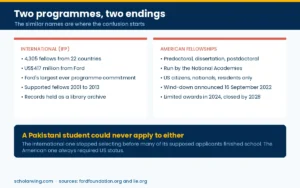
It was enormous. The Institute of International Education records that it supported 4,305 emerging leaders from 22 countries, backed by US$417 million from the Ford Foundation described as the single largest programme commitment in Ford’s history.
It supported fellows between 2001 and 2013. Columbia University holds its records, dated 2000 to 2013, as an archive.
That is the shape of a programme that ended. Its papers sit in a library, its alumni are tracked by a research study, and its last fellows were selected more than a decade ago.
Anyone advertising a 2026 or 2027 round of the International Fellowships Program is describing something that stopped before many of its supposed applicants finished school.
The Ford Foundation Fellowships, winding down by 2028
The second programme is American, and entirely different.
The National Academies of Sciences, Engineering and Medicine ran postdoctoral, dissertation and postdoctoral fellowships on the Ford Foundation’s behalf, through a national competition.
Its eligibility never included Pakistan. Applicants had to be a US citizen, US national or US permanent resident, with the list extending to DACA recipients, asylees and refugees. An international student in Pakistan could never apply, in any year.
And it is closing. On 16 September 2022, Ford’s then president Darren Walker published the decision, writing that the foundation “came to the difficult conclusion that we would wind down the Ford Fellowships program by 2028.” Ford says the decision was reached in 2020, and that a sunset plan followed with the National Academies.
The announcement describes a 2023 cohort and a limited number of awards in 2024, with existing fellows supported through the end of their terms. Ford gave its reason plainly: it wanted to move that money towards racial justice advocacy and movement-building work. Walker called it “a painful sacrifice, but a necessary one.”
University fellowship offices have updated accordingly. One we read states simply: “This fellowship program has been discontinued.”
The deadline being advertised right now
Here is what a scholarship aggregator currently publishes about a Ford “International Fellowship Program 2026-2027”:
Full tuition, living expenses, research costs and language training. Citizens of 22 countries across Africa, Latin America, the Middle East and Asia. Apply through national partner organizations. Deadline 15 December 2026. Results 31 May 2027.
Several of those details are historically accurate descriptions of the IFP as it ran before 2013. The country count matches. So does the national partner structure, and so does the return-home commitment.
Someone invented the dates. A programme that selected its last fellows over a decade ago has no December 2026 deadline, and nobody will send results in May 2027.
This is how a dead scholarship keeps living online. Someone copies a real description from an archived page, adds a plausible future date because a date brings clicks, and publishes. The next site copies that one. Within a few cycles, an invented deadline looks like a fact because five sites agree on it.
We are not naming the site, because the point is not one website. The point is the method, and the method is everywhere.
Four checks that would have caught this
Use these on anything, including on us.
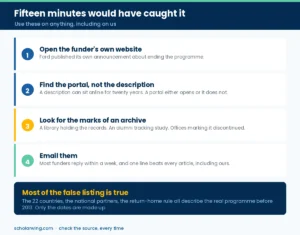
One. Open the founder’s own website. Not a blog, not a Facebook post. Ford publishes its own announcement about winding the programme down. Four minutes of reading settles the whole question.
Two. Find the application portal, not the description page. A description can sit online for twenty years. A portal either accepts registrations or it does not.
Three. Look for signs of an archive rather than a programme. When a university library holds the records, when a research institute runs an alumni tracking study, when university fellowship offices mark it “discontinued” those are the marks of something finished, not something recruiting.
Four. Email them. Most founders answer within a week, and one line from the organization beats every article on the internet, including this one.
Those four checks take fifteen minutes. The application you were about to build takes a month.
What to do instead
If Ford attracted you because you wanted a fully funded master’s or doctorate with a commitment to return home and serve your community, that model still exists. It simply has different names now.
For a funded master’s, Türkiye Bursları needs no language test and no admission letter to apply, and the CSC scholarship covers a wide range of fields and universities.
public health, policy and development, our public health guide lists the routes that genuinely accept applicants from Pakistan, with verified deadlines.
For a doctorate, stop looking for scholarships altogether. Across Europe a PhD is salaried employment with no tuition fee and no nationality restriction our DTU Denmark post, ORFeus guide and Örebro guide explain that market.
And if you want the social-change element specifically, that was always the heart of the IFP. Look for programmes that ask what you will change at home rather than what you will study. Our UNESCO guide and Faculty for the Future guide both describe awards built that way, with their country lists stated honestly.
Frequently asked questions
Is the Ford Foundation Fellowship open in 2027?
No. The international programme supported fellows between 2001 and 2013. The American programme is winding down by 2028, with its last awards described in 2024.
Could a Pakistani student ever apply to the American Ford Fellowships?
No, in any year. Eligibility required US citizenship, US national status or US permanent residence, extending to DACA recipients, asylees and refugees.
Why did Ford end the programme?
Ford says it chose to move the funding towards racial justice advocacy and movement-building work, which it described as receiving only a fraction of racial equity funding. It called the decision a painful but necessary sacrifice.
Will it come back?
Ford named no successor programme. It wrote about re-centering support for a new generation of individuals, ideas and institutions, without promising a replacement fellowship.
Then why do so many sites still list it?
Because an old description plus an invented future date produces traffic, and nobody verifies. The next site copies the first. After a few cycles the invented date looks like a fact.
What if a site shows a Ford application form? Check whether it leads to Ford or to the National Academies, and whether that page itself accepts registrations. A form on a third-party site proves nothing at all.
Is there any Ford funding left for international students?
Not through these fellowships. Ford funds organizations and movements rather than running an open scholarship competition for individuals abroad.
How do I avoid this next time?
Run the four checks above before you build anything. They cost fifteen minutes and they have saved our readers entire application seasons.
One last thing
We could have written a cheerful page about the Ford Foundation Fellowship with a December deadline, and it would have earned more traffic than this one.
If We would rather you kept your month.
We checked every claim on this page on 13 October 2026, and we will update it the day any Ford programme reopens.