
UNESCO Fellowships: There Is No Single Scholarship, and One Gate Decides Everything
Students write to us asking how to apply for “the UNESCO scholarship”. There is no such thing.
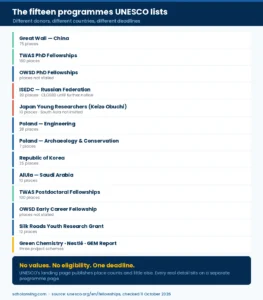
UNESCO lists fifteen separate fellowship programmes on its own fellowships page. Different donors pay for them, different countries qualify, the deadlines fall months apart, and several of them sit closed right now.
More importantly, almost every one of them shares a single rule that most articles skip entirely. You cannot apply to UNESCO. Your government must nominate you first.
Get that rule wrong and nothing else you do matters.
What UNESCO actually offers
Here is the real list, taken from UNESCO’s own page, with the number of places each programme states.
Programmes for students and PhD candidates: the Great Wall Co-Sponsored Fellowships with China (75 places), TWAS PhD Fellowships (160), OWSD PhD Fellowships, and the ISEDC Co-Sponsored Fellowships with the Russian Federation (20).
Programmes for early-career researchers: the Japan Young Researchers’ Fellowships, better known as Keizo Obuchi (10 places), Poland in Engineering (28), Poland in Archaeology and Conservation (7), the Republic of Korea (25), the AlUla Fellowships with Saudi Arabia (10), TWAS Postdoctoral Fellowships (100), the OWSD Early Career Fellowship, and the Silk Roads Youth Research Grant (12).
Project-based schemes: Green Chemistry for Life with PhosAgro and IUPAC, the Nestlé “Because Youth Matter” programme (20), and the GEM Report fellowship.
Notice what UNESCO’s landing page does not tell you: no values, no eligibility, no deadlines except one. Every one of those details lives on a separate programme page, and some of those pages have not changed in years.
The gate nobody mentions
UNESCO does not take applications from individuals. Read that sentence twice, because it quietly ends most applications before they start.
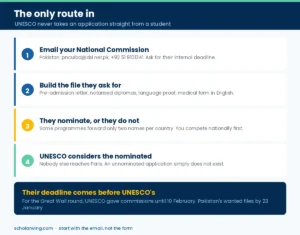
Each country has a National Commission for UNESCO, usually sitting inside its education ministry. That office collects applications, picks a small number of candidates, and forwards only those names to Paris. UNESCO then considers the nominated candidates and nobody else.
For Pakistan that office is the Pakistan National Commission for UNESCO. Its published contact details are pncuibd@dsl.net.pk and +92 51 9101341, open Monday to Friday, 9am to 5pm. Students elsewhere should search for “National Commission for UNESCO” plus their country’s name.
Two consequences follow, and both cost people places every year.
First, your real deadline is earlier than UNESCO’s. For the Great Wall programme, UNESCO’s own timetable gave National Commissions until 10 February to submit names, but Pakistan’s commission required applications by 23 January. That is eighteen days of difference, and a student working to the UNESCO date would have missed it.
Second, the commission ranks you against your own compatriots, not the world. Some programmes let a country nominate as few as two people. Your competition is national before it ever becomes international.
So the first thing to do is not downloading a form. Email your National Commission and ask what their internal deadline is and how many candidates they forward.
What is actually open to South Asia
This part will disappoint some readers, and we would rather disappoint you today than after you spend a month on documents.
The Japan Young Researchers’ Fellowships, worth up to US$10,000, do not accept South Asia.
The programme closes on 15 October 2026 and dozens of pages are promoting it right now. We opened UNESCO’s Annex 1 list of invited Member States and read it line by line. It names 83 countries. The Asia and the Pacific section holds seventeen: Cook Islands, Fiji, Kiribati, Maldives, Marshall Islands, Micronesia, Nauru, Niue, Palau, Papua New Guinea, Samoa, Singapore, Solomon Islands, Timor-Leste, Tonga, Tuvalu and Vanuatu.
Pakistan does not appear. Neither do India, Bangladesh, Nepal or Sri Lanka. The Arab States section contains exactly one country, Bahrain, and the European section two, Türkiye and Ukraine.
That list is not an oversight. UNESCO and Japan aim the programme at small island states and least-developed countries, which is a reasonable choice. It simply means most of our readers cannot apply, whatever the blogs say.
The Great Wall Fellowships with China do accept Pakistan
Along with 135 developing Member States across Africa, Asia and the Pacific, Latin America, the Arab States and Europe. This is the UNESCO route that matters most for South Asian students.
It covers one-year visiting scholar places, master’s degrees and doctorates of two to five years, and it offers 75 fellowships with 27 open to new recruitment. Age limits run to 45 for a general visiting scholar, 50 for a senior scholar, 35 for a master’s and 40 for a doctorate, measured at enrolment. English-taught programmes require proof of English. Chinese-taught ones ask for HSK Level 3 from visiting scholars and HSK Level 4 for degrees.
The ISEDC programme with the Russian Federation sits closed.
In UNESCO’s own words, “until further notice”. Its page still describes a four-week energy course with a US$450 monthly allowance, but those terms come from its 2020 session.
How the Great Wall application actually works
The mechanics confuse people, so here they are in order.
You need a pre-admission letter from a Chinese university before you apply. That is mandatory, and it means contacting universities months ahead.
You then register on the Chinese Government Scholarship Information System at campuschina.org, entering Agency Number 00001 and selecting Type A Application. Those two values route your file to the UNESCO quota rather than the ordinary CSC pool.
After that you submit hard copies to your National Commission, and only once they nominate you does anything go to thegreatwall@unesco.org.
Your diplomas need notarized copies, your documents need to be in English or Chinese, you must fill in your medical form in English and it stays valid for six months, and your passport must be an ordinary one rather than a service or diplomatic passport. Neither UNESCO nor China funds a spouse or any dependents.
If the CSC portal looks familiar, that is because it is the same system behind the main Chinese Government Scholarship. Our CSC guide walks through the portal itself in detail.
One contradiction worth knowing about
UNESCO’s Great Wall page carries a last-updated date of 26 June 2026 and describes the 2026-2027 edition as “now open for applications”.
Yet the deadlines printed on that same page fall on 23 January and 10 February 2026, months before that update. Its “About” section also refers to the academic year 2025-2026 rather than 2026-2027.
We cannot reconcile those, so we will not guess. Treat the January and February dates as the pattern for how early this programme closes, and email your National Commission to ask when the next cycle opens. One reply settles it.
Who should pursue a UNESCO fellowship
If you want a degree in China, the Great Wall route is worth your time, and you should start by asking your National Commission for the next cycle’s dates.
you are a researcher from a Pacific island state, a least-developed country, Türkiye, Ukraine or Bahrain, the Japan fellowship is a genuinely strong option and the 15 October 2026 deadline is close.
If you are a South Asian researcher hoping for Japan, look at MEXT instead, which takes Pakistani and Indian applicants every year and funds full degrees rather than a short research stay.
If you doctorate is your real aim, remember that across Europe a PhD is salaried employment with no tuition fee and no nomination gate at all. Our DTU Denmark post and ORFeus guide explain how that works.
The one email to send this week
Write to your National Commission for UNESCO and ask three questions: which UNESCO fellowship programmes they are currently nominating for, what their internal deadline is, and how many candidates they forward to Paris.
Three lines. Most commissions answer within a week, and the answer is worth more than every article about UNESCO fellowships, including this one.
We checked every claim on this page on 11 October 2026 and we will say so on the page whenever we check again.