
HFSP Fellowships: One of the Highest-Paid Postdocs in the World, and It Funds the Leap, Not the Continuation
Look at what the Human Frontier Science Program pays a postdoctoral researcher in the first year, from its own 2027 guidelines.
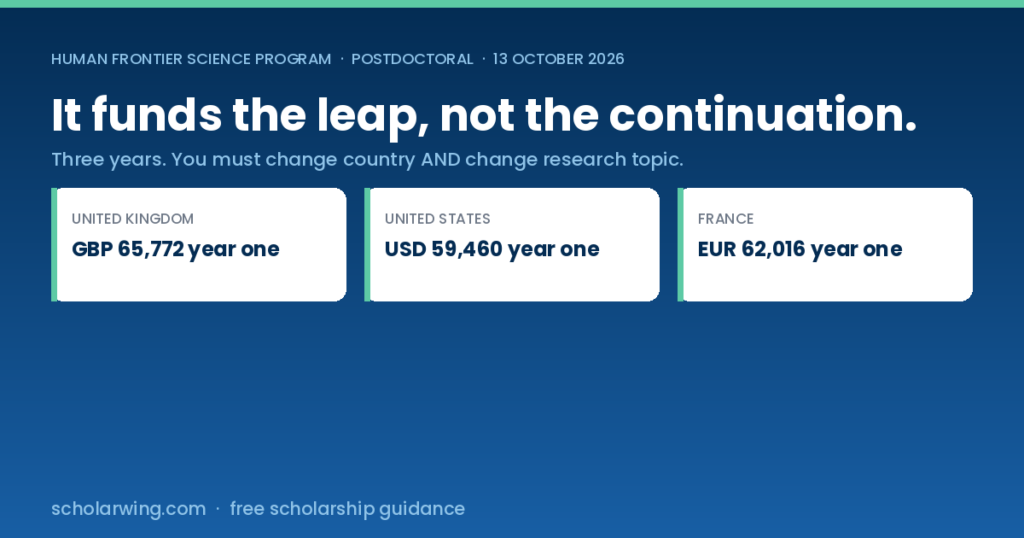
United Kingdom: £65,772. France: €62,016. United States: US$59,460.
Each rises in years two and three, the fellowship runs for three full years, and HFSP adds a research and travel allowance on top, plus 10% of the first-year living allowance for each child and a relocation allowance.
Those are among the strongest postdoctoral terms anywhere in the world. HFSP notes that the allowances sit under review and may change before a final offer, so treat them as the 2027 figures rather than a permanent promise.
Now the two things that make HFSP genuinely different, and that end most applications before anyone reads the science.
It funds the leap, not the continuation
HFSP does not pay you to keep doing what you already do somewhere warmer.
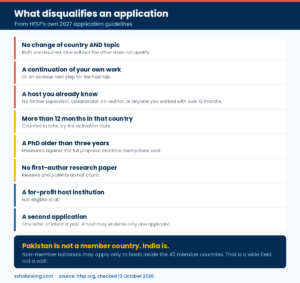
You must change country and change research topic. Both. HFSP states plainly that an application failing to propose both changes does not qualify.
It goes further. HFSP will reject a project that reads as a close continuation of your PhD or postdoctoral work, or as an obvious next step for the host lab. It also rejects purely applied work, purely observational work and standard projects.
And it polices the relationship with your host. Your host supervisor cannot be a former supervisor or collaborator, cannot be someone you have published with, and cannot be someone you have worked with for more than twelve months. The host institution cannot be for-profit.
Read those rules together and the design becomes clear. HFSP buys intellectual discontinuity. It wants a scientist to walk into an unfamiliar field, in an unfamiliar country, in a lab where nobody knows them.
That is also why the two fellowship types exist. The Long-Term Fellowship suits applicants with a biology or life sciences PhD and prior life sciences experience. The Cross-Disciplinary Fellowship suits applicants with a non-biological PhD and little or no life sciences background, a physicist, mathematician, chemist or engineer moving into biology. In both cases the project itself must sit in the life sciences.
If you are a physicist who wants to work on biological systems, the CDF exists precisely for you, and very few founders have an equivalent.
The nationality rule, and what it means for Pakistan
HFSP runs on a membership structure, and this decides where you may go.
Nationals of HFSPO member countries may apply to institutions in any country they are not a national of.
Nationals of non-member countries may apply only to institutions inside an HFSPO member country.
The member countries are Australia, Austria, Belgium, Bulgaria, Canada, Croatia, Cyprus, the Czech Republic, Denmark, Estonia, Finland, France, Germany, Greece, Hungary, India, Ireland, Israel, Italy, Japan, the Republic of Korea, Latvia, Lithuania, Luxembourg, Malta, the Netherlands, New Zealand, Norway, Poland, Portugal, Romania, Singapore, Slovakia, Slovenia, South Africa, Spain, Sweden, Switzerland, the United Kingdom and the United States.
Pakistan is not on that list. India is.
So a Pakistani researcher can apply, and the fellowship is genuinely open, but the host institution must sit in one of those forty countries. An Indian researcher, as a member national, could instead choose a host almost anywhere outside India.
That is a real difference, and it is also not a serious obstacle. Forty countries including the UK, Germany, Japan, Singapore and the United States is a wide field.
Three more location rules catch people. You cannot host in the country of your own nationality. You cannot host in the country where you earned your PhD. And you may not have spent more than twelve months in the host country in total by the date the fellowship activates.
The timing rules
These are strict and they are arithmetic, so check them before anything else.
Your PhD must be conferred no more than three years before the Full Proposal deadline. For the 2027 cycle, with its 24 September 2026 deadline, that meant a PhD awarded on or after 24 September 2023. HFSP allows exemptions for illness, parental leave, full-time family care and military or civil service, and asks you to contact fellow@hfsp.org before starting a Letter of Intent.
Your PhD must be complete before the fellowship starts, and no later than 31 December 2027 for that cycle.
You need at least one full-length original research paper in English where you are the lead author. Reviews and patents do not count. At the Letter of Intent stage a preprint in an open-access repository that has been submitted to a journal can qualify, but by the Full Proposal stage the paper must be published, in press or formally accepted.
One Letter of Intent per year, and a host supervisor may endorse only one applicant. So if two people in your network want the same host, one of you must move.
Previous HFSP postdoctoral fellows cannot apply again.
The cycle has closed, and that is useful to know now
HFSP’s own page states that the Letter of Intent deadline for the 2027 cycle has passed. The Full Proposal deadline for invited applicants fell on 24 September 2026, so nothing remains open in this round.
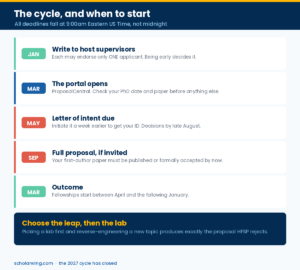
The 2027 cycle ran like this, and the pattern is what you plan against.
12 March the portal opened. 5 May you had to initiate the Letter of Intent and obtain an ID. 12 May the Letter of Intent was due. Decisions on those came by late August, invited Full Proposals were due 24 September, and final outcomes arrive around March the following year, with fellowships starting between April and the January after.
All deadlines fall at 9:00 am Eastern US Time, which is early afternoon in Pakistan. A deadline described as a date is really a morning.
One caution. When we checked, HFSP’s own page carried a banner saying the 2027 Letter of Intent deadline had passed while its deadline section still listed the May 2026 dates as upcoming. We read the banner as current, and you should confirm the 2028 dates with the Fellowships Office rather than with any article, including this one.
What to do between now and May
Seven months is roughly the right amount of preparation for this award, and that is not an exaggeration given the rules above.
Check the arithmetic first. Your PhD date against the three-year window. Your first-author paper, Your time already spent in the countries you are considering. If any of these fails, nothing else matters.
Choose the leap, then the lab. Decide what field you want to move into, and only then look for groups. Picking a lab first and reverse-engineering a “new topic” produces exactly the proposal HFSP rejects.
Check the host relationship rules before you write to anyone. If you have published with them, or worked with them for more than a year, they cannot host you. Finding that out in April wastes the cycle.
Write to host supervisors in January or February. They must endorse you and can endorse only one applicant, so being early matters more here than almost anywhere else.
And if a postdoc is still years away, the first step is a funded doctorate. Across Europe a PhD is salaried employment with no tuition fee and no nationality restriction our DTU Denmark post, Örebro guide and ORFeus guide explain that route.
We checked every claim on this page against HFSP’s own guidelines on 13 October 2026, and we will update it when the 2028 dates appear.