
Wellcome Trust Fellowships: Not for Students, and the Country Rules Change on 29 October
Students write to us asking how to get a Wellcome Trust scholarship for a PhD. We have to start with the hard part.
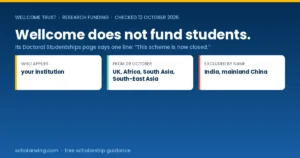
Wellcome does not fund students, and it closed the scheme that used to.
Its Doctoral Studentships page carries one line: “This scheme is now closed.” That scheme paid a stipend, research expenses and tuition fees for a three-year doctorate in humanities or social science applied to health. Its last round closed in March 2021. So is the PhD Training Fellowships for Clinicians scheme.
Wellcome says plainly that the way it funds research is changing, and what it funds now is different in kind. Understanding that difference saves you a month.
What Wellcome funds now
Three schemes, and none of them is a scholarship.
Wellcome Early-Career Awards. For researchers ready to build an independent research identity. Wellcome pays your salary at the host organisation’s normal pay scale, plus up to £400,000 in research expenses, usually across five years. You need a PhD with the viva passed by the deadline, or at least four years of equivalent research experience, and normally no more than three years of postdoctoral experience. At least 80% of your research time must go to the project.
Wellcome Career Development Awards. For mid-career researchers leading a substantial independent programme, running up to eight years, with annual expenditure usually below £250,000 excluding your own salary.
Wellcome Discovery Awards. For established researchers and research teams.
Notice what all three have in common. They fund a research programme and the person running it, not a degree. There is no tuition line, because there is no degree.
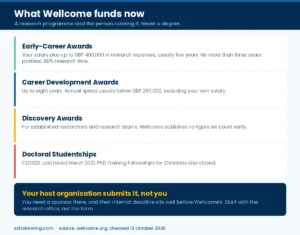
You are not the applicant. Your institution is.
This catches people even when they qualify on everything else.
The host organisation submits the application, not you. You need a sponsor at that organisation, and Wellcome recommends a mentor as well. Your university’s research office has to approve and submit the file, which means their internal deadline sits well before Wellcome’s.
Wellcome’s own deadline page now says apply anytime, with interview and decision dates attached to each round rather than a single annual cut-off. In practice each round still has a submission cut-off: the November 2026 Early-Career round required the administering organisation to submit by 10 November 2026 at 15:00 GMT, and Wellcome states it does not accept late applications.
Coapplicants are not accepted on Early-Career Awards. One lead applicant, one application.
The country rule that changes on 29 October
Here is the finding that makes this post worth publishing today.
From 29 October 2026, Wellcome will accept applications only from lead applicants based at eligible administering organisations in the UK and in low- and middle-income countries in Africa, South Asia and South-East Asia.
Low- and middle-income countries in Latin America, the Caribbean, Eastern Europe and the Pacific no longer qualify as a lead applicant’s host.
Read that against a map and the consequence for our readers is unusual. Pakistan sits inside the eligible region. So do Bangladesh, Nepal and Sri Lanka.
Wellcome excludes India and mainland China by name from the low- and middle-income host list.
A separate change took effect on 1 July 2026, applying new eligibility criteria to new applications from that date, with resubmissions following the rules in force when first submitted.
So a Pakistani researcher at a Pakistani university is, on this rule, in a stronger position than an Indian researcher at an Indian one. We have not seen that written anywhere else, and we would rather you heard it from a page that checked.
One more detail that matters in low- and middle-income countries. Researchers who already hold a tenured salaried post covering the award period are generally ineligible for an Early-Career Award — unless they are based in an eligible low- or middle-income country, where that restriction relaxes.
What a student should do instead
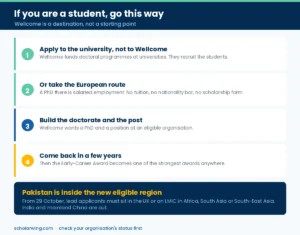
If Wellcome attracted you because you want a funded doctorate in health research, the route runs through a university rather than through Wellcome.
Wellcome funds PhD programmes at universities, and those universities recruit the students. The London School of Hygiene and Tropical Medicine and others run doctoral programmes with Wellcome money behind them. You apply to the university, on the university’s timetable, against the university’s criteria. Search for the programme, not for the funder.
Or take the European route, where a PhD is a job. Across Denmark, Sweden, the Netherlands, Norway and Germany a doctorate is salaried employment with no tuition fee and no nationality restriction. You apply to an advertised position. Our DTU Denmark post, Örebro guide and ORFeus guide explain how that market works.
And if public health is your field, our public health guide lists what is genuinely open to medical and health graduates, with verified deadlines.
Then come back to Wellcome in a few years. Once you hold a doctorate and a position at an eligible organization, the Early-Career Award becomes one of the strongest research awards available anywhere, and your country is on the right side of the new rule.
If you are already a researcher
Check your organization’s status first, before anything else. Wellcome requires an eligible administering organization, and after 29 October that list narrows. Your research office knows, or can ask.
Count your postdoctoral years honestly. Three years is the normal ceiling for an Early-Career Award, and people who exceed it apply anyway and lose a season.
Start with your research office, not the form. They submit it, so their calendar governs yours. Ask them for their internal deadline the same week you decide to apply.
We checked every claim on this page on 12 October 2026, and we will update it as Wellcome’s rules settle after 29 October.