
Amelia Earhart Fellowship: US$12,000 for Women in Aerospace, Closing 15 November
Most of what we write about turns out closed, paused, or shut to countries like yours.
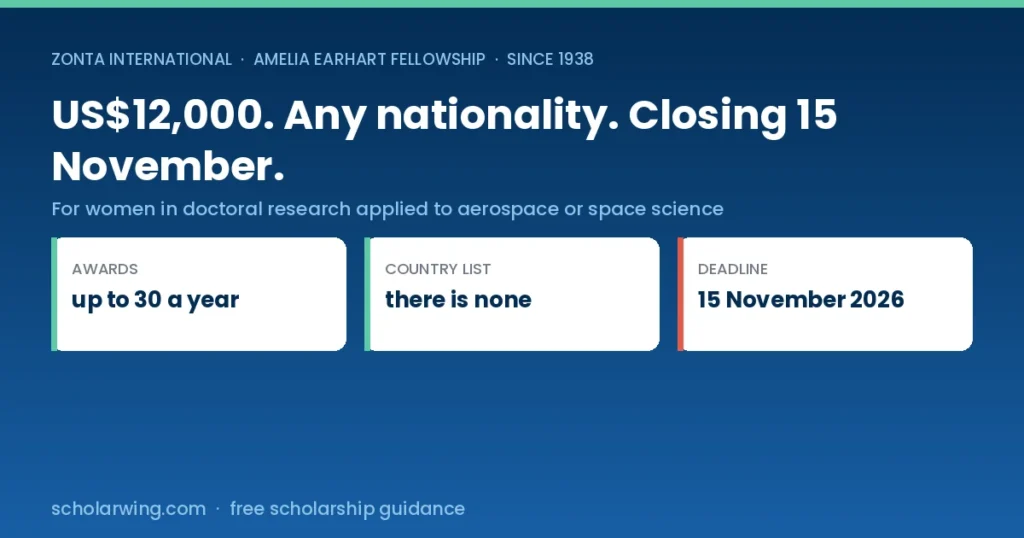
This one is open, it closes on 15 November 2026, and it accepts women of any nationality. No country list, No quota, No government nomination.
Zonta International awards up to 30 fellowships of US$12,000 each to women doing doctoral research applied to aerospace engineering or space sciences.
The field is narrow, and we will be honest about that in a moment. But if it fits you, this is one of the cleanest applications in this whole field.
What it gives, and what you may do with it
US$12,000, paid in September or October, subject to US sanctions regulations.
You may spend it on tuition, books, fees or living expenses, which Zonta defines to include room, board and travel. That flexibility is unusual. Most awards tell you exactly which line item they cover.
You may hold other grants and scholarships at the same time. Zonta does not ask you to give up existing funding, which separates it from several of the corporate fellowships we have covered.
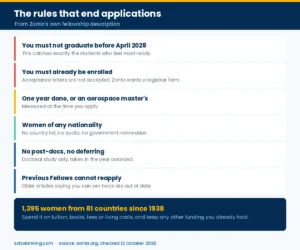
Two limits worth knowing. You cannot defer it, and previous Amelia Earhart Fellows cannot apply for a second year. Older articles still say you may win it twice, because historically some women did, Zonta has awarded 1,824 fellowships to 1,395 women since 1938, and that gap is the repeats. The current rules close that door, so read the rule rather than the history.
Who can apply
Women of any nationality. That sentence does a lot of work, and it is why this post exists. Over its history the fellowship has gone to women from 81 countries.
A full-time PhD or doctoral programme in aerospace engineering or space sciences, or research applied to those fields.
Registered full time by 15 November 2026, with either at least one year of the programme already completed, or a master’s degree in an aerospace-applied field.
You must not graduate before April 2028. This is the rule that catches people, and it catches exactly the students who feel most ready. If your defense falls in late 2027, you lose eligibility, however strong your work.
No post-doctoral researchers. The programme funds doctoral study only.
An acceptance letter is not enough. Zonta requires its own Verification of Current Enrolment form or an official registrar statement, and states plainly that acceptance letters are not accepted. You must already be enrolled.
Zonta club members, people with direct Zonta International membership, and employees of Zonta International or the Zonta Foundation for Women cannot apply.
What the application asks for
Zonta publishes its requirements precisely, which makes this easier to prepare than most.
Biographical information and your plans for study.
Official transcripts from every institution you attended, scanned in color as PDFs, with English translations of all grades. Start this early if your transcripts are not in English.
A list of scholarships, fellowships and honors.
Up to five previous publications. Theses do not count.
Your employment history, if you have any.
An essay of 500 words or fewer on your academic programme and professional goals. Five hundred words is short. Most applicants write twice that and then cut badly.
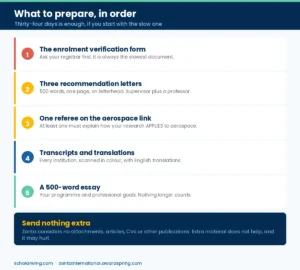
Three recommendation letters, each limited to 500 words and one page, on letterhead and signed. The rules here are specific: your thesis supervisor or advisor must be one referee, a university professor must be another, and at least one referee must address how your research applies to aerospace or space science.
That last requirement decides applications. A letter praising you as a good student without connecting your work to aerospace wastes one of your three slots.
The Zonta Verification of Current Enrolment form, or an official registrar statement.
English translations of anything not already in English.
And a warning Zonta states directly: it considers no attachments, articles, CVs or other publications. Sending extra material does not help and may hurt.
Who should apply
If you are a woman in year two or beyond of a doctorate in aerospace engineering, space science, satellite systems, propulsion, astrophysics, remote sensing or a related area, apply. Thirty awards worldwide against a field this specific gives you better odds than almost any award with a famous name, and there is no nationality barrier to clear first.
If your research merely touches space, read the wording again. Zonta says preference goes to candidates with a well-defined research programme applied to aerospace engineering or space sciences. One referee has to make that connection explicitly. If nobody can write that letter honestly, the application will not land.
you are a man, a post-doc, or a master’s student, this is not open to you, and we would rather say so in one line than waste your week.
If you are not yet in a doctorate, note that an offer does not qualify you. Get enrolled first. Across Europe a PhD is salaried employment with no tuition fee and no nationality restriction our DTU Denmark post, ORFeus guide and TU Delft guide explain how to win one.
And if you are a woman in STEM outside aerospace, the Faculty for the Future fellowship pays up to US$50,000 a year, though it runs a strict country list that excludes Pakistan.
The thirty-four day plan
This week. Confirm you clear the April 2028 rule. Request the enrolment verification form from your registrar, since that is the document most likely to be slow.
This week also. Ask your three referees, and tell each one what their letter must do. Give the aerospace-connection instruction to whichever referee can write it honestly. Give them the 500-word and one-page limits in writing.
Next week. Order official transcripts from every institution, and arrange English translations if you need them.
Two weeks out. Draft the 500-word essay, then cut it. Name the research problem, its application to aerospace, and what you intend to do after the doctorate.
One week out. Submit. Do not wait for the final day, because the portal closing on 15 November does not care about your time zone.
Apply at zontainternational.awardspring.com, and expect to hear by the end of April 2027.
We checked every claim on this page against Zonta’s own fellowship description on 12 October 2026.