
Hong Kong PhD Fellowship 2027/28: Two Applications, Not One, and a New AI Rule
Hong Kong’s Research Grants Council awards around 400 PhD fellowships a year, open to any nationality, any age, across eight universities. The initial application closes on 1 December 2026 at 12:00 noon Hong Kong time.
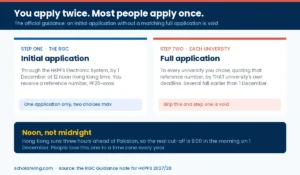
Note the time. Noon, not midnight. Hong Kong runs three hours ahead of Pakistan, so your real cut-off is 9:00 a.m. on 1 December, Pakistan time. People lose this one to a time zone every single year.
And then the thing that costs more applicants than anything else.
You apply twice. Most people apply once.
The Guidance Note states it plainly: an initial application without a matching full application is void.
Step one. Submit the initial application through the HKPFS Electronic System by 1 December. Four sections: personal particulars, your choice of university and programme, authorization and declaration, and where you heard about the scheme. English only, except the Chinese name field. You receive an HKPFS Reference Number in the format PF26-xxxxx.
Step two. Submit a full application to each university you chose, quoting that reference number, by that university’s own deadline.
Those university deadlines sit separately from the RGC date, and several fall earlier. So the day you receive your reference number, open the admissions page of each university you picked and write down its deadline. That is your real calendar, not 1 December.
A student who files the RGC form, feels finished, and waits for May gets nothing. The RGC will not chase them.
Four rules that disqualify people
One initial application only. Submitting more than one disqualifies all of them. Not the extra ones. All of them.
Two choices maximum, and only the two saved by the deadline get processed. Save your choices properly and check they stay saved.
No late submissions. The Guidance Note says the RGC does not consider them.
Already enrolled in a Hong Kong PhD? You normally fall outside the scheme. It exists for first-time admission as a new full-time PhD student.
The AI disclosure rule
This one is new enough that almost nobody shares it, and it matters more each year.
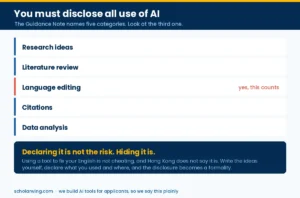
You must disclose all use of AI in your application. The Guidance Note names the categories: research ideas, literature review, language editing, citations, and data analysis.
Read that list again. Language editing is on it. If you ran your research proposal through a tool to fix your English, that counts and you declare it.
We build AI tools for applicants, so let us be straightforward about this. Using AI to tidy your grammar is not cheating, and Hong Kong does not say it is. Hiding it is the problem. Declare what you used and where, write the ideas yourself, and the disclosure becomes a formality rather than a risk.
Research involving personal or medical data carries its own requirements: how you collect data and obtain consent, how you secure it, how you share it, and how you comply with the law. Address those in the proposal rather than leaving them for an interview.
What the fellowship pays
In the most recent published cycle, the scheme provided:
- A monthly stipend totaling around HK$344,400 a year
- A conference and research-related travel allowance of around HK$14,400 a year
- Up to three years of support
We are quoting the most recent published figures rather than confirmed 2027/28 amounts, so read the current numbers on the RGC’s own site before you plan a budget. Several universities add their own top-up on the RGC award, which is worth asking each one about directly.
One thing to understand before you accept. The fellowship runs for three years. Many PhDs take four. After the fellowship ends, support depends on the host university’s own policies, so ask what happens in year four before you choose a programme, not after.
Who can apply
- First-time admission as a new full-time PhD student at a participating Hong Kong university for the 2027/28 intake
- A strong academic record typically a good relevant bachelor’s and, often, a master’s
- Research ability, communication skills and leadership potential
- The university’s own admission requirements, including English
Any nationality, Any age, Any gender. No country list, no age cut-off. That openness is rarer than it sounds compare it with TaiwanICDF, which restricts by country, or Schwarzman, which cuts off at 29.
How selection actually works
Universities nominate candidates to the RGC, and universities usually interview applicants.
That matters for where you put your effort. The university decides whether to nominate you. So contacting a potential supervisor in your chosen department, with a short email about the work you have done and the question you want to answer, does more for your chances than polishing the RGC form. Our email reviewer will tell you what a professor deletes in four seconds.
If both your choices nominate you, the RGC uses the priority you stated. Rank them honestly.
Results arrive in May 2027, by email and letter. The RGC gives no feedback to individual applicants.
And one genuinely good piece of news that nobody mentions: applicants who miss the fellowship may still receive admission for regular PhD study, and may receive other funding from the university. A rejection from HKPFS is not a rejection from the PhD.
There is no RGC application fee, though universities may charge their own.
Your seven weeks
This week. Decide your two choices university and programme and read two recent papers from each group you are targeting.
Within a week. Email a potential supervisor in your first choice. The nomination runs through the department.
By 10 November. Submit the initial application, get your PF26 reference number, then immediately look up each university’s own deadline and write it in your calendar.
By each university deadline. Submit the full application, quoting the reference number. The SOP generator and CV reviewer will get those documents ready.
1 December, 9:00 a.m. Pakistan time. The RGC window closes.
Where to apply: the HKPFS Electronic System, via the Research Grants Council.