
JASSO Scholarship Japan 2027: What It Actually Pays
More students confuse this award with MEXT than any other scholarship we write about, so start there.
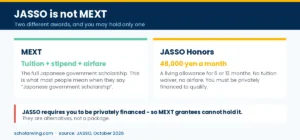
JASSO is not MEXT, and you cannot hold both. The scholarship’s full name is the Monbukagakusho Honors Scholarship for Privately-Financed International Students, and that middle phrase decides everything. JASSO requires recipients to be privately financed, which it defines as not holding a Japanese Government (Monbukagakusho) scholarship or a foreign government scholarship.
So the two are alternatives, not a package. MEXT funds your tuition, a monthly stipend and your airfare. JASSO pays a monthly allowance to students who are already paying their own way.
Once you understand that, the rest of this guide makes sense.
What it pays
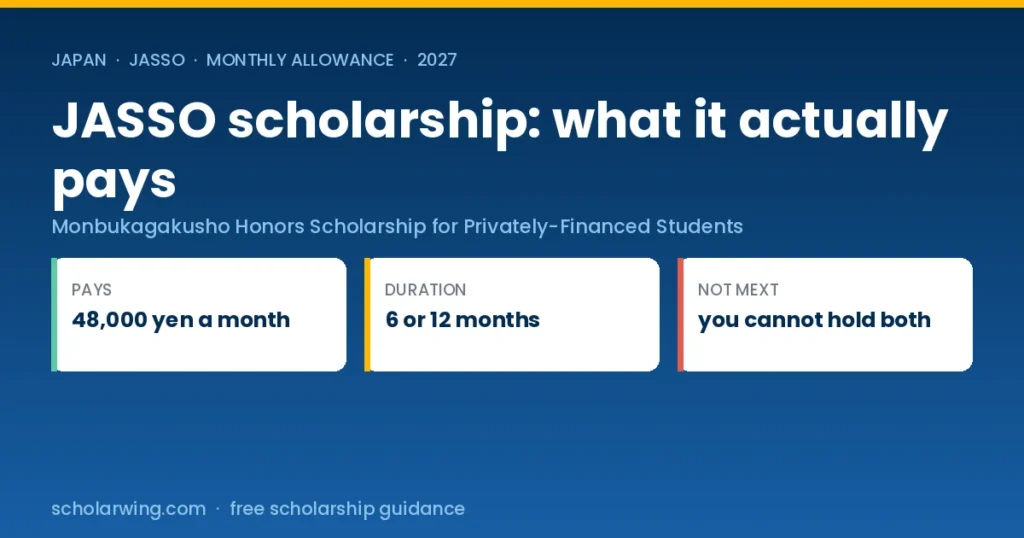
¥48,000 per month for graduate and undergraduate students. ¥30,000 per month for students at Japanese language institutes.
The period runs 12 months, from April to the following March, or 6 months, from October to the following March. That is the whole award. It does not stretch across your degree, and you would need a fresh recommendation for any further year.
There is no tuition waiver and no airfare.
What that covers, honestly
Japan’s official Study in Japan portal puts combined first-year admission and tuition fees at roughly ¥820,000 at a national university, for both undergraduate and graduate level, rising to about ¥1,300,000 at a private undergraduate university.
Twelve months of JASSO comes to ¥576,000.
But reading it against tuition misses the point, because the money reaches you monthly as a living allowance rather than as a fee reduction. The clearest way to size it sits inside JASSO’s own eligibility rules: to qualify, your monthly allowance excluding tuition must average no more than ¥90,000. So the scheme assumes a modest monthly budget, and ¥48,000 covers a little over half of it.
That is genuinely useful money for a student already enrolled and paying their own fees. It is not a route into Japan for somebody with no funding.
Who can apply
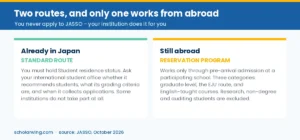
You hold “Student” residence status. This is the condition students abroad miss most often, and it means the standard route serves people already studying in Japan.
You pay your own way, so you hold no Monbukagakusho or foreign government scholarship holder.
You study full time at an eligible institution, graduate school, undergraduate university, junior college, college of technology, specialized training college, university preparatory course or Japanese language institute.
Your meet the language requirement. Japanese-track students need JLPT N2 or above, or an EJU Japanese as a Foreign Language score of 200 or more, or a level JASSO separately recognizes. English-track students need CEFR B2 or above. Preparatory Japanese courses, university preparatory courses and Japanese language institutes fall outside this requirement.
You pass the means test. Your monthly allowance, excluding enrolment and tuition fees, must average no more than ¥90,000. If you have a financial supporter in Japan, that person’s annual income must fall below ¥5 million.
You meet your institution’s grading criteria, which the application guidelines set rather than the public page.
You agree to take part in JASSO’s career path survey, which continues after you graduate.
How it actually works — and why there is no application form
You cannot apply to JASSO. Applications go through your institution, and JASSO’s own page tells students to ask the staff at the educational institution where they are enrolled.
Each institution receives an allocation, and the number of students it may recommend depends on how many international students it enrolls. A large university with thousands of international students recommends more than a small one.
Some institutions do not accept applications at all. JASSO says so directly. That single sentence should change what you do: before you build any expectation around this award, ask your university’s international student office whether it participates and how it selects.
Recipients sign a JASSO form every month at the international students’ office. Miss the signing and the payment stops, which catches out students who travel home during long holidays.
The Reservation Program, for students not yet in Japan
If you are still abroad, this is your route, and it works only through pre-arrival admission selection and admission granted without you visiting Japan.
It pays the same ¥48,000 a month, twelve months for an April enrolment and six months for a September or October one, and JASSO notes the amount may change between academic years.
Three categories exist. Graduate level, at universities offering pre-arrival admission to their graduate schools. The EJU route, at schools registered with JASSO that offer pre-arrival admission using the Examination for Japanese University Admission, excluding graduate schools. English courses, at schools whose undergraduate or associate degree courses run entirely in English with pre-arrival admission.
Several categories of student fall outside it entirely: research students, trainees, non-degree students, advanced course students, special course students, auditing students and special students. If your offer letter uses any of those words, check carefully before you count on this.
Here too, the school applies on your behalf. You cannot approach JASSO directly, and JASSO publishes lists of participating schools rather than a student application form.
What this means for your plan
If you are already studying in Japan, go to your international student office this week and ask three questions: does this institution recommend students for the Honors Scholarship, what are its grading criteria, and when does it collect applications. Everything depends on those answers.
If you are still abroad, your target is not the scholarship. It is a university that offers pre-arrival admission and participates in the Reservation Program. Choose the school first and the award follows; chase the award first and you will find no door to knock on.
If you need full funding, look at MEXT instead, since JASSO will not carry a degree on its own. Our guides to scholarships in the USA and scholarships in the UK set out comparable routes elsewhere, and our post on why “fully funded” UK medical PhDs reject international students explains the fee mechanics that decide most of these outcomes.
If you are heading for research study, remember that much of continental Europe pays doctoral students a salary instead of a scholarship. The Karolinska positions in Sweden and the Cologne ageing research posts in Germany show what that looks like.
Frequently asked questions
How much is the JASSO scholarship?
¥48,000 a month for undergraduate and graduate students, and ¥30,000 a month for students at Japanese language institutes.
How long does it last?
Twelve months from April to the following March, or six months from October to the following March.
Is JASSO a full scholarship?
No. It pays a monthly allowance with no tuition waiver and no airfare.
Can I hold JASSO and MEXT together?
No. JASSO requires recipients to be privately financed, which rules out Japanese Government and foreign government scholarship holders.
How do I apply for the JASSO scholarship?
Through your institution. JASSO accepts no direct student applications, and some institutions do not take part.
Can I apply from my home country?
Only through the Reservation Program, which requires pre-arrival admission at a participating school. The standard route requires you to hold Student residence status in Japan.
Do I need JLPT?
Japanese-track students need JLPT N2 or higher, or an EJU Japanese score of 200 or more. English-track students need CEFR B2 or higher. Some preparatory and language-institute students fall outside it.
Is there an income limit?
Yes. Your monthly allowance excluding tuition must average no more than ¥90,000, and a financial supporter in Japan must have an annual income below ¥5 million.
Can I hold another scholarship at the same time?
Not one that JASSO treats as incompatible, and not alongside JASSO’s own Student Exchange Support Program.
How many students receive it?
JASSO publishes no single national figure. Each institution receives an allocation scaled to its international student enrolment, so your real competition is inside your own university.
What to do this week
In Japan: email your international student office with the three questions above. The answer decides whether this award exists for you at all.
Abroad: check whether the universities on your list offer pre-arrival admission and appear on JASSO’s participating school lists, then write to their admissions office. Our free email reviewer checks that message first, and the CV reviewer goes through your academic CV line by line.
If an English test stands between you and an application, some institutions accept a medium of instruction letter; our free MOI generator produces the request letter for your registrar. Everything sits on our free tools page, free and without an account.
We checked every figure in this guide against JASSO’s own English pages and Japan’s official Study in Japan portal in October 2026. JASSO notes that the monthly amount may change between academic years, and institutional participation changes too
confirm with your own institution before relying on anything here. If you find something that no longer matches the official page, write to us at scholarwingofficial@gmail.com and we will correct it.
Sources: JASSO, Monbukagakusho Honors Scholarship for Privately-Financed International Students · JASSO, Reservation Program by Pre-arrival Admission · Study in Japan, Academic Fees.