
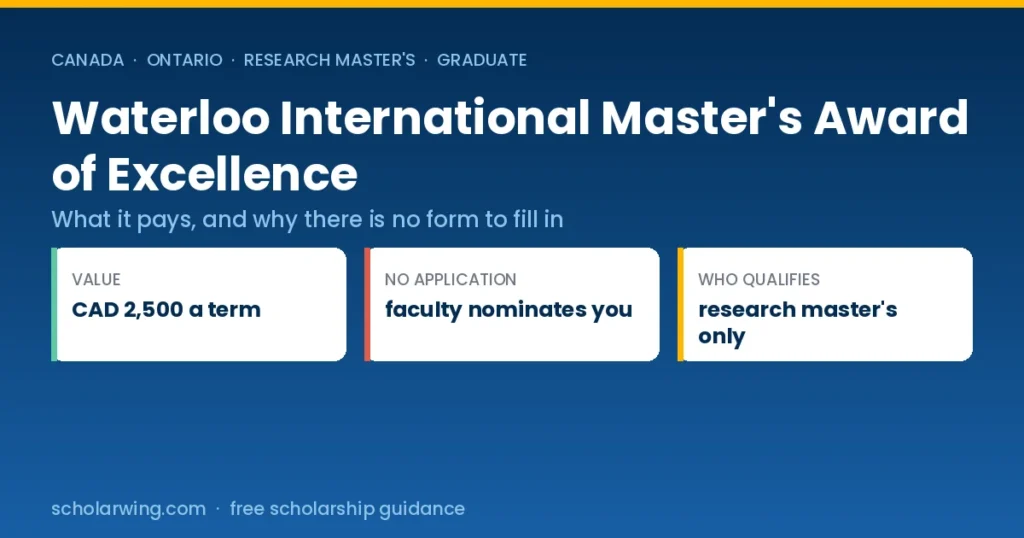
Waterloo International Master’s Award of Excellence

Two facts decide whether this award applies to you, and both sit buried on Waterloo’s own pages while listing sites print something else entirely.
You cannot apply for it. The University of Waterloo states that faculties nominate students based on their award allocation, and select recipients on academic excellence. There is no student application, no portal, no deadline you can meet by effort. Every page telling you to “apply by” a date is describing something that does not exist.
It is for research-based master’s students. Waterloo describes recipients as “normally entering a research-based graduate program” a thesis or research-paper master’s, not a course-based one. Most international students enroll in course-based master’s degrees, and for them this award is simply not on the table.
So the decision this award should drive is not how do I apply. It is which programme do I apply to, and that decision happens months earlier.
What the award pays
CAD 2,500 per term, for a maximum of five terms. At the full five terms that reaches CAD 12,500.
Waterloo pays it on top of your minimum funding rather than instead of it, so a funded research master’s student holds both.
The money arrives in your student account each term, where it goes against tuition and fees first. Anything left over comes back to you as a refund.
What that covers, honestly
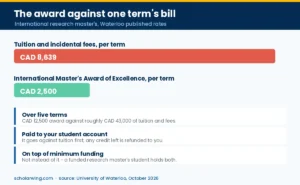
Waterloo publishes per-term tuition for international research master’s students at CAD 7,696, with full-time incidental fees of CAD 943 on top, bringing a term to roughly CAD 8,639. Co-op programmes add a further CAD 817 a term.
Against that, CAD 2,500 covers a little under a third of one term.
Across five terms the award totals CAD 12,500 against roughly CAD 43,000 of tuition and fees. It is a substantial contribution and it is not a full ride, and any site describing Waterloo as fully funded for international master’s students is misleading you.
The figures above come from Waterloo’s published Winter 2026 schedule, and the university notes that its own fee pages can lag behind. Confirm your programme’s current rate with Student Financial Services before you build a budget on it.
Minimum funding, which matters more than the award
Research-based programmes at Waterloo carry a minimum funding commitment, described by the university as the guaranteed minimum level of funding you receive, provided you stay in good standing and within your programme’s time limits.
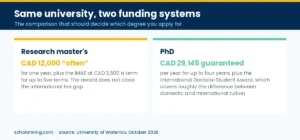
For master’s students the university says full-time students in the first year of certain programmes, MA, MFA, MES, MASc, MMath, MSc often receive minimum funding of CAD 12,000 for one year.
Read that word often. Waterloo chose it deliberately, and it means this is a norm rather than a promise. Before you accept an offer, ask your department in writing what your funding package contains, for how many terms, and whether the IMAE forms part of it or sits on top.
Minimum funding comes from a mix of scholarships and paid work as a Teaching Assistant or Research Assistant. Assistantship income is employment income, paid monthly, and taxed as such.
Waterloo also says plainly that minimum funding “may not cover all living expenses.” Plan for the gap rather than discovering it.
The comparison nobody shows you
Here is the part worth more than the award itself.
At PhD level, Waterloo funds international students properly. The university publishes minimum funding of CAD 29,145 per year, effective 1 May 2026, for up to four years. On top of that, international doctoral students receive the International Doctoral Student Award, which Waterloo describes as covering roughly the difference between domestic and international PhD tuition.
Read that last clause again. The doctoral award closes the international fee gap. The master’s award does not. That single structural difference explains why so many international students find a Canadian PhD affordable and a Canadian master’s a struggle.
| Research master’s | PhD | |
|---|---|---|
| Minimum funding | CAD 12,000, “often”, for one year | CAD 29,145 a year, up to four years |
| International award | IMAE, CAD 2,500 a term, max five terms | IDSA, covers the international tuition gap |
| Who decides | Faculty nomination | Automatic for eligible full-time students |
If your plan ends at a master’s, budget carefully. If a PhD is the real destination, applying directly to the doctoral programme, where your field allows it puts you in a far stronger funding position than arriving through a self-funded master’s.
Waterloo also notes that self-funded full-time doctoral study exists only on an exceptional basis, requires approval, and makes a student ineligible for departmental or faculty funding. So the self-funding route is not a shortcut into a funded PhD.
Other funding worth knowing about
Canada Impact+ Research Training Awards. Six hundred doctoral scholarships across Canada at CAD 40,000 a year for three years, and Waterloo states that they are open to international students.
Ontario Graduate Scholarship. Merit-based, for master’s and doctoral students in every discipline, and Waterloo notes that a small number are available to international students. This one does need an application, unlike most internal awards.
President’s Graduate Scholarship. Up to CAD 10,000 for outstanding students who hold certain major competition-based scholarships.
The general rule at Waterloo: most internal awards need no application, while external awards federal and provincial scholarships do.
What to actually do
Choose a research-based programme if funding matters to you. A thesis or research-paper master’s opens minimum funding and the IMAE. A course-based master’s opens neither.
Contact potential supervisors early. In research programmes the supervisor drives both admission and funding, and faculties nominate for the IMAE from among students they already want. A supervisor who has agreed to take you is the single strongest thing you can carry into that process. Our free email reviewer checks your message before a professor reads it, and the CV reviewer goes through your academic CV line by line.
Ask for your funding package in writing. Request the amount, the number of terms, the split between scholarship and assistantship, and whether the IMAE sits inside or on top. Departments answer this question readily, and the answer varies between them.
Apply for the external awards, because those are the ones where effort changes the outcome.
Frequently asked questions
How much is the Waterloo International Master’s Award of Excellence?
CAD 2,500 per term for a maximum of five terms, so CAD 12,500 in total.
How do I apply for the IMAE?
You do not. Faculties nominate students from their award allocation and select on academic excellence.
Can course-based master’s students get it?
Waterloo describes recipients as normally entering a research-based graduate programme. Course-based students should ask their department directly rather than assuming.
Is it renewable?
It runs up to five terms in total, subject to your faculty’s allocation and your continued eligibility.
Does it cover my tuition?
No. International research master’s tuition runs about CAD 7,696 a term plus CAD 943 in incidental fees, so the award covers a little under a third of one term.
What else will I receive?
Research-based master’s students often receive minimum funding of CAD 12,000 in the first year, from scholarships and assistantship work, with the IMAE on top.
Is the PhD funded better?
Substantially. Minimum funding of CAD 29,145 a year for up to four years, plus the International Doctoral Student Award covering roughly the international tuition difference.
Do I need IELTS?
Waterloo sets its own English requirement and several qualifications satisfy it. Where a medium of instruction letter applies to your case, our free MOI generator produces the request letter for your registrar.
Where else to look
For Canadian doctoral funding, read our guides to the Pierre Elliott Trudeau Foundation Scholarships and the Banting Postdoctoral Fellowships, including which programmes have changed since the listing sites last checked.
If you are weighing Canada against Europe, our post on why “fully funded” UK medical PhDs reject international students explains the fee mechanism that decides most of these outcomes, and the Karolinska positions show what a salaried doctoral post looks like instead.
Our free tools cost nothing and need no account.
We checked every figure in this guide against the University of Waterloo’s own graduate funding, awards database and tuition pages in October 2026. Waterloo notes that its fee pages can lag behind, and funding levels change each year — confirm your programme’s figures with your department and Student Financial Services before relying on them. If you find something here that no longer matches, write to us at scholarwingofficial@gmail.com and we will correct it.
Sources: University of Waterloo, International student funding · Waterloo, Funding for research-based graduate programs · Waterloo, Graduate funding and awards database · Waterloo Finance, Master’s and PhD program tuition.