
Destination Australia Scholarship
Every list of Australian scholarships includes Destination Australia, usually described as a government scholarship worth AUD 15,000 a year.
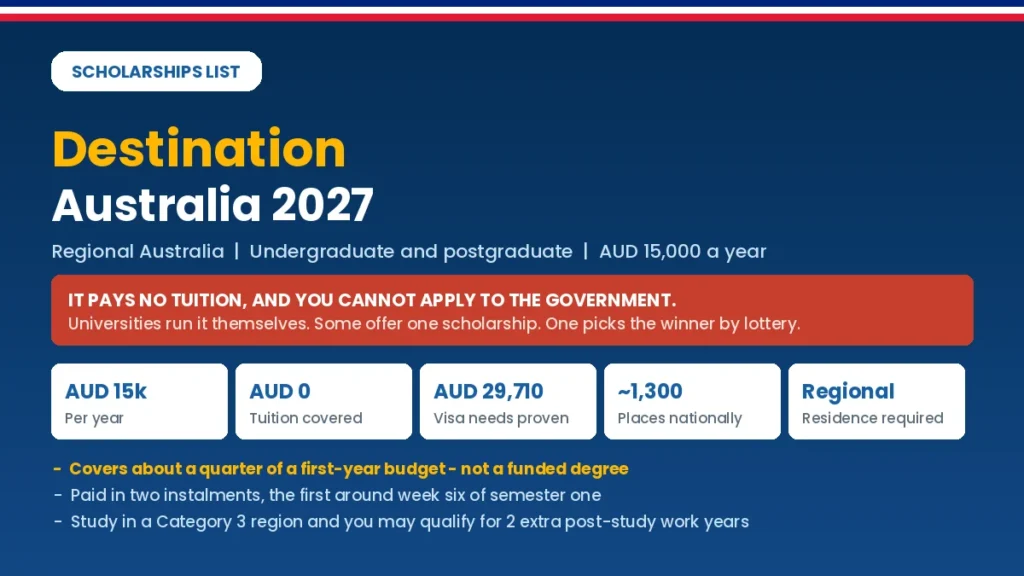
That description is accurate. It is also incomplete enough to mislead a student into an application that costs them a year. Here is what the lists leave out. Destination Australia pays no tuition. Australia requires international students to prove AUD 29,710 in living costs for a single year before it issues a student visa, which means the scholarship covers roughly half of the living costs and none of the fees. You cannot apply to the Australian Government for it; you apply to a university, and each university runs its own process. Some of those universities award one scholarship. At least one of them picks the winner by computer lottery.
None of that makes Destination Australia a bad scholarship. For a student who already planned to study in regional Australia, AUD 15,000 a year across a three-year degree is AUD 45,000 that changes the math’s considerably. It makes it a specific scholarship, useful to a specific applicant, and useless to the much larger group who read “government scholarship Australia” and assumed a funded degree.
This guide explains exactly what it funds, who runs it, how the regional rule works, and whether the numbers add up for you.
What the Program Actually Is
The Australian Government built Destination Australia to solve a problem that has nothing to do with scholarships. Regional universities and training providers were losing students to Sydney, Melbourne and Brisbane, and regional towns were losing young people with them. The government decided to pay students to study outside the big cities.
It committed AUD 93.7 million over four years, releasing roughly AUD 19.5 million a year, and it pays that money to providers rather than to students. Universities, TAFEs and private colleges with regional campuses bid for a share. The successful ones then run their own scholarship competitions and hand out AUD 15,000 a year to the students they choose.
Two consequences follow, and both matter more than the headline amount.
First, there is no central application. No government portal exists for students. Searching for one wastes the weeks you should spend on university applications.
Second, every provider decides its own rules. Each one sets the number of scholarships, the eligible courses, the deadline, the selection method and the split between domestic and international students. Two universities running the same program can offer completely different odds and completely different conditions.
The program funds both Australian and international students, and the provider decides how to divide its allocation between them. Nothing guarantees international students a share at any given institution.
What You Actually Receive
AUD 15,000 per year, usually paid in two instalments of AUD 7,500, one per semester, by direct transfer into your Australian bank account.
The payments arrive after each semester begins, often around week six, and only after the university verifies that you still meet the conditions. Your first instalment therefore lands months after your first rent payment, your flights and your visa fee. Plan for that gap, because it defeats students who budgeted on the scholarship arriving with the semester.
The award runs for the duration of your degree, which usually means three years for a bachelor’s and a maximum of two years for a postgraduate programme. A four-year degree can attract four years of payments at some institutions.
It does not cover tuition. This is the central fact. International tuition in Australia runs roughly AUD 25,000 to AUD 45,000 a year, higher for medicine, dentistry and veterinary science. Destination Australia leaves all of it on you.
A small number of universities attach their own tuition discount to the same award. CQUniversity, for instance, has advertised the AUD 15,000 alongside a 25% tuition scholarship for its Queensland regional campuses. Those combinations exist, and they are worth hunting for, but they come from the university’s own funds rather than from the program.
The Maths You Need to Do First
Work this out before you write a single personal statement.
The Australian student visa, subclass 500, requires you to show AUD 29,710 for twelve months of living costs. That figure is the Department of Home Affairs’ national average, and it applies regardless of how cheap your regional town is. Add a partner and the requirement rises by AUD 10,394; add a child and it rises by AUD 4,449.
On top of the living costs, the visa requires evidence of your course fees for the first twelve months, plus Overseas Student Health Cover at roughly AUD 500 to AUD 3,000 a year, plus travel money.
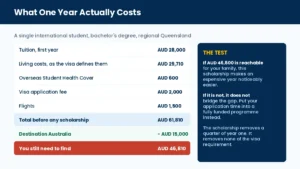
So a single international student starting a bachelor’s degree in regional Queensland faces something like this for year one:
| Item | Amount (AUD) |
|---|---|
| Tuition, first year | 28,000 |
| Living costs, as the visa defines them | 29,710 |
| Overseas Student Health Cover | 600 |
| Visa application fee | about 2,000 |
| Flights | 1,500 |
| Total before any scholarship | about 61,800 |
| Destination Australia | −15,000 |
| You still need | about 46,800 |
The scholarship removes a quarter of the first-year cost. It does not remove the visa requirement, because the visa assesses your access to funds separately and a scholarship letter covers only the amount it names.
This is the calculation that should decide whether you apply. If AUD 46,800 is reachable for your family, Destination Australia makes an expensive year noticeably easier. If it is not, the scholarship does not bridge the gap, and a fully funded program elsewhere deserves your application time instead.
The Regional Rule, Explained Properly
Destination Australia pays you to live in regional Australia, and it checks.
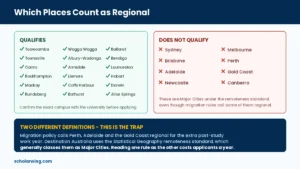
“Regional” here follows the Australian Statistical Geography Standard Remoteness Structure, which sorts the country into Major Cities, Inner Regional, Outer Regional, Remote and Very Remote. The scholarship covers everything except Major Cities.
A trap sits inside that sentence, and it catches people every year. Australian migration policy uses a different and much looser definition of regional, one that includes Perth, Adelaide, the Gold Coast, Newcastle, Wollongong and Canberra for purposes like the extra post-study work year. The remoteness standard used here generally classes those as Major Cities. A student who reads a migration blog and assumes Adelaide qualifies for Destination Australia has misread two different rules as one.
Places that do typically qualify include Toowoomba, Townsville, Cairns, Rockhampton, Mackay, Bundaberg, Wagga Wagga, Albury-Wodonga, Armidale, Lismore, Coffs Harbour, Ballarat, Bendigo, Launceston, Darwin and Alice Springs, along with the regional campuses that sit in or near them.
Never take that list, or any list, as your answer. Confirm the specific campus with the specific university before you apply, because the classification attaches to the location rather than to the university’s name.
The condition continues after you arrive. You must maintain residence in a regional area for as long as you hold the scholarship, and universities verify it before each payment. Expect to supply a rental agreement, a utility bill in your name or a statutory declaration every semester. Limited exemptions exist, usually for a required clinical placement, and they need written approval beforehand.
Move to Melbourne for a better job, defer your studies, withdraw, drop below full-time load or change your visa status, and the payments stop. The university reassesses eligibility at every instalment, and it does not pay in arrears for a semester you spent elsewhere.
Your Real Odds, Stated Plainly
This is where most guides go quiet, so here are the numbers.
The national pool runs at roughly AUD 19.5 million a year. At AUD 15,000 per student, that funds somewhere around 1,300 scholarships nationally and that total covers both domestic and international students across every participating provider in the country, from large regional universities down to small private colleges.
Spread across a hundred-odd providers and both student groups, the allocation per institution gets small quickly. Southern Cross University has advertised one Destination Australia scholarship for a specific veterinary degree at its Lismore campus. CQUniversity has advertised two for international students across four Queensland campuses.
Larger regional universities offer more, sometimes dozens. The point stands: this is not a program with thousands of international places waiting. At any single university your competition is measured against a handful of awards.
Some providers do not select on merit at all. Southern Cross has stated that its award goes to a qualified applicant chosen by computer-generated lottery. Read that sentence again, because it changes your strategy completely. Where a lottery decides the outcome, a perfect personal statement buys you nothing beyond eligibility, so you confirm you qualify, you apply, and you spend your remaining effort on applications where quality counts.
Other universities do assess properly, weighing academic record, a personal statement and sometimes socio-economic background. You need to know which system you face, and the scholarship page usually says so in one line that applicants skim past.
How to Apply, Step by Step
Step one: get admitted first. Nearly every provider requires an admission offer, or at least a current application, before it will consider you. The scholarship follows the offer rather than the other way round.
Step two: find the providers. Search for “Destination Australia” on the scholarship page of every regional university you are considering, and check the national scholarship search at studyaustralia.gov.au. The participating list changes between funding rounds, so a university that offered it two years ago may not offer it now.
Step three: read the specific terms. For each one, establish four things: the number of scholarships, the eligible courses, the selection method, and the deadline. Those four facts tell you whether an application is worth writing.
Step four: apply at the university. The application usually sits inside the university’s own scholarship system. Some universities consider every admitted student automatically; most require a separate form.
Step five: write the personal statement where one is required. Expect a question like “How would a Destination Australia Scholarship assist with your studies?” in about 500 words.
Writing the Personal Statement
The question looks simple, which is why most answers are weak. Applicants write about financial need in general terms and about how much they admire Australia. Neither answers the question the program is actually asking.
Remember what the government is buying. It wants students who will come to a regional town, stay in it, contribute to it, and possibly remain after graduating. Every strong statement answers that underlying question.
Say why this town, concretely. “I want to study agricultural science at Gatton because my family farms sixteen acres of sugarcane in Sindh and the water problems there look like the ones this department researches” beats any paragraph about Australia’s quality of education.
Show that you will stay. Mention the placement you want, the local industry you want to work in, the research group you want to join. Selectors have watched funded students leave for Sydney in year two.
Describe community contribution in specifics. If you tutored, volunteered, organized or coached, name what you did and for how long. Vague community-minded language convinces nobody.
Handle the money honestly and briefly. One or two sentences showing that you have realistically budgeted the rest of your costs reassures a selector far more than an account of hardship. They have seen funded students run out of money in semester two.
Cut everything that would read identically in another application. Draft it, then delete any sentence that could go to a different university unchanged. What survives is your actual statement.
The Benefit Nobody Puts in the Scholarship Listings
Studying in regional Australia carries a second financial advantage that dwarfs the scholarship itself over time, and almost no Destination Australia page mentions it.
Australia’s Temporary Graduate visa, subclass 485, lets international graduates work after they finish. Graduates who studied and lived in regional Australia can apply for a second 485 visa, which adds one or two extra years on top of the first.
The rules work on three categories of location.
Category 1
covers Sydney, Melbourne and Brisbane, and graduates who lived there get no extension.
Category 2
covers designated cities and major regional centers such as Perth, Adelaide, the Gold Coast, Newcastle, Wollongong and Canberra.
Category 3
covers the genuinely regional places and those are largely the same towns that qualify for Destination Australia.
A graduate who both studied and lived in a Category 3 area can qualify for two extra years of work rights. A Category 2 combination generally yields one. Tasmania has its own arrangement worth two years when study and residence both happened there.
Price that properly. Two additional years of full work rights in Australia is worth far more than AUD 15,000 a year in scholarship money, and it also widens the path towards permanent residence through regional skilled visas.
The rules change often, the categories run on postcodes rather than city names, and the Department of Home Affairs assesses every case individually. Confirm your postcode’s category before you build a plan around it. But when you weigh a regional campus against a city one, this belongs in the comparison alongside the scholarship.
Which Universities to Check
The participating list shifts between funding rounds, so treat any list as a starting point rather than an answer. These institutions run large regional campuses and have appeared in the program:
Queensland: CQUniversity across Rockhampton, Mackay, Bundaberg and Cairns; James Cook University in Townsville and Cairns; University of Southern Queensland in Toowoomba; University of the Sunshine Coast.
New South Wales: Charles Sturt University across Wagga Wagga, Bathurst, Albury-Wodonga and Orange; University of New England in Armidale; Southern Cross University in Lismore and Coffs Harbour.
Victoria: Federation University in Ballarat; La Trobe University’s Bendigo, Albury-Wodonga, Mildura and Shepparton campuses; Deakin’s Warrnambool presence.
Tasmania and the Territories: University of Tasmania, which combines the regional scholarship landscape with the state’s own 485 arrangement; Charles Darwin University in Darwin and Alice Springs.
Also worth checking: the regional campuses of large universities, such as UQ Gatton, Monash Gippsland and Sydney University’s rural clinical schools. These often attract fewer applications than the main campuses while qualifying on exactly the same remoteness rules.
TAFEs and private colleges with regional campuses participate too, and vocational pathways sometimes offer the easier route into the same towns at a fraction of the fee.
A Timeline That Works
Work backwards from a February semester start, which is when most Australian degrees begin.
Twelve months out, in February.
Decide the course and shortlist regional universities. Book your IELTS, TOEFL or PTE now, because retaking a test later compresses everything that follows.
Ten months out, in April.
Sit the English test. Request transcripts and have them certified, which takes longer in most countries than students expect.
Nine months out, in May.
Apply for admission. Australian universities process applications year-round and many decide within weeks, so an early offer gives you the scholarship window.
Seven months out, in July.
Accept your offer and start the scholarship applications. Check every shortlisted university’s Destination Australia page and write the deadlines in one place.
Six months out, in August.
Submit the scholarship applications. Write the personal statement once, then rewrite the town-specific paragraph for each university rather than sending an identical file everywhere.
Five months out, in September.
Arrange your proof of funds and gather the visa documents. The money needs to sit in an accessible account with a visible history, so moving it the week before you apply creates problems.
Four months out, in October.
Lodge the student visa. Processing varies widely by country and course, and a comfortable margin here protects everything else.
Two months out, in December.
Arrange accommodation. Regional rental markets are small, which cuts both ways cheap, but with few vacancies at once.
On arrival.
Open an Australian bank account immediately, because the scholarship pays into one and the first instalment arrives around week six.
Six Mistakes That Cost Students This Scholarship
Searching for a government application portal. None exists. Every week spent looking for one is a week not spent on university applications.
Confusing the two regional definitions. Adelaide and the Gold Coast count as regional for some migration benefits and generally do not for this program. Confirm the campus, not the city’s reputation.
Treating AUD 15,000 as a funded degree. It covers about a quarter of a first-year budget. Students arrive, run short by semester two, and withdraw.
Applying after the university deadline because the program is federal. The deadline belongs to the university, not to the government, and the dates differ widely between institutions.
Ignoring the ongoing residence condition. Moving to a capital city for work or a cheaper room ends the payments immediately.
Applying to one university only. With one or two awards per institution, a single application is a lottery ticket in the most literal sense.
Destination Australia Compared With the Alternatives
Australia Awards Scholarships are the fully funded Australian government option full tuition, return airfares, a living allowance, health cover and establishment support. They target developing countries with a development rationale and heavy competition, and recipients must return home for two years afterwards. If you qualify by nationality, Australia Awards is a far larger award than Destination Australia and deserves your application first.
Research Training Program scholarships fund doctoral and research master’s students at Australian universities, covering tuition and a living stipend. For a research candidate, these outweigh Destination Australia entirely.
Individual university scholarships at regional institutions frequently offer tuition discounts of 20% to 50%, which is worth more in absolute terms than AUD 15,000 at most fee levels. Apply for these alongside Destination Australia rather than instead of it, since the two often stack.
New Zealand charges lower fees and lower living costs than Australia, with a comparable post-study work pathway, and attracts fewer applicants.
The honest summary: Destination Australia suits a student who can largely fund an Australian degree already and wants a regional campus. It does not suit a student who needs a scholarship to make Australia possible at all. For that student, Australia Awards or a fully funded European programme is the better use of the same effort.
What Studying in Regional Australia Is Actually Like
Regional campuses run smaller than the city universities, and that changes the experience in ways the brochures understate.
Classes are small enough that lecturers know your name, which matters when you need a reference or a research place. Rent runs far below Sydney or Melbourne,a room in Toowoomba or Rockhampton costs a fraction of one in Sydney, which is the quiet reason the financial math’s works at all. Part-time work in regional towns is often easier to find than in the saturated city markets, especially in agriculture, hospitality, aged care and retail.
The trade-offs are real too. The international community is smaller, and students from large cities find the social scene limited at first. Public transport is thin, and in many regional towns a car becomes close to necessary. Specialist medical and administrative services sit further away. Distances between towns are long in a way that maps understate.
Students who thrive in regional Australia are usually those who arrived expecting a town rather than a city. Those who struggle are usually those who pictured Sydney with cheaper rent.
Frequently Asked Questions
Can international students apply for Destination Australia?
Yes. The program funds both domestic and international students, and each provider decides how to split its allocation between the two groups.
How do I apply to the Australian Government for it?
You do not. The government funds providers, and you apply to the university or college directly.
Does it cover tuition fees?
No. It pays AUD 15,000 a year towards your costs. A few universities attach their own tuition discount to the same award, from their own funds.
Is it enough for a student visa?
On its own, no. Australia requires proof of AUD 29,710 for living costs plus your first year of tuition, and the scholarship counts only for the amount it names.
Which places count as regional?
Everywhere outside Major Cities under the Australian Statistical Geography Standard Remoteness Structure. Confirm your specific campus with the university, because the migration definition of regional is looser and does not apply here.
What happens if I move to a capital city?
The payments stop. Universities verify your regional residence before each instalment.
How many scholarships exist?
Roughly 1,300 nationally across all providers and both student groups. Individual universities often offer one or two for international students.
Can I hold it alongside another scholarship?
Usually yes, especially a university tuition discount, but each provider sets its own rule. Ask before you accept.
Part of our complete guide to scholarships in Australia for international students — every major award compared.