
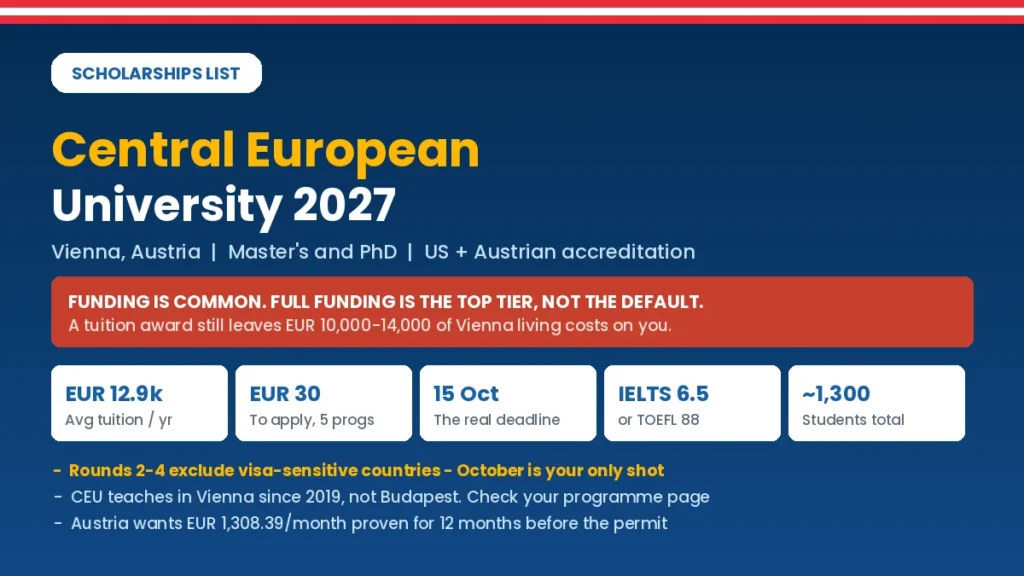
Central European University Scholarships
Central European University funds a larger share of its students than almost any university in Europe.
That sentence is true, and it is also the reason so many applicants arrive in Vienna underfunded.
CEU awards something to most admitted international students. It awards everything full tuition, a stipend, accommodation and medical insurance, to a much smaller group. The gap between those two sentences is where applicants get caught, because a tuition award with no stipend still leaves you to find €1,000 a month in one of Europe’s more expensive cities, and the Austrian immigration office asks you to prove that money twelve months in advance before it issues your residence permit.
This guide explains exactly what CEU funds, what the tiers are worth, which deadline actually matters for your passport, and what the whole year costs once the scholarship letter arrives. It also clears up the Hungary-or-Austria confusion, which trips up more applicants than any other single thing about this university.
Vienna or Budapest? Clearing Up the Confusion First
Search for CEU and you will find pages calling it a Hungarian university and pages calling it Austrian. Both are describing the same institution at different moments in its history.
George Soros founded CEU in Budapest in 1991, after communism fell across Central Europe. It built a reputation quickly in political science, philosophy, history, economics and public policy, and it taught entirely in English with an overwhelmingly international student body.
In 2017 Hungary passed a law known everywhere as “lex CEU” requiring foreign universities to operate a campus in their country of origin. CEU held a New York State charter but had no American campus, so the law made its US-accredited degrees impossible to deliver in Budapest. In December 2018 the university announced it would move the bulk of its operations to Vienna, and it did so in September 2019. The European Court of Justice later ruled the Hungarian legislation incompatible with EU law, in October 2020, but by then the move had happened.
What this means for you in 2027: CEU teaches in Vienna. That is where you will study, live and need a residence permit. A minority of Hungarian-accredited programmes and a research presence remain in Budapest, and a handful of joint arrangements still touch it, but an applicant planning a Master’s should assume Vienna unless a specific programme page says otherwise.
The accreditation is genuinely dual. CEU degrees carry accreditation from the Middle States Commission on Higher Education in the United States and from AQ Austria. For a graduate who later applies to jobs or doctorates in either region, that combination is unusually useful.
What CEU Actually Costs Before Aid
CEU charges the same tuition to every student regardless of nationality, which already separates it from most of Europe. There is no higher non-EU rate.
Tuition runs roughly €12,000 to €17,000 a year, averaging around €12,900, depending on the programme. Business, finance and data programmes sit at the top of that range, humanities and social sciences nearer the bottom.
On top of that, Vienna living costs run €850 to €1,200 a month for a student, which is €10,000 to €14,000 over an academic year once you include accommodation, food, transport and insurance.
So an unfunded year at CEU costs somewhere between €22,000 and €31,000. That is the number your funding has to work against, and it is why the difference between award tiers matters so much.
The Funding Tiers, Explained Honestly
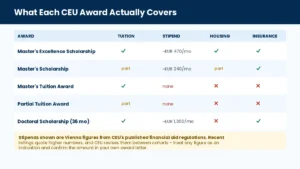
CEU’s financial aid splits into two families: scholarships, which include living support, and tuition awards, which do not. Reading the difference correctly is the single most useful thing in this guide.
CEU Master’s Excellence Scholarship
The top tier. It covers full tuition, provides medical insurance, includes accommodation in a single or shared room, and pays a monthly stipend. Published regulations have listed the Excellence stipend at around €470 a month on the Vienna campus, while more recent listings quote figures running up to €750. CEU revises these figures between cohorts, so treat any number you read anywhere including here as an indication and confirm it in your own award letter.
This is the award people mean when they call CEU “fully funded.” It goes to a minority of admitted students.
CEU Master’s Scholarship
The same structure, one step down. Full or partial tuition waiver, medical insurance, in some cases accommodation, and a smaller stipend published regulations have listed around €240 a month in Vienna.
Note that phrase: in some cases accommodation. Two students can both say truthfully that they hold a CEU Master’s Scholarship and have very different financial years.
CEU Master’s Tuition Award
Tuition only, at 100% or a partial rate. No stipend. No guaranteed accommodation, although recipients may request a dorm room where space allows and pay for it themselves.
This is the most common award, and it is the one that catches people. A full tuition award removes €12,900 from your costs, which is a serious benefit. It leaves roughly €10,000 to €14,000 of living costs entirely on you.
CEU Doctoral Scholarship
Doctoral funding is a different world. CEU funds doctoral students for up to 36 months with full tuition and a stipend that published regulations have listed around €1,300 a month in Vienna, rising for business and economics programmes, while recent listings quote figures above €2,000 gross. CEU does not automatically give doctoral students dorm accommodation, and most of them rent privately.
A funded CEU doctorate is a genuinely competitive position in European terms. The Master’s awards are good. The doctoral award is excellent.
The Deadline That Actually Decides Your Chances

CEU runs four application rounds, and they are not equal. This is the most important practical fact on this page.
| Round | Deadline | Financial aid? | Who may apply |
|---|---|---|---|
| Round 1 | 15 October 2026 | Yes | Everyone |
| Round 2 | 2 February 2027 | Yes | Excludes visa-sensitive countries |
| Round 3 | 15 April 2027 | No | Excludes visa-sensitive countries |
| Round 4 | 15 July 2027 | No | Visa-free entry only, space permitting |
Read that table twice.
Institutional financial aid decisions happen in the first two rounds only. Rounds 3 and 4 admit students who pay their own way.
More importantly, Rounds 2, 3 and 4 exclude applicants from countries CEU classifies as visa-sensitive, because the Austrian residence permit takes about 90 days and can take 180. If you hold a passport from Pakistan, Nigeria, Bangladesh, Afghanistan, Iran or a similar country, you should assume you have one deadline: 15 October. Miss it and your cycle is over, regardless of how strong your file is.
That single fact changes how you should plan. For an October deadline you need your IELTS or TOEFL booked by July, your referees asked in August, and your statement drafted in September. Working backwards from February, which is what most applicants do, puts you four months late before you start.
Who Gets the Full Scholarship
CEU decides financial aid alongside admission, using the same file. You do not submit a separate scholarship application; you indicate during the application that you want to be considered, and the department ranks you.
What moves you up that ranking:
Fit with the specific programme, stated precisely. CEU departments are small and research-driven. A statement of purpose naming two faculty members whose work connects to yours, with a reason, beats a statement praising the university’s international atmosphere. The reviewer is usually someone from that department.
Academic trajectory rather than a single number. A student whose grades climbed across a degree reads better than one who started strong and drifted. If something went wrong in one semester, explain it in one sentence and move on.
Evidence that you will finish. CEU’s Master’s programmes are intense, one or two years, with heavy reading. Anything showing you complete difficult things on time, a thesis, a published paper, a sustained job alongside study, carries weight.
Referees who taught you. Two letters, from academics who can describe your actual work. A letter from a famous professor who barely knows you is worth less than a detailed one from your thesis supervisor.
Nothing about financial need, unless asked. CEU’s awards run on merit. Describing hardship in a statement of purpose takes space away from the case that wins the award.
What the Application Actually Requires
The application runs online, costs €30, and that single fee covers up to five programmes in one cycle. Applying to two or three related programmes is sensible; applying to five unrelated ones tells the reader you have no clear direction.
You need:
- A bachelor’s degree, or proof you will hold one before enrolment. Two-year Master’s programmes require at least 180 ECTS, one-year programmes 240 ECTS.
- Official transcripts and your diploma, in English
- English proficiency: TOEFL iBT 88 or IELTS 6.5 as the usual minimums, or equivalent evidence
- A CV
- A statement of purpose, or a research proposal where the programme asks for one
- Two confidential letters of recommendation
- Optional GRE or GMAT scores, which help for the quantitative programmes and matter little elsewhere
If CEU admits you, expect a 14-day window to accept the study agreement and a registration fee of €500 for most programmes, rising to €1,000 for Social Data Science and €3,000 for Finance and Business Analytics. Budget for that deposit, because it falls due months before any stipend starts.
The Austrian Residence Permit, and Why Your Stipend Does Not Cover It
Here is the part that surprises funded students, and almost no guide mentions it.
Austria requires a student residence permit, and the permit requires proof of funds for twelve months in advance:
- Under 24: €722.58 per month
- 24 and over: €1,308.39 per month
For a 25-year-old, that means showing roughly €15,700 in an accessible account.
A confirmed CEU scholarship counts towards this proof, and a full Excellence award with accommodation goes a long way. A stipend of €240 or €470 a month does not reach €1,308. The authority will expect you to cover the gap from savings or a sponsor’s account, with bank statements.
Processing takes about 90 days, and the authority can take another 90 if it asks for more documents. Apply as soon as your admission letter arrives, not when the semester approaches. This is the real reason CEU closes later rounds to visa-sensitive countries, the university has watched admitted students miss the start of term waiting for permits.
Which CEU Departments Are Worth Targeting
CEU is small, so its reputation does not spread evenly across subjects. In global subject rankings the university sits highest in political science, where it has placed around 45th in the world, and in philosophy and history, both in the 51–100 band. Overall it sits in the mid-200s, which tells you something useful: CEU punches far above its size in a few fields and sits at a reasonable level elsewhere.
That distribution should shape where you apply.
Political Science, International Relations and Public Policy
form the university’s core. Graduates move into the UN system, the EU institutions, think tanks and doctoral programmes across Europe and North America. If your target is policy work in an international organization, this is the strongest reason to choose CEU over a cheaper Central European university.
Philosophy, History and Medieval Studies
carry real weight for doctoral admission. CEU’s medieval studies department in particular has a long reputation disproportionate to its size.
Economics and Business
sit in the School of Public Policy and the business school. Finance and Business Analytics charge the highest registration deposits and attract the most career-focused cohort.
Environmental Sciences and Policy
connects to the MESPOM joint programme, which runs across several European universities and brings Erasmus Mundus funding into the picture.
Cognitive Science, Network Science and Social Data Science
are the newer quantitative programmes. They recruit actively, they fund reasonably, and they receive fewer applications than the flagship social science departments do.
Gender Studies
deserves a specific note. CEU’s department pioneered the field in the region, and Hungary’s 2018 decision to strip accreditation from gender studies programmes made CEU’s continuation of it a matter of public record. The programme now runs from Vienna.
A practical read: if your subject is one of the three ranked fields, CEU competes with far more expensive universities and often wins. If your subject sits outside them, weigh the fee against a public university in Vienna or Prague before committing.
How to Write the CEU Statement of Purpose
The statement decides both your admission and your funding, because the department reads one file for both. Most applicants waste it.
The common failure looks like this: a first paragraph about a childhood fascination, a second praising CEU’s diversity and international atmosphere, a third listing grades the reader already has on the transcript, and a closing promise to contribute to the university community. Nothing in it tells the department why this person belongs in this programme.
A statement that earns funding does four things in about 800 to 1,000 words.
It opens with the question you want to work on.
Not a field, a question. “Why do anti-corruption agencies in hybrid regimes survive their founding governments?” tells a reader more in one line than three paragraphs of background.
It shows where that question came from in your own work.
A thesis, a job, a dataset you built, an argument you lost. This is the paragraph that separates a real candidate from a well-written application.
It names two faculty members and says why.
Read their recent work first, not their biography page. One specific sentence about a paper, what it argued, where your question meets it proves more than a paragraph of admiration.
It states what you intend to do afterwards, plainly.
Doctoral study, policy work, a return to a specific institution at home. Reviewers fund students whose plans make the degree look like a step rather than a destination.
What to leave out: your financial situation, unless a form asks; your admiration for Vienna; adjectives about CEU; and any sentence that would read identically in an application to a different university. The last test is the most useful one. Read your draft and cross out every sentence that could go to another university unchanged. If more than a third survives, you have not written a CEU statement yet.
A Realistic Budget for One CEU Year
Work this out before you apply, not after an offer arrives. The numbers below describe a Vienna academic year.
If you hold a full Excellence award with accommodation: tuition covered, insurance covered, housing covered, and a stipend of a few hundred euros a month against food, transport and the rest. You will likely add €150 to €300 a month from your own funds. A year costs you roughly €1,500 to €3,000 plus flights and the registration deposit.
If you hold a Master’s Scholarship with partial tuition and no housing: you cover rent at €400 to €700 a month, food, transport and whatever tuition remains. Budget €10,000 to €14,000 for the year, minus the stipend.
If you hold a full tuition award only: tuition disappears, living costs do not. Budget €10,000 to €14,000 for the year, entirely from your own resources.
If you hold a partial tuition award: add the remaining fee to the figure above. This is the combination that most often ends with a student declining a place, and the earlier you model it, the less painful that decision becomes.
Against all four, remember the registration deposit of €500 to €3,000 within fourteen days of acceptance, flights, the visa fee, and the residence permit proof of funds. The proof is not a payment, the money stays yours, but it must sit in an accessible account, and that requirement defeats more admitted students than tuition ever does.
Six Mistakes That Cost Applicants CEU Funding
Planning around the February deadline. For most South Asian and African passports, February is closed. October is the deadline. Applicants discover this in November.
Reading “tuition award” as “fully funded.” The two phrases describe very different years. Check which award your letter names before you book a flight.
Writing a general statement of purpose. CEU departments are small, and the person reading your file often works in the area you are applying to. Specificity is the whole game.
Applying to five unrelated programmes to improve the odds. One fee covers five applications, which tempts people. Five scattered applications read as indecision, and the departments see the same file.
Ignoring the registration fee. €500, or €3,000 for Finance, falls due within days of acceptance. Several admitted students lose places over this every year.
Treating the Hungary question as settled by a blog post. Confirm the campus on the programme page itself. Teaching location affects your visa, your rent and your residence permit.
CEU Compared With the Alternatives
Stipendium Hungaricum funds full degrees in Hungary for dozens of partner countries, covering tuition, a monthly stipend and accommodation, with no tuition charged at all. It reaches more students than CEU does and asks less of them financially. CEU wins decisively on international reputation and on the US-plus-Austrian accreditation, and its graduates place better in international organizations and doctoral programmes.
Austrian OeAD grants fund research stays of one to nine months rather than degrees. If you want a funded Master’s in Austria, CEU is a far more direct route than the government programmes.
Erasmus Mundus Joint Masters fund more generously than a CEU Master’s Scholarship, cover travel and installation costs, and move you between countries. Competition is heavier, and CEU participates in several of them, so these routes overlap rather than compete.
Central European alternatives The University of Vienna, Charles University in Prague, the University of Warsaw charge far less tuition but fund international students much more thinly. For a self-funding student they often cost less overall than CEU with a partial award.
The honest summary: apply to CEU if your work fits a small research-driven department and you want a degree recognised in both the United States and Europe. Apply to Stipendium Hungaricum alongside it if your finances need a full package rather than a likely one.
What Studying at CEU Is Actually Like
The student body is extraordinarily international CEU has repeatedly ranked among the most international universities in the world, with the large majority of its roughly 1,300 to 1,400 students coming from outside the host country. A seminar of twelve people routinely holds ten nationalities.
That size cuts both ways. Departments are small enough that faculty know your name and your thesis topic, which is rare at this level and genuinely valuable. The same smallness means fewer course options than a large university offers, and a narrow programme can feel narrow by the second semester.
The workload is heavy and front-loaded with reading. Students arriving from systems built on final examinations find the continuous assessment demanding in the first term.
Vienna itself is comfortable, well-connected and expensive. Public transport is excellent, the semester ticket is cheap, and the city consistently ranks near the top of global livability surveys. Housing is the pressure point: start looking the week you accept your place, not the month you arrive.
Frequently Asked Questions
Is CEU in Hungary or Austria?
Austria. CEU teaches in Vienna, having moved the bulk of operations there in 2019. A minority of Hungarian-accredited programmes and a research presence remain in Budapest.
Is CEU fully funded?
Partly. CEU awards funding to most admitted international students, but full funding tuition, stipend, accommodation and insurance is the top tier rather than the standard offer.
Can Pakistani, Indian, Nigerian or Bangladeshi students apply?
Yes, and the application is open to everyone in Round 1. Later rounds exclude visa-sensitive countries, so applicants from these countries should treat the October deadline as their only one.
Do I need a separate scholarship application?
No. CEU decides financial aid alongside admission, from the same file. You indicate that you want to be considered when you apply.
What English score do I need?
TOEFL iBT 88 or IELTS 6.5 are the usual minimums, with equivalents accepted.
What does it cost to apply?
€30, covering up to five programmes.
How much is tuition without aid?
Roughly €12,000 to €17,000 a year depending on the programme, charged at the same rate to all nationalities.
Is a CEU degree recognised internationally?
Yes. Degrees carry both US accreditation through the Middle States Commission and Austrian accreditation through AQ Austria.