
Mastercard-ALU Scholarship
The Mastercard-ALU Scholarship Has Two Intake Deadlines — And the January 2027 Window Is Still Open
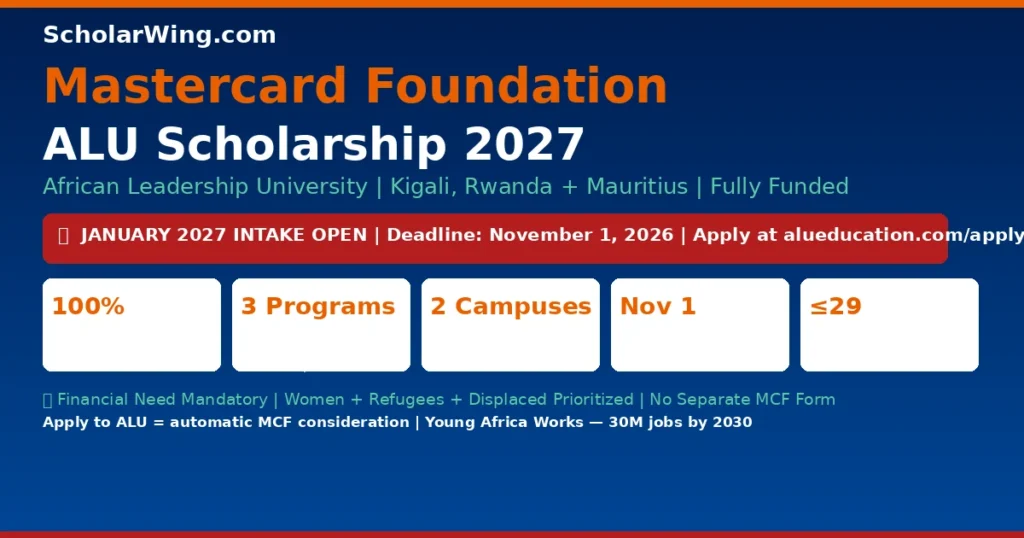
The Mastercard Foundation Scholars Program at the African Leadership University (ALU) operates on a two-intake model unlike most scholarships with a single annual deadline. Understanding this changes how you plan your application.
For the September 2026 intake, applications close on July 1, 2026. The January 2027 intake is also available, with applications closing on November 1, 2026.
As of September 2026, the January 2027 intake deadline is November 1, 2026. If you missed the September intake, you have weeks to apply for January.
The Mastercard Foundation Scholars Program at the African Leadership University (ALU) provides fully funded scholarships for talented young Africans who would otherwise be unable to access higher education due to financial constraints. Launched in 2020 as part of the Mastercard Foundation’s Young Africa Works initiative, the ALU-Mastercard partnership aims to deliver dignified employment to millions of young Africans by 2030.
Before anything else: the ALU-Mastercard scholarship is not applied for separately. It is automatic.
Eligible applicants are automatically considered for the Mastercard Foundation Scholars Program once they apply for admission to ALU. There is no separate MCF scholarship application form.
Apply to ALU. If you are eligible and demonstrate financial need, you are considered for the Mastercard Foundation scholarship as part of that process. One application, two outcomes determined simultaneously.
Who Is ALU — Africa’s Most Distinctive University
The African Leadership University (ALU) is not a conventional university. Founded in 2015 by Ghanaian entrepreneur Fred Swankier, ALU is built on a fundamentally different philosophy about what university education should do, especially for Africa.
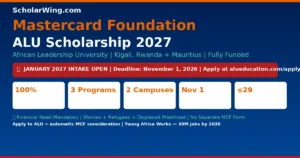
ALU’s unique, student-centered learning model emphasizes real-world problem-solving, practical skill development, and purpose-driven mindsets, diverging from traditional academics to foster ethical, entrepreneurial leaders who address continental challenges.
Fred Swankier is the founder of the African Leadership Group, an ecosystem that includes:
- African Leadership Academy (ALA) — Johannesburg, South Africa (pre-university leadership program)
- African Leadership University (ALU) — Kigali, Rwanda + Pamplemousses, Mauritius
- ALX Africa — Africa’s largest tech talent training platform
- Sand Technologies — AI and data company built to create African tech jobs
Swaniker’s stated mission: train 3 million African leaders by 2035. His argument is simple, Africa’s development challenges will not be solved by foreign experts, governments alone, or aid. They will be solved by a generation of African entrepreneurs, technologists, and civic leaders who understand African contexts and are deeply committed to the continent.
ALU is the higher education component of this vision.
ALU’s learning model: Traditional universities teach content through lectures, assignments, and exams. ALU teaches through “Missions” real-world projects tied to African challenges and “Quests” structured learning experiences that build specific skills. Students work on actual problems from their first week. There are no traditional academic departments in the conventional sense. The curriculum is integrated, interdisciplinary, and practically oriented.
This model is not for every student. It requires high self-direction, comfort with ambiguity, and genuine motivation to work on real problems. Students who want a conventional lecture-and-exam experience will find ALU disorienting. Students who want to build, create, lead, and solve within an intensely collaborative community find ALU transformative.
Two Campuses — Rwanda and Mauritius
Campus 1: Kigali, Rwanda Rwanda’s capital city, one of Africa’s fastest-growing economies and arguably its best-governed state. Kigali is clean, safe, and technologically connected. Rwanda has become a major hub for African innovation and business. The ALU Kigali campus is the flagship most MCF scholars are placed here.
Campus 2: Pamplemousses, Mauritius A secondary campus on the Indian Ocean island nation of Mauritius, one of Africa’s highest-income countries and a financial hub. The Mauritius campus has a stronger international finance and business focus.
Three Bachelor’s Programs — What You Can Study
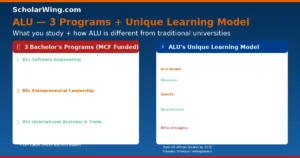
ALU currently lists three main bachelor’s degree programs: BSc (Hons) Software Engineering, BSc (Hons) Entrepreneurial Leadership, and BSc (Hons) International Business and Trade.
Program 1: BSc (Hons) Software Engineering
Building the technical skills to develop software solutions for Africa’s most pressing problems. Coding, product development, systems thinking, and the entrepreneurial mindset to build tech startups. Africa’s tech sector is one of its fastest-growing, Nigerian fintech, Kenyan agritech, South African insurtech, and this program trains the engineers who will build the next wave.
Program 2: BSc (Hons) Entrepreneurial Leadership
Entrepreneurial Leadership is a strong choice for students who want to become ethical leaders, founders, community builders, business problem-solvers, or social innovators.
ALU’s signature program, building the next generation of African entrepreneurs and civic leaders. Combines business fundamentals, leadership theory, design thinking, and practical project work. Not a traditional business degree, deeply integrated with leadership development and African context.
Program 3: BSc (Hons) International Business and Trade
Africa’s integration into global trade flows, intra-African trade under the African Continental Free Trade Area (AfCFTA), and international business strategy. Particularly relevant as AfCFTA reshapes the continent’s economic landscape.
Full Financial Package — What Mastercard Covers
The Mastercard Foundation Scholars Program provides fully funded scholarships for talented young Africans who would otherwise be unable to access higher education due to financial constraints. The scholarship covers all costs necessary for study.
Complete Coverage:
| Benefit | Detail |
|---|---|
| Tuition | 100% — all academic fees |
| Accommodation | On-campus housing covered |
| Meals | Food costs covered |
| Monthly stipend | Living allowance |
| Travel/airfare | To and from campus |
| Health insurance | Medical coverage |
| Academic materials | Books, technology, equipment |
The scholarship is designed to remove ALL financial barriers, not just tuition. A student from a low-income family in Malawi, Nigeria, or Tanzania should be able to attend ALU without any financial burden beyond what the scholarship covers.
Eligibility — Financial Need Is Central
Launched in 2020 as part of the Mastercard Foundation’s Young Africa Works initiative, the target group is African youth (≤29 years), with financial need; emphasis on young women, refugees, displaced persons, and students with disabilities.
Core Requirements:
1. African National — Sub-Saharan Africa Priority You must be a resident and citizen of a Sub-Saharan African country whose personal circumstances would make accepting an offer from ALU difficult.
Sub-Saharan Africa is the primary target. Applications from Malawi, Nigeria, Rwanda, Tanzania, Zimbabwe, and other African countries are particularly welcome.
2. Financial Need — Mandatory This is not a merit-only scholarship. Financial need is a core eligibility criterion. The scholarship specifically targets students from economically disadvantaged backgrounds, those who could not otherwise afford university education.
3. Age: Under 29 years
4. Meet ALU Minimum Admission Requirements Academic eligibility for the chosen bachelor’s program. ALU’s admissions are holistic, they look at potential, motivation, and character as much as grades.
5. Priority Groups:
- Women — the Young Africa Works strategy targets 30 million jobs primarily for young women
- Refugees and displaced persons — explicitly eligible and welcomed
- Students with disabilities — explicitly welcomed
- Students from conflict-affected and fragile states
Application Process — One Application Serves Both
Apply for admission to ALU via the specified intake cycle. Eligible applicants are automatically considered for the Mastercard Foundation Scholars Program. Submit all required documents before the intake deadline.
Step-by-Step:
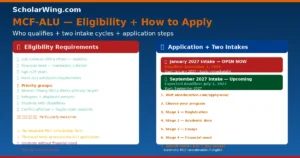
Step 1: Choose your intake cycle
- January 2027 intake: Deadline November 1, 2026 ← still open!
- September 2027 intake: Deadline expected July 1, 2027
Step 2: Choose your program BSc Software Engineering, BSc Entrepreneurial Leadership, or BSc International Business and Trade. Choose what genuinely matches your interests and career vision.
Step 3: Complete ALU application
The first step includes registration and basic personal information such as date of birth, country of birth, nationality, residence, gender, phone number, and high school details.
The ALU application has multiple stages:
- Stage 1: Registration + basic personal information
- Stage 2: Academic background + documents
- Stage 3: Personal essays + motivation
- Stage 4: References and additional materials
Step 4: Demonstrate financial need As part of the application, you will provide information about your financial situation. This information is used to determine MCF scholarship eligibility.
Step 5: Upload all documents before November 1, 2026 (January intake)
Step 6: Receive admissions decision + scholarship notification If admitted and determined financially eligible, you receive both the offer of admission and the MCF scholarship notification together.
Apply at: alueducation.com/apply-now/
The Broader Mastercard Foundation Scholars Program
Important context: The MCF Scholars Program at ALU is one component of a much larger initiative.
The Mastercard Foundation Scholars Program enables outstanding African students to undertake degrees at one of the world’s top universities much more than a scholarship, the program helps young people fulfil their academic potential and lays the foundations for a meaningful, fulfilling career.
The Mastercard Foundation partners with 50+ universities globally for this program including the University of Cambridge, University of Toronto, UBC, McGill, University of Cape Town, USIU-Africa (Nairobi), University of Ghana, and many more. Each partnership has its own eligibility criteria, deadlines, and focus areas.
If you are eligible for the ALU program but also interested in postgraduate study, the MCF Scholars Program at Cambridge, UCT, or other partner universities may be more relevant, they operate separately with different requirements.
Quick Reference
| Element | Detail |
|---|---|
| Program | Mastercard Foundation Scholars Program at ALU |
| Partner | Mastercard Foundation + African Leadership University |
| Campuses | Kigali, Rwanda + Pamplemousses, Mauritius |
| Level | Undergraduate (Bachelor’s) primarily |
| Programs | Software Engineering |
| Coverage | Full tuition + accommodation + meals + stipend + travel + health |
| Countries | Sub-Saharan Africa (primary) |
| Financial need | Mandatory |
| Age | ≤29 years |
| Priority | Women + refugees + displaced + disabilities |
| Application | To ALU — automatic MCF consideration |
| No separate MCF form | MCF assessed as part of ALU admission |
| January 2027 deadline | November 1, 2026 |
| September 2027 deadline | July 1, 2027 (expected) |
| Apply at | alueducation.com/apply-now/ |
| Launched | 2020 |
| Strategy | Young Africa Works — 30M jobs by 2030 |
FAQ
What does the scholarship cover?
Full tuition, accommodation, meals, stipend, travel, and health insurance, all costs necessary for study.
Do I apply separately for the MCF scholarship?
No, eligible applicants are automatically considered for the Mastercard Foundation Scholars Program once they apply for admission to ALU.
When is the January 2027 deadline?
November 1, 2026.
Which countries are eligible?
Sub-Saharan African citizens and residents. Applications from Malawi, Nigeria, Rwanda, Tanzania, Zimbabwe and other African countries are particularly welcome. Refugees and displaced persons are explicitly eligible.
Is financial need required?
Yes, The target group is African youth with financial need. This is not a merit-only scholarship.
What programs are available?
BSc (Hons) Software Engineering, BSc (Hons) Entrepreneurial Leadership, and BSc (Hons) International Business and Trade.
Is the MCF Scholars Program only at ALU?
No, the MCF Scholars Program operates at 50+ universities globally. ALU is one partner institution. Cambridge, UCT, U of Toronto, and others are separate MCF partnerships with different requirements.