
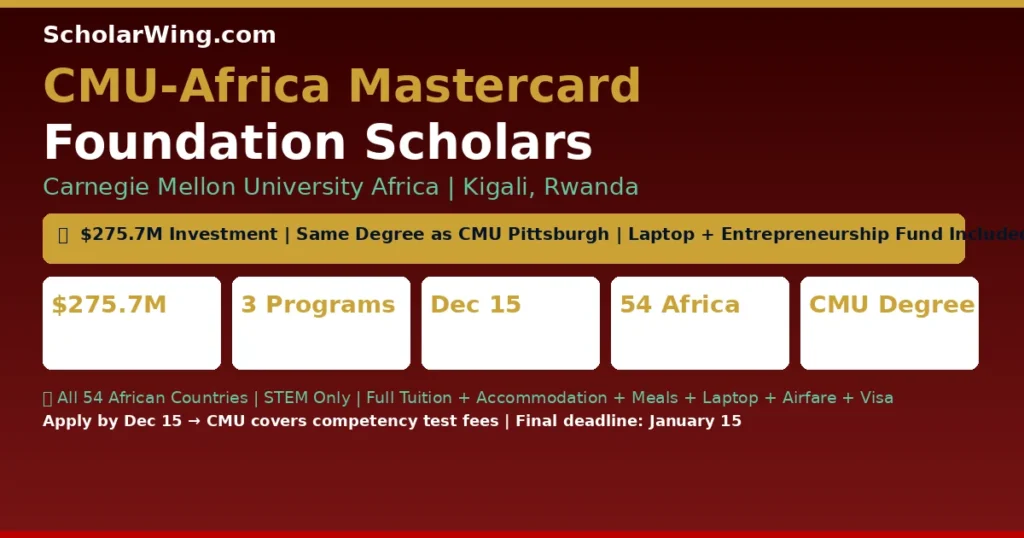
The Carnegie Mellon Degree You Earn in Kigali Is Identical to the One Earned in Pittsburgh
Carnegie Mellon University is consistently ranked among the world’s top five universities for engineering, computer science, and technology. Its Pittsburgh, Pennsylvania campus is a global reference point for technical excellence, producing alumni who lead Google, NASA, Tesla, and the world’s most consequential technology organizations.
In 2011, Carnegie Mellon established CMU-Africa in Kigali, Rwanda. In 2016, the Mastercard Foundation joined as a scholarship partner. And In September 2022, the partnership was transformed into something unprecedented:
Carnegie Mellon University and the Mastercard Foundation, in collaboration with the Government of Rwanda, announced a $275.7 million partnership, including a $175 million endowment to perpetually fund CMU-Africa and $100.7 million to establish CMU-Africa’s Center for the Inclusive Digital Transformation of Africa.
$275.7 million invested in African engineering and technology education, the largest single investment of its kind in African higher education history.
CMU-Africa offers graduate degrees in information technology, electrical and computer engineering, and engineering artificial intelligence through Carnegie Mellon’s top-ranked College of Engineering, with the same standards, curricula, and requirements as its Pittsburgh campus.
The degree is the same. The curriculum is the same. The standards are the same. A student who graduates from CMU-Africa in Kigali holds an identical Carnegie Mellon University degree to a student who graduates from CMU Pittsburgh. That degree is recognized and valued everywhere in the world that Carnegie Mellon’s name carries weight, which is everywhere.
The Mastercard Foundation Scholars Program at CMU-Africa supports highly talented, service-oriented young people who face the highest social and economic barriers to opportunity. The graduate students complete their Master of Science degrees in Information Technology, Electrical and Computer Engineering, or Engineering Artificial Intelligence.
The CMU-Africa Mastercard Foundation Scholars Program is one of the most distinctively valuable scholarships in this entire guide because it combines one of the world’s most respected degrees with the most comprehensive scholarship support package available to African students.
What Is CMU-Africa — The Institution
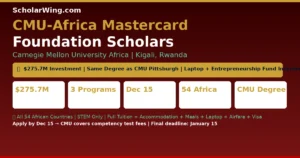
In 2011, upon the invitation of the Government of Rwanda, Carnegie Mellon and the Government of Rwanda signed an agreement to establish a new CMU location in Kigali, Rwanda. This ambitious and innovative partnership was designed to respond to the critical shortage of high-quality engineering talent required to harness Africa’s tremendous potential as home to the fastest-growing workforce in the world. CMU-Africa, located in Kigali Innovation City, is a regional ICT center of excellence educating a diverse composition of future leaders from all over Africa, who will use their hands-on skills and knowledge to advance technology innovation and grow businesses.
CMU-Africa key facts:
- Location: Kigali Innovation City, Kigali, Rwanda
- Established: 2011 — CMU + Government of Rwanda
- By spring 2022: 230+ enrolled students from 21+ African countries
- Scholars connected: 561 young people from 21 African countries (by spring 2022)
- Mastercard Foundation partnership: Established 2016 — expanded to $275.7M in September 2022
- Degree awarded: Carnegie Mellon University degree — identical to Pittsburgh campus
- Part of: Afretec — network of 10 African universities driving digital transformation
CMU-Africa’s vision is to educate and empower the next generation of African leaders and innovators by delivering a world-class educational experience. Our mission is to produce creative and technically strong engineers, who have been trained in the African context and prepared to make a transformative impact in their communities and the world.
The Three Programs — STEM Only
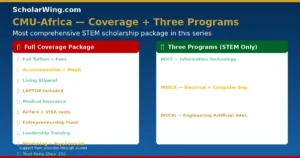
The CMU-Africa Mastercard Foundation Scholars Program funds graduate study in three specific Master of Science programs only. This is not a humanities, social sciences, or business scholarship. It is specifically designed to build Africa’s technology and engineering leadership.
Program 1: Master of Science in Information Technology (MSIT)
Focus areas: Software engineering, cybersecurity, mobile and cloud computing, data science, systems engineering.
CMU’s information technology programs are globally recognized. Graduates work at leading African tech startups, multinational technology companies, and government technology agencies.
Program 2: Master of Science in Electrical and Computer Engineering (MSECE)
Focus areas: Hardware systems, embedded systems, circuit design, communications, robotics, signal processing, computer architecture.
Engineering Africa’s physical technology infrastructure, from mobile networks to power systems to manufacturing automation.
Program 3: Master of Science in Engineering Artificial Intelligence (MSEAI)
Focus areas: Machine learning, deep learning, natural language processing, computer vision, AI systems design, human-AI interaction.
Graduate students complete their Master of Science degrees in Information Technology, Electrical and Computer Engineering, or Engineering Artificial Intelligence.
The MSEAI is particularly significant Carnegie Mellon pioneered artificial intelligence as an academic discipline, and CMU’s AI programs are globally ranked #1 or #2 consistently. An MSEAI from CMU-Africa positions African graduates at the frontier of AI development directly relevant to Africa’s technology transformation.
Who these programs are for:
- Computer science, engineering, IT undergraduate graduates
- Students with strong mathematics and quantitative backgrounds
- Professionals in technology, engineering, or related fields (some experience helps but is not always required)
- Those committed to using technology for African development
Who these programs are NOT for:
- Students in humanities, social sciences, law, medicine, or business without quantitative background
- Students without a foundation in mathematics, computing, or engineering
What the CMU-Africa Scholarship Covers — The Most Comprehensive Package
The scholarship offers comprehensive, fully funded support, including: Full tuition and academic fees. Accommodation and meals. Living stipend. Laptop and learning materials. Medical insurance. Airfare and visa costs. Career and leadership development training. Entrepreneurship and project funding support. Mentorship, counseling, and psychosocial support. Disability-inclusive support (where needed).
This is the most comprehensive scholarship package in this entire series. Let’s break down what makes it exceptional:
Standard Benefits (Shared with Other Scholarships):
Full tuition and academic fees — 100% covered for the entire degree.
Medical insurance — healthcare coverage throughout the program.
Accommodation and meals — living arrangements and food covered. This is more comprehensive than most scholarships that provide only a living stipend and expect you to arrange your own accommodation.
Living stipend — additional monthly allowance for personal expenses.
Unique Benefits (Not Available at Most Other Scholarships):
Laptop and learning materials Laptop and learning materials included. A laptop is provided essential for engineering and computer science study. Most scholarships assume you already own a computer or provide a supplement; CMU-Africa provides the device directly.
Airfare AND visa costs Airfare and visa costs covered. Both the flight to Rwanda AND the visa fees. In previous guides, some scholarships cover travel but not visa costs; some cover neither. CMU-Africa covers both.
Entrepreneurship and project funding support This is CMU-Africa’s most distinctive benefit. Holistic support includes project and entrepreneurship support. Scholars receive access to entrepreneurship mentoring and can apply for project funding enabling them to develop technology ventures, social enterprises, or research projects during their studies. This transforms the scholarship from an education grant into a potential startup launching pad.
Application preparation support The scholarship covers application preparation support. Even before you are selected, CMU-Africa provides support for the application process itself.
Orientation support When scholars arrive in Rwanda, orientation support is provided helping international students adapt to Kigali’s environment, CMU-Africa’s campus culture, and Rwanda’s broader context.
The $275.7 Million Investment — What It Means
The new initiative builds on a previous partnership between the Mastercard Foundation and Carnegie Mellon University, as well as a successful 10-year partnership between the Government of Rwanda and CMU-Africa that has connected 561 young people from 21 African countries to world-class training including 125 students supported through the Mastercard Foundation Scholars Program.
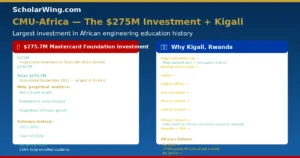
This investment from the Mastercard Foundation includes a $175 million endowment to perpetually fund CMU-Africa. It also includes $100.7 million to establish CMU-Africa’s Center for the Inclusive Digital Transformation of Africa (CIDA).
What the $175 million endowment means: The word “perpetually” is significant. This is not a 5-year or 10-year program with an uncertain future. The $175M endowment is designed to generate interest income that funds CMU-Africa’s operations permanently regardless of what happens to external grant funding or Mastercard Foundation priorities in future years. CMU-Africa’s existence is secured.
What the $100.7 million Center for Inclusive Digital Transformation of Africa (CIDA) means: This center focuses on research and entrepreneurship ensuring CMU-Africa is not just a teaching institution but a research and innovation engine for Africa’s digital economy.
The broader context: Africa has the youngest and fastest-growing population in the world. By 2030, there will be 375 million young people in the job market in Africa, and that number is expected to grow to more than a billion people within the next few decades.
The $275.7 million investment is a bet on that population that Africa’s young people, given world-class technical education and the support to succeed, will build the digital economy that Africa needs.
Eligibility — Who Can Apply
1. African Citizen — All 54 Countries All African countries are eligible. Every citizen of every African country is eligible for the scholarship.
2. Social and Economic Barriers to Higher Education The program supports highly talented, service-oriented young people who face the highest social and economic barriers to opportunity. Financial need is central, this scholarship is designed for students who could not otherwise access a CMU education.
3. Academic Excellence in Technical Field Strong undergraduate record in computer science, engineering, mathematics, information technology, or related technical fields. CMU-Africa’s programs are rigorous academic preparation matters.
4. Leadership and Service Commitment Candidates should have a proven record of contributing positively to their communities and a desire to continue making a meaningful impact. Applicants must demonstrate leadership abilities and the potential to become role models, mentors, innovators, and change-makers in their societies.
5. Admission to a CMU-Africa Program To be considered for the Mastercard Foundation Scholars Program, applicants must first gain admission into one of CMU-Africa’s degree programs.
You cannot apply for the scholarship independently of the degree program admission. The admission process is the gateway.
6. Scholarship Not Currently Held Cannot simultaneously hold another scholarship.
Application Process — Two Deadlines
Early admission deadline: December 15 for test-fee coverage. Final deadline: January 15.
Why December 15 matters: Submit your application by the early admission deadline of December 15 so that CMU-Africa will cover your competency test fees.
The application process includes competency tests, English proficiency and potentially other assessments. These tests have fees. If you submit your CMU-Africa application by December 15, CMU-Africa pays those test fees on your behalf. If you submit after December 15 (but before January 15), you pay the test fees yourself.
Full application timeline:
| Action | When |
|---|---|
| Research CMU-Africa programs (MSIT/MSECE/MSEAI) | October-November |
| Prepare application materials | October-November |
| Submit CMU-Africa application — indicate MCF Scholars interest | By December 15 (early) |
| CMU-Africa covers competency test fees (if applied by Dec 15) | December |
| Final deadline (if missed December 15) | January 15 |
| Competency tests (English + other) | January-February |
| Admission and scholarship decisions | March-May |
| Studies begin | September |
How to apply:
Step 1: Visit africa.engineering.cmu.edu — review the three programs and identify which aligns with your background.
2: Apply for admission to your chosen CMU-Africa program through the official CMU application portal.
3: During the application, indicate your interest in being considered for the Mastercard Foundation Scholars Program.
Step 4: Complete all required supporting materials:
- Academic transcripts (all previous degrees)
- Statement of purpose (why this program, what impact will you make)
- Letters of recommendation (typically 2-3 academic or professional)
- CV
- English proficiency proof (TOEFL/IELTS — or CMU-Africa covers the test if you apply by Dec 15)
- Evidence of financial need
- Leadership and community engagement documentation
Kigali — Why Rwanda
CMU-Africa is not located in a traditional African scholarship destination like Cairo, Accra, or Nairobi. It is in Kigali, Rwanda and this choice is significant.
Rwanda has undergone one of the most remarkable national transformations in history from the catastrophe of the 1994 genocide to a stable, growing, technology-focused economy. The Government of Rwanda’s Vision 2050 explicitly targets becoming a knowledge-based economy, and the partnership with Carnegie Mellon is one of its flagship investments.
Kigali Innovation City: CMU-Africa is located within Kigali Innovation City Rwanda’s purpose-built technology and innovation district, designed to attract global technology companies, startups, and research institutions. Studying at CMU-Africa means being embedded in Africa’s most ambitious technology ecosystem.
Rwanda’s advantages for African students:
- One of Africa’s safest and cleanest cities
- English and Kinyarwanda are official languages (French is secondary)
- Pro-business, low-corruption regulatory environment
- Strong internet infrastructure
- Growing startup ecosystem with connections to global venture capital
- Central African location — accessible from East, West, Central, and Southern Africa
Afretec: CMU-Africa is the leader of Afretec, a network of ten African universities driving digital transformation across the continent. Being at CMU-Africa means connecting to this 10-university pan-African research network.
CMU-Africa vs Standard Mastercard Foundation Guide
The previous guide in this series covered the broader Mastercard Foundation Scholars Program 62+ partner universities including Cambridge, Sciences Po, Berkeley, and Makerere. CMU-Africa is one of those partners but deserves its own guide because of its distinctive profile.
| Feature | CMU-Africa | Other MCF Partners |
|---|---|---|
| Fields | STEM ONLY (IT/ECE/AI) | All fields (humanities, medicine, business, law) |
| Location | Kigali, Rwanda | Africa + global |
| Degree quality | CMU Pittsburgh equivalent | Partner institution quality varies |
| Investment | $275.7M (perpetual) | Program-by-program |
| Laptop | ✅ Included | ❌ Usually not |
| Entrepreneurship fund | ✅ Included | ❌ Rarely included |
| Visa costs | ✅ Covered | Varies |
| Test fees | Covered if Dec 15 deadline met | Varies |
| Deadline | Dec 15 (early) / Jan 15 (final) | Institution-specific |
| Global university prestige | Carnegie Mellon (top 5 engineering) | Varies |
Practical Tips for CMU-Africa Applicants
1. Apply by December 15 — not January 15 The test-fee coverage is a concrete financial benefit. Apply by December 15 to avoid paying competency test fees out of pocket.
2. Choose your program based on undergraduate background
- Strong in software, web development, data: MSIT
- Strong in electronics, circuits, hardware, communications: MSECE
- Strong in mathematics, statistics, computer science: MSEAI (or MSIT)
3. Prepare your statement of purpose around Africa’s technology future CMU-Africa is not a generic engineering school. It is explicitly about African digital transformation. Your statement should articulate HOW your specific technical expertise will contribute to specific African development challenges not general technology ambitions.
4. Leadership must be documented, not claimed “I am a leader” without documentation does not work. Provide specific examples with organizations, timelines, outcomes. Technology-related community projects, tech training initiatives, coding bootcamps, school programming clubs — all count.
5. Financial need documentation must be honest and specific The scholarship is for students who face genuine economic barriers. Provide honest, verifiable documentation of your financial situation. Exaggerated claims can harm your application.
6. The CMU degree is global — think about where you want to work A CMU degree is recognized anywhere. CMU-Africa alumni return to Africa with credentials recognized by Silicon Valley, European tech companies, and global organizations. Think about your career trajectory, this degree is a global passport.
FAQ
What is CMU-Africa?
CMU-Africa, located in Kigali Innovation City, is a regional ICT center of excellence educating diverse African leaders from across the continent, established in 2011 through a partnership between Carnegie Mellon University and the Government of Rwanda.
Is the CMU-Africa degree the same as CMU Pittsburgh?
CMU-Africa offers graduate degrees through Carnegie Mellon’s top-ranked College of Engineering, with the same standards, curricula, and requirements as its Pittsburgh campus. Yes, identical degree.
What programs are available?
Master of Science degrees in Information Technology, Electrical and Computer Engineering, or Engineering Artificial Intelligence.
Does the scholarship include a laptop?
Yes, laptop and learning materials are included.
What is the December 15 advantage?
Submit by December 15 so that CMU-Africa will cover your competency test fees.
What is the final deadline?
Final deadline: January 15.
What is the $275.7 million investment?
$175 million endowment to perpetually fund CMU-Africa plus $100.7 million for the Center for Inclusive Digital Transformation of Africa (CIDA).
Is Pakistan or Bangladesh eligible?
No, the CMU-Africa Mastercard Foundation Scholars Program is for African citizens only. All 54 African countries are eligible.
Related Guides:
- Fully Funded Scholarships for Rwandan Students 2026-27 — CMU-Africa | Chevening | Commonwealth | DAAD
- African Union (PAU) Scholarship 2027 — Complete Guide | Study in Africa | 55 Countries | Master’s + PhD
- Mastercard Foundation ALU Scholarship 2027 — Complete Guide | Fully Funded | Africa | Two Intake Cycles