
Malta Is the Only EU Country With English as an Official Language — And Most Students Don’t Know It
When international students think of English-speaking study destinations in Europe, they think of the UK and Ireland. Few think of Malta.
That oversight is a competitive advantage worth using.
Malta is a full European Union member state. Its degree recognition extends across all 27 EU countries and internationally. And unlike every other EU country, English is one of Malta’s two official languages, the other is Maltese. Programs at the University of Malta are taught in English. Campus life operates in English. Daily life in Malta is accessible in English.
This means a student from Pakistan, Ghana, Nigeria, Bangladesh, or any Anglophone-educated country can study in a fully EU-recognized institution, in English, without needing to learn a European language first and with an English Medium of Instruction (EMI) certificate accepted in place of IELTS for many programs.
The scholarship landscape is more limited than Germany or the UK, but it exists, it is real, and it gives a specific, documented advantage to students from ODA-eligible developing countries. This guide explains exactly what’s available.
The University of Malta — The Institution
The University of Malta is the island’s main higher education institution. It has around 11,500 students, including 1,700 international students from more than 100 countries. Each year, nearly 3,500 students graduate. UM includes 14 faculties, 16 institutes, 11 centres, and 3 schools, offering a wide range of master’s and doctoral programs. Its campus hosts a library of nearly one million volumes and provides extensive digital resources.
Location: Msida, central Malta — 5 minutes from the capital Valletta, 15 minutes from the sea.
Language: English is the language of instruction across all programs.
EU recognition: A University of Malta degree is fully recognized across all EU member states and widely recognized internationally.
Faculties include:
- Faculty of Engineering
- Faculty of Information and Communication Technology
- Faculty of Medicine and Surgery
- Faculty of Science
- Faculty of Economics, Management and Accountancy
- Faculty of Laws
- Faculty of Arts
- Faculty of Education
- Faculty of Health Sciences
- Faculty of Built Environment
- Faculty of Social Wellbeing
The Main Scholarship — University of Malta Postgraduate Tuition Waiver
The University of Malta’s primary scholarship for international students is a postgraduate tuition fee waiver scheme.
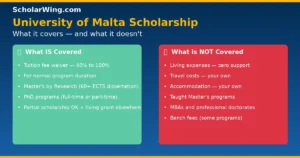
What it covers: These scholarships take the form of a partial or full tuition fee waiver (from 40% to 100%), awarded to the most deserving applicants.
What it does NOT cover — critical honest note: The scholarship covers neither travel costs nor living expenses. Applicants must therefore have sufficient resources to live in Malta during their studies.
This is a key distinction from scholarships like DAAD, CSC China, or GKS Korea that include monthly living stipends. The University of Malta scholarship removes your tuition barrier — it does not fund your life in Malta. You must arrive with your own living costs covered.
Who is eligible: Only applicants who have been accepted unconditionally to read for a Master by research or a Ph.D. on a full-time and part-time basis are eligible to apply. Professional doctorates and MBA-type programmes are not eligible.
In plain terms: this scholarship is for research-focused postgraduate programs only — Master’s by Research (where your dissertation is at least 60 ECTS) and PhD. Taught Master’s degrees, MBAs, and professional doctorates are not eligible.
Deadline: For courses starting in October, scholarship application must be submitted by April 30, 2026. Additional deadlines apply for January and May intake, check um.edu.mt for exact dates.
How to apply: Email the International Office (internationalstudents@um.edu.mt or postgrad.admissions@um.edu.mt) with the subject “University of Malta Postgraduate Scholarship Application”, and include your student number (UM Applicant ID).
Shortlisted applicants will be invited to an online interview with the Scholarship Selection Board. The interview evaluates your research proposal, academic profile, and motivation.
The ODA Advantage — Developing Country Students Are a Named Priority
This is the most important thing most guides about the University of Malta scholarship don’t mention.
The University of Malta’s official scholarship selection criteria includes this factor:
“Is the nationality and/or place of habitual residence of the candidate a priority area for the foreign and/or economic policy of the Malta Government? (This includes those countries in receipt of official Overseas Development Assistance).”
This means students from ODA-eligible developing countries which includes Pakistan, most African nations, Bangladesh, Myanmar, Nepal, and dozens of other countries, have a named criterion working in their favor during scholarship selection. Malta’s government specifically values bringing in students from ODA-priority countries.
This is a concrete, documented advantage for ScholarWing’s core audience. Most guides about the University of Malta scholarship never mention it.
English — No IELTS Required With EMI Certificate
Malta’s status as an English-speaking country creates a direct practical advantage for international students from English-medium educational backgrounds.
Malta is one of the easiest European countries for IELTS-free applications, thanks to its status as an English-speaking nation. Many programs also accept English-Medium Instruction (EMI) certificates, allowing eligible students to apply without IELTS.
For students who completed their degree at an English-medium institution, a free EMI Certificate (Medium of Instruction Certificate) from your university registrar may satisfy the University of Malta’s English proficiency requirement for many programs.
Use ScholarWing’s free MOI/EMI Certificate Generator to prepare the correct format
Important: Always confirm English requirement specifics with your target program before assuming EMI is accepted, some competitive programs may still require IELTS. Email the faculty admissions office directly to confirm.
Student Visa for Malta
Non-EU/EEA international students need a National Long-Stay Visa (Type D) and a Residence Permit to study in Malta for programs lasting more than 90 days.
Process:
- Receive your unconditional admission letter from the University of Malta
- Apply for a Type D long-stay visa at the nearest Maltese Embassy or consulate (or at Identity Malta if applying from within the Schengen area)
- On arrival, apply for a Residence Permit (Study) at the Identity Malta Agency within the first week
Documents typically required:
- Valid passport (minimum 3 months validity beyond your intended stay)
- University admission letter
- Proof of accommodation
- Proof of sufficient funds (approximately €8,000+ for the academic year)
- Health insurance valid in Malta
- Police clearance certificate
- Two passport-size photographs
Important proof of funds requirement: Applicants must ensure they have sufficient resources to live in Malta during their studies. Without demonstrable proof of living funds, the visa application will fail, even with a tuition scholarship. Budget carefully.
Processing time: 4-8 weeks. Apply as early as possible after receiving your admission offer.
Work rights: Non-EU students in Malta are generally permitted to work up to 20 hours per week during term time with a valid residence permit. This can meaningfully supplement living costs.
Cost of Living in Malta — What You Need to Know
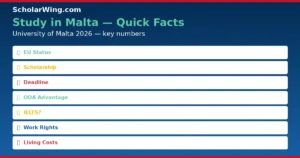
Malta is generally cheaper than Northern Europe but more expensive than non-EU destinations in Asia or the Middle East.
Typical monthly costs:
- Accommodation: €500-900/month (private rooms, shared apartments in Msida/Valletta area)
- Food: €200-350/month (supermarkets affordable; eating out moderate)
- Transportation: €20-40/month (bus network covers the island; affordable)
- Personal expenses: €100-150/month
Total typical budget: €850-1,450/month (~USD 920-1,570)
The honest planning point: The University of Malta scholarship covers tuition only. For a 2-year Master’s by Research, you need approximately €20,000-35,000 in personal funds or additional funding sources to cover living costs — or a combination of part-time work income and scholarship.
Options to supplement:
- Part-time work (up to 20 hours/week permitted)
- Home country scholarships or government funding topped up with UM tuition waiver
- Erasmus+ mobility grants if enrolled (for later-year exchanges to partner institutions)
Erasmus+ and International Programs
As an EU institution, the University of Malta participates in Erasmus+ across multiple programs:
- Erasmus+ Student Mobility: Spend a semester at a partner European university while enrolled at UM
- Erasmus+ Staff Mobility: For academic and administrative staff
- Erasmus+ Research Projects: Collaborative research with EU partner institutions
For international students enrolled at UM, Erasmus+ mobility grants for outgoing exchanges can provide additional financial support for semesters spent at partner universities partially offsetting overall study costs.
Other Scholarship Sources for Malta
Commonwealth Scholarships: Malta is a Commonwealth member, meaning Chevening and Commonwealth Scholarships to the UK are available to Maltese nationals but not the primary route for non-Maltese students studying in Malta.
Bilateral agreements: Check whether your home country has any bilateral educational agreements with Malta through your Ministry of Higher Education or Ministry of Foreign Affairs, some countries have specific Malta-focused quotas.
Faculty-specific funding: Some UM faculties have research project funding that supports PhD students beyond the tuition waiver. Contact your target department directly about research assistant positions or project-embedded funding.
External Scholarships Combined: Applicants who hold a partial scholarship or maintenance grant to cover living costs from another organization may be considered. meaning you can combine a UM tuition waiver with a home-country government grant for living costs.
Why Malta — Specific Reasons Beyond “It’s in Europe”
1. Only English-speaking EU country A University of Malta degree is EU-recognized — the same weight as a German, French, or Italian university degree but taught entirely in English. For students who want European credentials without language barriers, this is genuinely unique.
2. Small island, real community With 11,500 students and 1,700 internationals across 100+ nationalities, UM is small enough that international students integrate genuinely rather than disappearing into a large city university. This is a meaningful quality-of-life difference.
3. Mediterranean location Malta’s climate, safety, and geographic position between Europe, North Africa, and the Middle East make it a comfortable destination for students from the Middle East, North Africa, and South Asia. Cultural familiarity is higher than in Northern Europe.
4. Gateway to EU A degree from a Maltese university gives graduates access to EU job markets and EU Blue Card eligibility, a meaningful career pathway for students from developing countries.
5. Lower competition than UK or Germany Fewer international students target Malta specifically as a study destination. This means less competition for the scholarship and for places in research programs, an early-mover advantage.
Practical Tips for Applying to Malta
1. Apply for admission first — scholarship comes second Only applicants who have received unconditional admission to a Master’s by Research or PhD program can apply. The scholarship application cannot be submitted independently. Get your admission offer, then apply for the scholarship within one month of receiving it.
2. Research programs are the only path The scholarship is specifically for Master’s by Research and PhD programs where the dissertation is at least 60 ECTS. Taught Master’s, MBAs, and professional doctorates are excluded. If your goal is a taught postgraduate program, the scholarship does not apply.
3. Plan your living costs before applying You must demonstrate sufficient living funds to the university and the Maltese immigration authorities. The scholarship covers tuition, not life. Have a clear budget for your living costs before committing.
4. Use EMI Certificate if eligible If you graduated from an English-medium institution, your free MOI/EMI Certificate may substitute for IELTS. Confirm with your specific program before assuming, and generate the correct format at MOI Generator.
5. Mention ODA eligibility in your scholarship application The selection board explicitly considers whether your country receives ODA from Malta. If you are from an ODA-eligible country (Pakistan, most African nations, South and Southeast Asia), make this a visible and relevant part of your application narrative, your contribution to Malta’s development cooperation priorities.
FAQ
Does the University of Malta scholarship cover living costs?
No, the scholarship covers tuition fees only (40-100% waiver). Living costs, travel, and accommodation are entirely the student’s responsibility. Budget for approximately €850-1,450/month in living costs.
Is Malta the only EU country with English as an official language?
Yes, Malta is the only EU member state where English is an official language (alongside Maltese). All University of Malta programs are taught in English.
Can I use an EMI Certificate instead of IELTS for Malta?
For many programs, yes the University of Malta accepts proof of English-medium previous education in place of IELTS. Confirm with your specific program before assuming this applies.
When is the University of Malta scholarship deadline?
For courses starting in October, the scholarship application deadline is April 30, 2026. Submit your admission application first, then email the International Office within one month of receiving your unconditional admission offer.
Can students from developing countries apply?
Yes, and they have a named advantage. The University of Malta’s selection criteria explicitly considers whether the applicant’s nationality is a priority area for Malta’s ODA foreign policy, giving developing country applicants a documented advantage in selection.
Can international students work in Malta?
Generally yes, non-EU students with a valid residence permit may work up to 20 hours per week during term time. This can meaningfully supplement living costs.