
Madagascar Is Called the “8th Continent” — And That Shapes a Scholarship Landscape Unlike Any Other African Nation
Madagascar is home to approximately 90% of species found nowhere else on Earth. Its 592,000 square kilometers contain lemurs found only here, baobab trees unique to this island, over 300 endemic bird species, and ecological systems that have evolved in isolation for 88 million years. Scientists routinely describe it as one of the world’s highest biodiversity hotspots and most urgent conservation priorities simultaneously.
This is not just natural heritage. It is a scholarship angle.
For Malagasy students interested in ecology, environmental science, conservation biology, climate change, sustainable development, and natural resource management, Madagascar’s unique position creates scholarship pathways that are not available to students from most other countries in this series. Conservation foundations, environmental research institutions, and international bodies specifically fund Malagasy students because Madagascar’s environmental story is globally irreplaceable.
Combined with Madagascar’s French-speaking status (which opens Eiffel Excellence, ARES Belgium, AUF, and OIF scholarships), its SADC membership, and standard access to DAAD, Chevening, CSC China, Fulbright, and GKS Korea, Malagasy students in 2026-27 have a more diverse scholarship landscape than is commonly known.
Top Scholarships for Madagascar Students
1. Eiffel Excellence Scholarship — France (€1,200-2,100/month)
Madagascar is a French-speaking nation and a member of the Organisation Internationale de la Francophonie — placing it among the primary target nationalities for the France Excellence Eiffel Scholarship.
What it covers:
- Master’s: €1,200/month (from January 2026) + international transportation, insurance, housing search, cultural activities
- PhD: €2,100/month + same services
Priority fields: Law, Economics and Management, Medicine and Public Health, Engineering, Exact Sciences, Humanities and Social Sciences, Architecture.
Critical process: Applications are submitted by French universities — Malagasy students cannot apply directly. Contact your target French university’s International Relations office, which then nominates you to Campus France.
Madagascar advantage: As a Francophone developing country with significant environmental and development needs, Malagasy applicants in environment, public health, agriculture, and engineering are especially competitive for Eiffel consideration. French universities with Madagascar programs include Université Paris-Saclay, Sorbonne, and Institut Agronomique Méditerranéen de Montpellier.
2027 cycle: Contact target French university by September-October 2026 for their internal deadline. Campus France deadline: typically January 8.
Apply through: campusfrance.org — contact Campus France Madagascar / Alliance Française Antananarivo for guidance.
2. AUF (Agence Universitaire de la Francophonie) Scholarships
The Agence Universitaire de la Francophonie (AUF) provides scholarships specifically for students enrolled at Francophone universities. Madagascar is a member of both the AUF and the OIF and the University of Antananarivo is an AUF member institution.
AUF scholarship programs include:
- Bourses de mobilité internationale AUF — for postgraduate students at AUF member universities to pursue studies or research abroad at another AUF institution
- Soutien aux formations doctorales — doctoral support grants for students enrolled in joint supervision programs between Francophone institutions
Why Madagascar-specific advantage: Students at the University of Antananarivo (a confirmed AUF member) can apply for AUF mobility programs with access to the full AUF partner network across France, Belgium, Canada (Quebec), Morocco, Tunisia, Lebanon, and other Francophone countries.
Apply at: auf.org — AUF Bureau for the Indian Ocean (covers Madagascar)
3. ARES Belgium Scholarships — Francophone Priority
Belgium’s Académie de Recherche et d’Enseignement Supérieur (ARES) scholarship programs explicitly prioritize French-speaking African countries. Madagascar is among the primary target nationalities for ARES.
What it covers: Full tuition + monthly living stipend + travel costs at Belgian universities.
Fields ARES prioritizes for Madagascar: Environmental management, agricultural development, public health, governance, all directly connected to Madagascar’s development challenges.
Apply at: ares-ac.be — deadlines typically January-February.
4. Chevening Scholarship — United Kingdom (£1,378-1,690/month)
Chevening is open to Madagascar as an eligible country. The scholarship is competitive but actively accepts West Indian Ocean / Sub-Saharan African applicants.
What it covers:
- Full university tuition fees
- Monthly living allowance: £1,690 (London) / £1,378 (outside London)
- Economy class return airfare
- Additional academic grants
Requirements:
- 2 years of work experience (~2,800 hours)
- IELTS 6.5+ or TOEFL iBT 79+ — required
- Must return to Madagascar after scholarship
For Malagasy applicants: English language preparation is the primary barrier — most Malagasy secondary and university education is in French. Invest in IELTS preparation early. See: IELTS vs TOEFL vs Duolingo for Scholarship Applications 2026 — Which Test?
Next cycle: Opens August 2027, closes November 2027.
Apply at: chevening.org
5. DAAD Scholarships — Germany (€934-1,300/month)
DAAD is open to Malagasy students across Sub-Saharan Africa programs. Madagascar’s development context extreme poverty alongside extraordinary natural wealth, makes DAAD’s development-oriented programs directly relevant.
Key DAAD programs for Malagasy students:
DAAD Study Scholarships: €934/month for Master’s, German or English-medium programs. Deadline: mid-October.
DAAD EPOS (Development-Related Postgraduate Courses): Specifically designed for students from developing countries in development-relevant fields. For Malagasy students in environmental management, marine biology, forestry, agriculture, or public health, EPOS aligns directly with Madagascar’s most urgent national priorities.
DAAD Helmut Schmidt Programme: Public policy and good governance, relevant to Madagascar’s ongoing governance challenges.
Language: Many DAAD programs accept a free MOI Certificate instead of IELTS for English-medium programs — see: MOI Generator
6. CSC China Scholarship (CNY 3,000-3,500/month + Free Tuition)
Madagascar has maintained diplomatic relations with the People’s Republic of China and is included in China’s FOCAC (Forum on China-Africa Cooperation) scholarship framework.
What it covers:
- Full tuition waiver
- Monthly stipend: CNY 3,000 for Master’s (~USD 410), CNY 3,500 for PhD (~USD 480)
- Free university accommodation
- Health insurance
No IELTS required — MOI Certificate accepted for English-medium programs.
Apply through:
- Chinese Embassy in Antananarivo (Embassy/Type A track)
- Directly at Chinese universities via campuschina.org (Type B track)
Typical deadline: Embassy track December-January; university route varies.
7. Fulbright Foreign Student Program — USA
The US Embassy in Antananarivo administers the Fulbright program for Madagascar. Given Madagascar’s environmental and development context, Fulbright applications in conservation science, environmental policy, public health, and sustainable development are particularly competitive.
What it covers: Full tuition, living stipend, round-trip airfare, health insurance.
Apply through: US Embassy Antananarivo — mg.usembassy.gov
Deadline: Typically July-August for the following academic year. Confirm current deadlines with the US Embassy Public Affairs Section.
8. The Biodiversity and Conservation Scholarship Pathway — Madagascar’s Unique Advantage
This is the scholarship category that exists for Madagascar in a way it does not exist for most other countries.
Because Madagascar is recognized as one of the world’s most critical biodiversity hotspots with 90% endemic species and accelerating deforestation threatening irreplaceable ecosystems, major international conservation and environmental organizations specifically fund Malagasy researchers and students.
Rufford Foundation Small Grants: The Rufford Foundation provides grants for nature conservation projects in developing countries. Malagasy students and researchers working on wildlife conservation, habitat protection, and community-based conservation are among the most funded recipients globally. rufford.org
WWF Russell E. Train Education for Nature Program: The World Wildlife Fund’s Education for Nature (EFN) fellowship specifically targets students from biodiversity-rich developing countries pursuing conservation-related graduate degrees. Madagascar is explicitly among the highest-priority countries. worldwildlife.org/efn
Mohamed bin Zayed Species Conservation Fund: Provides grants for conservation of specific species and habitats. Malagasy researchers working on lemur conservation, endemic plant protection, or marine ecosystem research are regularly funded. speciesconservation.org
IUCN: The International Union for Conservation of Nature has active Madagascar programs and occasionally funds Malagasy professionals for international training and postgraduate study. iucn.org
CGIAR (Consultative Group on International Agricultural Research): CGIAR’s climate change, food security, and biodiversity programs provide postgraduate and research fellowships. For Malagasy students in agriculture, forestry, and food systems, particularly relevant given Madagascar’s vanilla and clove export economy.
Conservation-specific guidance: If your field is environmental science, ecology, marine biology, or conservation management, apply for both a government scholarship (DAAD, CSC, GKS) AND a conservation foundation grant simultaneously. These are not mutually exclusive, many conservation fellowships can supplement a government scholarship.
9. GKS Korea (Global Korea Scholarship)
GKS Korea has the lowest published GPA minimum of any major government scholarship (2.64/4.0) and requires no English test — making it one of the most accessible fully funded scholarships for Malagasy students.
What it covers: Full tuition + monthly stipend (~USD 650-700) + funded Korean language preparation year + round-trip airfare.
No IELTS required — Korean language preparation provided in Year 1.
Apply through: Korean Embassy or nearest Korean diplomatic mission. Embassy Track closes February annually.
10. MEXT Japan Scholarship
Japan’s government scholarship is open to Malagasy students via the MEXT Embassy Track at the Japanese Embassy in Antananarivo.
What it covers: Full tuition + monthly stipend JPY 143,000-147,000 (~USD 950-980) + round-trip airfare + Japanese language preparation year.
Deadline: MEXT Embassy Track typically closes May-June.
11. Erasmus Mundus — Europe (€1,100-1,400/month)
Open to all nationalities. Malagasy students are eligible for all Erasmus Mundus consortiums.
Key advantage for Malagasy students: Many Erasmus Mundus consortiums include French universities — making French-medium consortium tracks more accessible. Erasmus Mundus programs in environmental science, sustainable development, and ecology are particularly relevant to Madagascar’s context.
Deadline: Most consortiums January-February for September intake. Apply at eacea.ec.europa.eu
12. Mastercard Foundation Scholars Program
The Mastercard Foundation Scholars Program supports talented African students from disadvantaged backgrounds who demonstrate transformative leadership potential.
Why relevant for Madagascar: Madagascar’s very low HDI ranking means Malagasy students often represent exactly the disadvantaged-but-high-potential profile this scholarship seeks. Students with stories of building community impact despite resource constraints are the target.
Apply through partner universities: mastercardfdn.org/scholarships
13. Stipendium Hungaricum — Hungary (Europe, Full Funding)
Open to developing countries including Madagascar. Full tuition + accommodation support + monthly stipend (~EUR 115-130) + health insurance.
Apply at: stipendiumhungaricum.hu — deadline January-February.
14. Turkiye Burslari — Turkey (All Nationalities, Full Funding)
Open to students of all nationalities. No IELTS required, Turkish language preparation year provided.
What it covers: Full tuition + accommodation + monthly allowance (~USD 300-350).
Apply at: turkiyeburslari.gov.tr — deadline typically February.
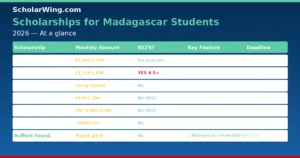
Quick Reference: Scholarships for Malagasy Students 2026-27
| Scholarship | Monthly Amount | IELTS? | Key Feature | Deadline |
|---|---|---|---|---|
| Eiffel Excellence (France) | €1,200-2,100 | Per program | French priority + university sponsorship | Jan 8 |
| Chevening (UK) | £1,378-1,690 | Yes 6.5+ | Leadership focus | November |
| ARES Belgium | Living stipend | No | French priority, Francophone pool | Jan-Feb |
| AUF Mobility | Travel + stipend | No | Francophone university network | Varies |
| DAAD (Germany) | €934-1,300 | No (MOI OK) | EPOS for development | October |
| CSC China | CNY 3,000-3,500 | No (MOI OK) | FOCAC track | Dec-April |
| Fulbright (USA) | Living stipend | Yes | US Embassy Antananarivo | July-Aug |
| GKS Korea | ~$650-700 | No | Min GPA 2.64/4.0 only | February |
| MEXT Japan | ~$950-980 | No | Embassy track, Japan | May-June |
| WWF EFN | Project funding | No | Conservation focus, Madagascar priority | Varies |
| Rufford Foundation | Project grant | No | Conservation, Madagascar priority | Varies |
| Erasmus Mundus | €1,100-1,400 | Per program | French consortium tracks | Jan-Feb |
| Mastercard Foundation | Full funding | Varies | Disadvantaged background | Varies |
| Stipendium Hungaricum | ~EUR 115/month | Per program | Hungary, Europe | Jan-Feb |
| Turkiye Burslari | ~$300-350 | No | All nationalities | February |
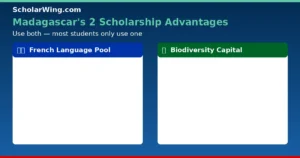
Madagascar’s Two Strategic Advantages — Use Both
1. French Language = Francophone Scholarship Pool The Eiffel Excellence (France), ARES (Belgium), AUF (global Francophone network), and OIF scholarships are significantly less competitive than their English-language equivalents for Malagasy applicants who are strong in French. Most Malagasy secondary and university graduates are more comfortable in French than in English, this is a competitive advantage in the Francophone scholarship world that is underused.
2. Biodiversity = Conservation Scholarship Priority No other country in this series has the same density of conservation-specific funding opportunities as Madagascar. The Rufford Foundation, WWF EFN, Mohamed bin Zayed Fund, and IUCN programs specifically exist in part because Madagascar’s biodiversity is globally irreplaceable and requires trained local conservationists. A Malagasy student in ecology, environmental science, or conservation biology should apply for government scholarships AND conservation foundation grants simultaneously.
Practical Tips for Malagasy Applicants
1. Start with Campus France Madagascar Campus France has a bureau in Antananarivo. This is your primary resource for French scholarship pathways Eiffel Excellence, French Embassy bilateral scholarships, and French government programs. Visit in person if possible: campusfrance.org
2. IELTS is the main barrier for Chevening and Australian Awards Most Malagasy students complete secondary and university education in French. IELTS preparation requires specific investment. Start at least 6-8 months before the scholarship deadline. See: IELTS vs TOEFL vs Duolingo for Scholarship Applications 2026 — Which Test?
3. For environmental science — apply to both DAAD EPOS and Rufford simultaneously DAAD EPOS funds your formal postgraduate degree. The Rufford Foundation can fund a conservation project in Madagascar simultaneously. These are complementary, not competing.
4. Use MOI Certificate for DAAD and CSC China Both accept a free Medium of Instruction Certificate instead of IELTS for English-medium programs. Generate the correct format at: MOI Generator
5. GKS Korea for applicants without strong English or French test scores GKS Korea requires no language test and has a minimum GPA of only 2.64/4.0. It is the most accessible major scholarship for students building their profile.
FAQ
Is Madagascar eligible for Chevening?
Yes, Chevening is open to Madagascar. The scholarship is competitive, requires IELTS 6.5+, and 2 years of work experience. Given that most Malagasy education is French-medium, English preparation is the key investment required.
Can Malagasy students apply for AUF scholarships?
Yes, the University of Antananarivo is an AUF member institution. AUF mobility grants for students at AUF member universities pursuing study at other Francophone partner institutions are accessible to Malagasy students.
Is Madagascar eligible for the Rufford Foundation conservation grants?
Yes, Madagascar is among the highest-priority countries for conservation funding globally. Malagasy researchers and students working on endemic species protection, habitat conservation, or community-based conservation are competitive applicants.
Do Malagasy students need IELTS for DAAD or CSC China?
No, both DAAD and CSC China accept a free Medium of Instruction (MOI) Certificate for English-medium programs. This eliminates one of the largest pre-scholarship costs.
What is the best scholarship for a Malagasy student in environmental science?
Apply simultaneously to DAAD EPOS (for the degree) and Rufford Foundation or WWF EFN (for conservation project funding). These complement each other and both recognize Madagascar’s environmental context as a competitive asset.