
Most Guides About Indonesian Scholarships Contain a Critical Error — Let’s Fix It First
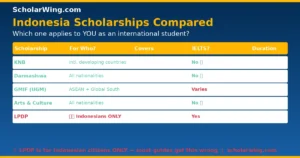
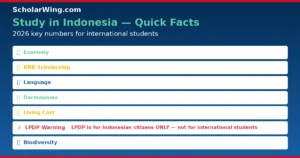
Before anything else: LPDP (Lembaga Pengelola Dana Pendidikan) is one of Indonesia’s most prestigious and well-known scholarship programs. It is also a scholarship exclusively for Indonesian citizens. The LPDP scholarship is for Indonesian nationals pursuing Master’s and doctoral degrees in Indonesia or abroad.
If you are an international student from Pakistan, Ghana, Nigeria, Bangladesh, Egypt, or any other non-Indonesian country, LPDP is not available to you.
This distinction matters because most scholarship websites and social media posts about “Indonesian scholarships” list LPDP prominently without this clarification. Students spend time preparing LPDP applications they cannot submit.
The correct scholarship for international students from developing countries is the KNB (Kemitraan Negara Berkembang) Scholarship, a separate, genuinely international program funded by the Indonesian government specifically for students from developing nations. This guide focuses on the pathways that actually apply to you.
Read This: Fully Funded Scholarships for Indonesian Students
The KNB Scholarship — Indonesia’s Flagship International Scholarship
The Kemitraan Negara Berkembang (KNB) Scholarship, which translates to “Developing Country Partnership Scholarship,” is the Indonesian government’s primary fully funded scholarship for international students from developing countries.
KNB Scholarship is a scholarship awarded by the government of the Republic of Indonesia to selected applicants originating from developing countries who wish to pursue higher education in Indonesia.
What it covers:
- Full tuition fees
- Monthly living allowance
- Accommodation support
- Health insurance
- Cultural orientation programs
- Indonesian language preparation course
Degree levels: Undergraduate, Master’s, and PhD
Universities participating: The program places students at top Indonesian universities including:
- Universitas Indonesia (UI) — Jakarta
- Universitas Gadjah Mada (UGM) — Yogyakarta
- Institut Teknologi Bandung (ITB) — Bandung
- Universitas Brawijaya — Malang
- Universitas Airlangga — Surabaya
- Universitas Hasanuddin — Makassar
Who can apply: Students from developing countries eligible for the scholarship. Pakistan, most African nations, most South and Southeast Asian nations qualify, Indonesia specifically targets countries with which it has cultural and diplomatic cooperation agreements.
Important: No IELTS is required for the KNB Scholarship for programs taught in Indonesian (Bahasa Indonesia). Students typically complete a Bahasa Indonesia language preparation course before their degree program begins.
Apply through: Indonesian Embassy or consulate in your home country. Applications are submitted through your country’s Ministry of Higher Education or the Indonesian Embassy directly. Check with the Indonesian Embassy in your country for the current cycle deadline, applications typically open between January-March annually.
The Darmasiswa Scholarship — Indonesian Language and Culture
Darmasiswa is a unique, non-degree scholarship program funded by the Indonesian Ministry of Education and Culture. It is designed for international students interested in learning about Indonesian language, arts, music, dance, crafts, and culture.
What it covers:
- Course fees
- Monthly living allowance
- Accommodation
- Airfare (partial)
Duration: 1 academic year
Who can apply: Students from all countries with diplomatic relations with Indonesia. No IELTS required. No minimum GPA published.
What you study: Indonesian language (Bahasa Indonesia), batik, gamelan, traditional dance, traditional music, and other Indonesian arts and cultural practices.
Why it matters beyond culture: The Darmasiswa scholarship provides free Bahasa Indonesia language proficiency which then opens the door to degree programs at Indonesian universities, including the KNB scholarship track. Many students use Darmasiswa as a foundation year before applying for degree-level scholarships.
Apply through: Indonesian Embassy in your home country or Ministry of Education and Culture portal — kemdikbud.go.id
The Gadjah Mada International Fellowship (GMIF) — UGM
The Gadjah Mada International Fellowship (GMIF) Degree Program stands as a beacon of educational opportunity, extended by Universitas Gadjah Mada to international students seeking to pursue a Master’s and Doctoral degree. With a special emphasis on candidates from the ASEAN region (excluding Indonesia) and Global South Countries, this scholarship program aims to empower individuals with outstanding academic achievements to excel in their chosen fields of study.
What it covers:
- Full or partial tuition waiver
- Monthly living allowance
- Access to UGM research facilities
Target: ASEAN students (excluding Indonesians) and Global South country students which includes Pakistan, most African nations, South Asian and Southeast Asian countries.
Universitas Gadjah Mada is Indonesia’s premier public university, located in Yogyakarta, Indonesia’s cultural heartland. UGM is consistently ranked among Southeast Asia’s top 5 universities.
Apply at: ugm.ac.id through the international admissions office.
Universitas Indonesia International Scholarship
Universitas Indonesia (UI), ranked in Asia’s top 100, offers the UI International Student Scholarship for international undergraduate and postgraduate students.
What it covers: Partial to full tuition support depending on academic merit and program.
UI’s strongest programs for international students:
- Computer Science and IT
- Economics and Business
- Public Health and Medicine
- Law and Governance
- Engineering
Apply at: ui.ac.id through the international office.
Indonesian Arts and Culture Scholarship
A unique program by the Indonesian Ministry of Foreign Affairs for young artists and cultural enthusiasts.
What it covers: Full tuition, accommodation, living allowance for a 3-month intensive program.
Who it’s for: Young people from countries with diplomatic relations with Indonesia who want to learn traditional Indonesian arts batik, wayang, gamelan, traditional dance, and crafts.
Apply through: Indonesian Embassy in your home country.
This scholarship is worth knowing even if you’re primarily interested in degree programs, it builds Indonesian cultural context and language exposure that strengthens future KNB and Darmasiswa applications.
Top Universities in Indonesia for International Students
Universitas Indonesia (UI) — Jakarta Indonesia’s most internationally recognized university. Strong in medicine, law, IT, and social sciences. Ranked Asia #75 (QS 2026). Jakarta location provides access to Southeast Asia’s largest city and business hub.
Universitas Gadjah Mada (UGM) — Yogyakarta Indonesia’s oldest public university and widely considered its most prestigious overall. Strong research culture. Yogyakarta is Indonesia’s cultural capital more affordable and relaxed than Jakarta.
Institut Teknologi Bandung (ITB) — Bandung Indonesia’s top engineering and technology university. Strong in engineering, architecture, natural sciences, and IT. Bandung is Indonesia’s third-largest city, known as a creative and entrepreneurial hub.
Universitas Airlangga — Surabaya Strong in health sciences, pharmacy, and medicine. Surabaya is Indonesia’s second city — lower living costs than Jakarta.
Institut Pertanian Bogor (IPB) — Bogor Indonesia’s agricultural and natural sciences university. Strong in agriculture, forestry, fisheries, and environmental sciences, highly relevant for students from agricultural economies.
Student Visa for Indonesia
International students need a Student Stay Permit (KITAS) to study in Indonesia for programs lasting more than 60 days.
Process:
- Receive admission letter from your Indonesian university
- Apply for an initial Study Visa (C316 social-cultural visa) at the Indonesian Embassy in your home country
- On arrival, convert to a Student Stay Permit (KITAS) through the university’s sponsorship
Documents typically required:
- Valid passport (minimum 18 months validity)
- Admission letter from Indonesian university
- Application form
- Passport-size photographs
- Proof of scholarship (for scholarship holders)
Processing time: 2-4 weeks for initial visa. KITAS conversion typically handled by the university’s international office.
Work rights: International students on a Student Stay Permit are not permitted to work in Indonesia. Plan finances accordingly.
Cost of Living in Indonesia — Among the Lowest in Asia
Indonesia’s cost of living is one of the most attractive aspects of studying there. Compared to any European destination, Singapore, Hong Kong, or even Malaysia, Indonesia is exceptionally affordable.
Typical monthly costs:
- Accommodation: IDR 1,000,000-2,500,000/month (~USD 65-165) for a basic room near campus
- Food: IDR 1,500,000-3,000,000/month (~USD 95-195) — local food is very cheap; Western food is moderate
- Transportation: IDR 200,000-500,000/month (~USD 13-33) — Grab (ride-hailing) affordable
- Personal expenses: IDR 300,000-600,000/month (~USD 20-40)
Total typical budget: IDR 3,000,000-6,600,000/month (~USD 195-430)
The KNB scholarship context: A KNB monthly living allowance combined with free accommodation covers basic living costs in any Indonesian city very comfortably. Indonesia’s low cost of living is a genuine competitive advantage for the scholarship value it delivers.
Clarification: What LPDP Actually Is (and Why It Matters to Know)
Since LPDP appears in almost every “scholarship in Indonesia” search result, it’s worth understanding what it is — even though it’s not available to international students.
LPDP is Indonesia’s endowment fund for education, one of the world’s largest national education endowment funds. It funds Indonesian citizens for Master’s and PhD programs both in Indonesia and at top universities worldwide (including Oxford, Harvard, and MIT).
In 2026, LPDP has transformed from being education-centric to more impact-driven, with a stronger emphasis on national priority sectors and measurable contributions to Indonesia’s development goals.
The batch 1 registration period for 2026 is from 22 January to 23 February.
Why this is relevant to non-Indonesian readers: If you are a naturalized Indonesian citizen or hold Indonesian permanent residency, LPDP may apply to you. If you are a foreign student collaborating with Indonesian institutions on bilateral research, there are specialized LPDP categories that may cover international co-researchers. In all other cases, LPDP is not accessible, focus your energy on KNB and university-specific scholarships.
Why Indonesia for International Students?
1. SE Asia’s largest economy Indonesia is Southeast Asia’s largest economy and the G20’s only Southeast Asian member. For students interested in development economics, trade, manufacturing, and regional affairs, Indonesia offers direct access to one of the world’s most important emerging economies.
2. Fourth most populous country With 280+ million people, Indonesia is the world’s fourth most populous country. The scale of its public health, education, environmental, and governance challenges and the research opportunities they create is genuinely massive.
3. Extraordinary biodiversity Indonesia contains approximately 10-15% of the world’s species despite covering less than 2% of its land area. For environmental science, ecology, marine biology, and agriculture students, Indonesian research environments are among the world’s richest.
4. Islamic world’s largest Muslim population Indonesia has the world’s largest Muslim population. For students interested in Islamic governance, Islamic economics, regional development, and Islamic studies, Indonesian universities offer unique depth and context.
5. Extremely low cost of living USD 300-400/month covers a comfortable student life in most Indonesian cities. A KNB scholarship’s monthly allowance effectively stretches further than equivalent European scholarship stipends.
Practical Tips for Applying to Indonesia
1. LPDP is for Indonesian citizens — don’t apply if you’re not Indonesian Apply to KNB, GMIF, UI International Scholarship, or university-specific programs instead. The Indonesian Embassy in your home country is your best source for current KNB eligibility and application timelines.
2. Darmasiswa first if you’re targeting Indonesian-medium programs If your target KNB degree program is taught in Bahasa Indonesia, apply for Darmasiswa first to build language proficiency. Many successful KNB scholars did a Darmasiswa year before applying for their degree program.
3. Contact Indonesian Embassy early — KNB quotas are country-specific KNB scholarships are allocated by country through bilateral agreements. Your country’s specific quota and application process may differ from the general KNB guidelines. Contact the Indonesian Embassy in your country directly for current-year information.
4. No IELTS required for most Indonesian scholarship programs KNB and Darmasiswa scholarships do not require IELTS, Bahasa Indonesia language preparation is provided. For English-medium programs at UI or UGM’s international tracks, IELTS may be required verify with the specific program.
5. Yogyakarta is cheaper and more culturally rich than Jakarta If you have flexibility in choosing your placement city, Yogyakarta (home of UGM) is significantly cheaper, more student-focused, and more culturally immersive than Jakarta. Both have excellent universities.
FAQ
Is LPDP available for international students?
No, LPDP is exclusively for Indonesian citizens. The scholarship for international students from developing countries is the KNB (Kemitraan Negara Berkembang) Scholarship. This distinction is critical and most scholarship guides do not state it clearly.
What is the KNB Scholarship?
KNB stands for Kemitraan Negara Berkembang (Developing Country Partnership). It is the Indonesian government’s fully funded scholarship for international students from developing countries. It covers full tuition, monthly living allowance, accommodation, health insurance, and cultural orientation programs.
Do I need IELTS to study in Indonesia?
Not for most scholarship programs. KNB and Darmasiswa scholarships do not require IELTS, Indonesian language preparation is provided. English-medium programs at UI and UGM may require IELTS verify with your specific program.
What is Darmasiswa?
Darmasiswa is a 1-year non-degree scholarship by the Indonesian Ministry of Education and Culture for learning Indonesian language, arts, and culture. It is open to all nationalities with diplomatic relations with Indonesia, requires no IELTS, and is a useful foundation year before degree-level scholarship applications.
What is the GMIF scholarship at UGM?
The Gadjah Mada International Fellowship (GMIF) is a degree scholarship at Universitas Gadjah Mada for Master’s and PhD students from ASEAN (excluding Indonesians) and Global South countries. Apply through ugm.ac.id.
How cheap is Indonesia to live in?
Very cheap, a typical student budget in Indonesian cities is USD 200-430/month. The KNB scholarship monthly allowance covers this comfortably, with meaningful savings possible.