
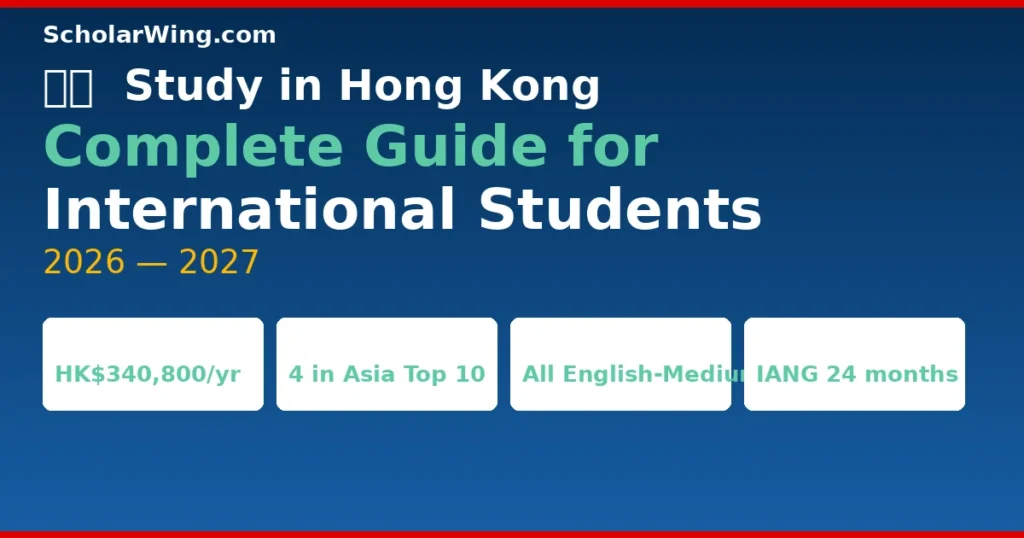
Hong Kong Has Four Universities in Asia’s Top 10 — And One of the World’s Most Generous PhD Scholarships
Hong Kong is one of the most competitive study destinations in Asia and one of the most underestimated outside the region.
Four Hong Kong universities consistently rank in Asia’s top 10: The University of Hong Kong (HKU, ranked #11 globally in QS 2026), The Hong Kong University of Science and Technology (HKUST), The Chinese University of Hong Kong (CUHK, ranked #32 globally in QS 2026), and City University of Hong Kong (CityU, whose public administration program ranks #1 in Asia and #7 in the world).
The flagship scholarship — the Hong Kong PhD Fellowship Scheme (HKPFS) — provides an annual stipend of HK$337,200 (approximately USD 43,230) plus a travel allowance. It is among the most generous PhD fellowships globally, and it is open to applicants of any nationality.
All major programs at Hong Kong universities are taught in English. The city is a gateway to Mainland China and the broader Asia-Pacific economy. And unlike many Asian study destinations, Hong Kong’s scholarship process is often automatic, many universities consider you for scholarships at the point of admission, without a separate application.
The 5 Major Scholarships for International Students in Hong Kong
1. Hong Kong PhD Fellowship Scheme (HKPFS) — The Flagship
The Hong Kong PhD Fellowship Scheme is administered by the Research Grants Council of Hong Kong and is open to PhD applicants of any nationality, at any of the eight publicly funded universities.
What it covers:
- Annual stipend of HK$337,200 (~USD 43,230) — recently updated to HK$340,800 in the latest cycle
- Conference and research-related travel allowance of HK$14,000 (~USD 1,790) per year
- Duration: 3 years, with possible extension
Participating universities: HKU, CUHK, HKUST, PolyU, CityU, HKBU, Lingnan University, and EdUHK
Requirements:
- Outstanding academic performance
- Research ability
- Communication skills
- Leadership qualities
Application process: Apply simultaneously to both your target university’s PhD program AND the HKPFS. Deadlines typically fall in November of the year prior to entry, meaning November 2026 for a September 2027 PhD intake.
Apply at: cerg.ugc.edu.hk
Over 330 fellowships are awarded annually. The scheme is genuinely competitive globally, the best non-local PhD funding available in Asia by stipend amount.
2. HKSAR Government Scholarship Fund — Outstanding Performance Scholarship
The Hong Kong SAR Government provides scholarships to outstanding non-local students through the Scholarship for Outstanding Performance, worth HK$80,000 (~USD 10,300) per year.
Who it covers: Non-local students pursuing degree and above level programs at the eight University Grants Committee-funded universities, HKAPA, and VTC.
Apply through: Your enrolled university’s financial aid office.
3. Belt and Road Scholarship
The Belt and Road Scholarship is specifically designed for students from BRI countries (which includes Pakistan, Bangladesh, most African countries, and a wide range of developing nations). It covers tuition fees for eligible students admitted to publicly-funded Hong Kong universities.
The scholarship has been expanded to cover all Belt and Road countries for both undergraduate and research postgraduate levels.
Designated Country Track: Special scholarships for students from Indonesia, Malaysia, Thailand, Myanmar, Mongolia, and Kazakhstan for full-time publicly-funded undergraduate programs.
How to apply: Students admitted to publicly-funded local degree-awarding institutions should inquire with the institution directly, the scholarship is institution-administered.
Apply through: Your enrolled university’s international admissions office.
4. University-Specific Scholarships — Merit-Based, Often Automatic
This is what sets Hong Kong apart from most other study destinations: many scholarships are automatically considered during the admissions process without a separate application.
HKU: Full-ride scholarships for top non-local entrants covering tuition, accommodation, and living allowance. Need-aware scholarships via CSS Profile for students with financial need.
HKUST:
- Full tuition + one-time HK$50,000 grant (renewable with 3.0+ GPA)
- IB-based: IB score 43/45 = half tuition; 44/45 = full tuition; 45/45 = full tuition + HK$60,000 living allowance
- International Students’ Admissions Scholarships — up to full tuition + HK$60,000/year
CUHK:
- Admission Scholarships from HK$5,000 up to full tuition
- HK$15,000 scholarships + allowances of up to HK$45,000/year for top performers
- Automatically selected based on academic achievement
CityU: Full-ride covering tuition, accommodation, and stipend for daily expenses — competitive, merit-based
PolyU: Up to full tuition + HK$50,000 allowance (renewable), plus one-off exchange scholarship
Lingnan: Full-tuition awards for strong non-local students
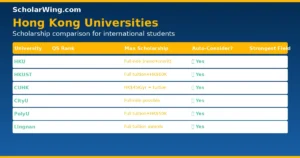
Top Universities in Hong Kong — Which Is Right for You?
The University of Hong Kong (HKU) QS 2026: #11 globally. Strongest in medicine, law, humanities, and social sciences. Need-aware financial aid available through CSS Profile. Campus in Pokfulam with outstanding views of the harbor. Early decision rounds open around October.
HKUST Top-ranked globally for engineering and technology. Strong business school. IB score-based automatic scholarships make planning straightforward. Waterfront campus in Clear Water Bay. Excellent for STEM and quantitative finance.
CUHK QS 2026: #32 globally. Shenzhen campus gives access to Greater Bay Area opportunities. Strong in social sciences, arts, and research. CUHK Medical School is Asia’s most prestigious. High-achieving students automatically considered for admission scholarships.
CityU Public administration ranked #1 in Asia. Strong in creative media, law, and business. Full-ride scholarships available for outstanding non-local students. Merit-based automatic consideration upon application.
PolyU Practical, career-oriented programs in data science, AI, applied sciences, and design. Strong industry connections. Non-local entry scholarships up to full tuition plus allowance.
HKBU Triple-accredited business school (AACSB, EQUIS, AMBA). Lingnan University — ranked 2nd globally for Quality Education in THE Impact Rankings. Liberal arts focus, service-learning emphasis.
Admission Process — Step by Step
Step 1: Choose your university and program Research programs at your target university. Note that HK deadlines run parallel to the US — Early Decision rounds open around October with results in December or January. Regular admissions run January to March.
Step 2: Prepare required documents
- Academic transcripts
- CV or resume
- Statement of Purpose (SOP)
- Two or three recommendation letters
- IELTS or TOEFL scores (IELTS 6.5-7.0 or TOEFL 90-100 for most programs; some competitive programs require 7.0+)
- Passport
Use ScholarWing’s free tools:
Step 3: Apply online through each university’s portal Many HK universities limit extracurricular activities listed, PolyU allows only three (each requiring a certificate), HKUST caps at five honors and five activities. Be strategic with what you include.
Step 4: Interview Almost every HK university conducts interviews for scholarship consideration. Formats vary, some are academic, some assess leadership and personal fit. Prepare specific examples from your background.
Step 5: HKPFS application (for PhD students) Apply to HKPFS simultaneously with your university PhD application. Deadline typically November. Apply at cerg.ugc.edu.hk.
Student Visa for Hong Kong
Non-local international students need a student entry permit to study in Hong Kong for programs lasting more than 180 days.
Application process:
- Receive admission offer from your Hong Kong university
- University submits a sponsorship form on your behalf
- Apply for student entry permit through the Hong Kong Immigration Department
- Processing typically takes 4-6 weeks
Key documents:
- Valid passport
- University admission letter
- Passport-size photographs
- Application form (ID995A)
- Proof of financial means
Work rights: International students can work up to 20 hours per week during term time and full-time during holidays. Many postgraduate students also work as Research Assistants (RAs) or Teaching Assistants (TAs), which come with stipends or tuition waivers.
After graduation — IANG: International graduates can apply for the Immigration Arrangements for Non-local Graduates (IANG) — a visa that allows you to stay and work in Hong Kong for up to 24 months without a confirmed job offer. This is a significant post-graduation pathway.
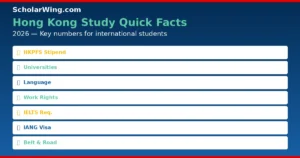
Cost of Living in Hong Kong
Hong Kong is one of Asia’s most expensive cities. Budget planning is essential.
Typical monthly costs:
- Accommodation: HK$4,000-8,000/month (university hostel is cheaper; private market is very expensive)
- Food: HK$3,000-5,000/month (dining out affordable in local eateries; Western restaurants expensive)
- Transport: HK$500-1,000/month (MTR is efficient and not expensive by international standards)
- Personal expenses: HK$1,000-2,000/month
Total typical budget: HK$9,000-19,000/month (~USD 1,150-2,430)
Important context: University hostels are heavily subsidized and should be your priority accommodation. Most universities offer on-campus housing for international students — apply for it immediately upon admission acceptance.
HKPFS stipend perspective: The HK$340,800 annual stipend (~HK$28,400/month) comfortably covers Hong Kong living costs, making it one of the most livable PhD funding packages globally.
Why Hong Kong for International Students?
1. Asia’s gateway city Hong Kong is a major global financial hub and gateway to Mainland China’s Greater Bay Area — the economic cluster including Shenzhen, Guangzhou, and Macau with a combined economy larger than many G20 countries. HK graduates have access to one of the world’s largest job markets.
2. English-medium throughout All major Hong Kong universities teach in English at undergraduate, Master’s, and PhD level. Cantonese and Mandarin classes are offered for daily life but are not required for academic programs.
3. Global career outcomes Graduates from HK universities are sought after by international employers. The city’s finance, tech, legal, and research sectors actively recruit HKU, HKUST, and CUHK alumni.
4. Automatic scholarship consideration Unlike most European or North American universities where scholarships require separate applications, many HK universities consider you automatically at the point of admission. Strong academic records are rewarded without extra process.
5. Research funding Hong Kong’s research universities have access to substantial Research Grants Council funding. PhD students at HK universities are typically well-resourced compared to equivalent programs in other Asian countries.
Practical Tips for Applying to Hong Kong
1. Apply early — full scholarships are awarded in the first admissions round Most full scholarships at HKU, HKUST, CityU, and CUHK are awarded during the early admissions round (October-December). Applying in the regular round significantly reduces scholarship chances. Submit as early as possible.
2. HKPFS — apply in November, not later The Hong Kong PhD Fellowship Scheme closes in November for the following academic year. Start your PhD research proposal and supervisor contacts by July-August to meet this timeline.
3. Contact potential PhD supervisors before applying For HKPFS and university PhD programs, a prior email contact with your intended supervisor strengthens your application significantly — this is similar to the DAAD PhD process. Read one of their recent papers and write a short, specific email.
4. Research the IANG visa option If you plan to stay in Hong Kong after graduation, the IANG visa gives you 24 months to find employment without a job offer in hand. This is a major advantage over most other Asian study destinations.
5. University hostel is essential — apply immediately Hong Kong private rental market is one of the world’s most expensive. University hostel allocation is limited and competitive. Apply for on-campus accommodation the moment you receive your admission offer.
FAQ
Which Hong Kong university is best for international students?
This depends on your field. HKU (#11 QS 2026) for medicine, law, and humanities; HKUST for engineering, technology, and quantitative finance; CUHK (#32 QS 2026) for social sciences and research; CityU for public policy (ranked #1 in Asia) and creative media; PolyU for applied sciences and design.
What is the Hong Kong PhD Fellowship Scheme?
The HKPFS is a flagship PhD scholarship administered by the Research Grants Council, providing an annual stipend of HK$337,200-340,800 (~USD 43,000+) plus travel allowance. It is open to PhD applicants of any nationality and is among Asia’s most generous PhD fellowships. Applications typically close in November.
Are Hong Kong universities English-medium?
Yes, all major Hong Kong universities (HKU, HKUST, CUHK, CityU, PolyU) teach in English at all degree levels.
Can international students work in Hong Kong?
Yes, up to 20 hours per week during term time and full-time during holidays. PhD students often have additional RA/TA income. After graduation, IANG visa allows 24 months of job-seeking residency.
Is Hong Kong eligible for Belt and Road Scholarship?
Yes, the Belt and Road Scholarship is established for students from BRI countries studying at publicly-funded Hong Kong universities. Pakistan, Bangladesh, and most African and Central Asian countries are BRI members.
When do Hong Kong university applications open?
Early decision rounds open around October with results in December or January. Regular admissions run January to March. Apply early, most full scholarships are awarded in the first round.
Related Guides:
- Malaysian Government Scholarship 2027 — Complete Guide | MIS + MTCP | Postgraduate | All Countries
- Brunei Darussalam Government Scholarship (BDGS) 2027 — Complete Guide | All Countries | Fully Funded
- How to Study in South Korea for Free 2026-27 — GKS $800/Month | No IELTS | Min GPA 2.64 | Complete Guide