
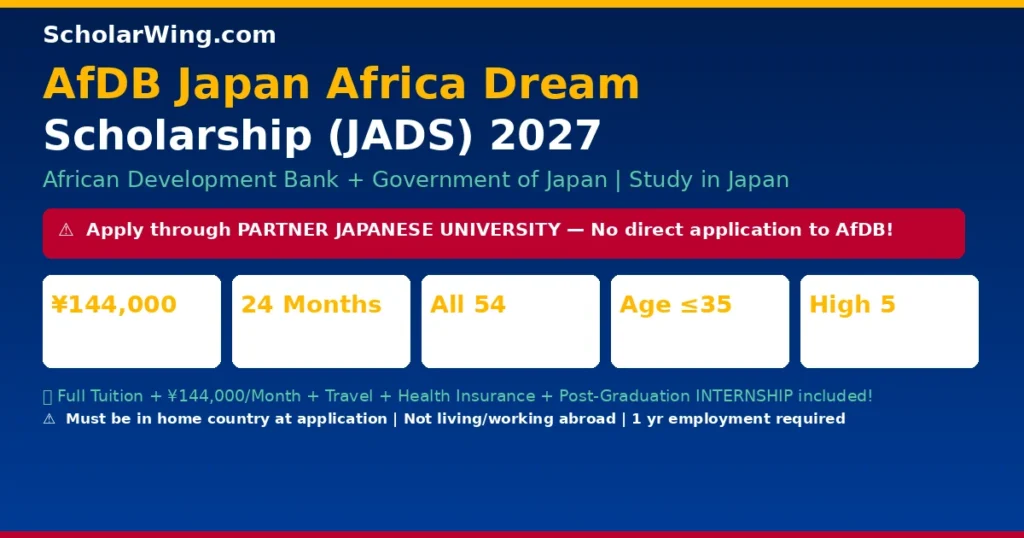
The AfDB’s Flagship Scholarship Sends African Students to Japan — Not the UK, France, or Germany
When people search for “AfDB scholarship,” they find a program that most Africa scholarship guides handle in two sentences. This guide covers it in depth because the Japan Africa Dream Scholarship (JADS) has specific operational requirements that routinely eliminate candidates who haven’t read carefully enough.
The Japan Africa Dream Scholarship (JADS) Program is a capacity-building initiative jointly funded by the African Development Bank (AfDB) and the Government of Japan aimed at building Africa’s human-resource capacity in key development sectors aligned with AfDB’s “High 5” strategic priorities.
The “High 5” are AfDB’s five strategic development pillars for Africa:
- Feed Africa — agricultural transformation, food security
- Light up and power Africa — energy access, electricity
- Industrialize Africa — manufacturing, value chains
- Integrate Africa — regional trade, connectivity
- Improve quality of life — health, social services, human development
The scholarship offers high-achieving African students a two-year opportunity to pursue postgraduate studies at the master’s level in energy, agriculture, health, environmental sustainability, and engineering.
The fields are not arbitrary. They are specifically selected to build human capital in exactly the areas AfDB’s strategy prioritizes. Your application will be strongest when your field, your professional experience, and your post-scholarship plan connect directly to one or more of the High 5.
Japan Africa Dream Scholarship:
The Japan Africa Dream Scholarship is a fully funded opportunity: full tuition, 144,000 JPY monthly stipend ($11,420/year), travel costs, health insurance, and a post-graduation internship.
The post-graduation internship is one of JADS’s most distinctive features not just a scholarship, but a program that extends into your professional transition after completing the degree.
Critical process fact: All applications must be initiated through JADS partner universities. There is no direct or separate application to the African Development Bank.
You apply to a Japanese partner university. The university evaluates and nominates you to AfDB. AfDB makes the final selection. If you approach AfDB directly, nothing happens.
What Is the AfDB — The Institution Behind the Scholarship
The African Development Bank Group (AfDB) is a multilateral development finance institution established in 1964, headquartered in Abidjan, Côte d’Ivoire. It is one of the world’s largest multilateral development banks, focused exclusively on the African continent.
The AfDB Ten-Year Strategy (2024-2033) is sharply focused on five major areas the High 5 to accelerate delivery for Africa: Feed Africa, Light up and power Africa, Industrialize Africa, Integrate Africa, and Improve the quality of life of the people of Africa.
The Japan Africa Dream Scholarship is one of AfDB’s human capital investment programs recognizing that infrastructure, financing, and policy reform alone cannot develop Africa. The people who design, implement, and manage Africa’s development projects need world-class education. JADS is designed to send Africa’s most capable young professionals to Japan’s leading universities to gain exactly that education then return home to apply it.
Why Japan specifically? Japan is a world leader in the specific fields JADS prioritizes infrastructure engineering, agricultural technology, energy systems, environmental management, and public health. Japan’s universities (and its bilateral development cooperation through ODA and JICA) have a long partnership history with Africa. JADS formalizes this through AfDB’s institutional framework.
Full Financial Package — What JADS Covers
Comprehensive financial support covering: Full tuition for the duration of the study program (24 months). Monthly living stipend of 144,000 JPY ($11,420/year). Travel costs. Health insurance. Additional funding for research and thesis preparation. Post-graduation internship.
Detailed Breakdown:
Full Tuition — 24 Months All academic and enrollment fees at the partner Japanese university, paid directly for the full 2-year Master’s program.
Monthly Stipend: 144,000 JPY/month 144,000 JPY monthly living stipend ($11,420/year), approximately USD 950-980/month at current exchange rates. In Japan, 144,000 JPY/month covers modest but comfortable living in most university cities (Beppu/Oita for APU, Tsukuba for University of Tsukuba).
Travel Costs International flights to and from Japan from your African home country at the start of the scholarship and upon return at completion.
Health Insurance Medical coverage throughout the scholarship period in Japan.
Research and Thesis Preparation Funding Additional financial support for research activities, data collection, fieldwork, and thesis preparation costs.
Post-Graduation Internship Post-graduate internship support. This is JADS’s distinctive feature, the program does not end at graduation. An internship opportunity is provided to help scholars transition from their Master’s degree into professional roles where they can apply their new expertise.
Important Financial Restriction:
The JADS stipend may be withdrawn completely or partially if during the scholarship period the program has evidence of additional sources of support.
Unlike some scholarships that permit part-time work, JADS is structured around the assumption that the stipend is your sole income source. Evidence of additional income from part-time work, other scholarships, or other sources, may result in stipend reduction or withdrawal.
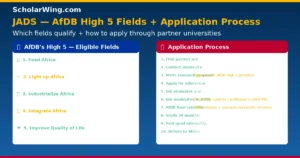
AfDB’s “High 5” Strategic Priorities — What Fields Qualify
Your field of study must align with AfDB’s development mandate. The five strategic priorities are:
High 5 Priority 1: Feed Africa
Related study fields: Agricultural science, food technology, agribusiness, nutrition science, agricultural economics, rural development, irrigation engineering, soil science, food systems management.
Context: Africa has 60% of the world’s uncultivated arable land. Transforming African agriculture from subsistence to productive commercial farming is one of the continent’s most critical development imperatives. AfDB specifically funds agricultural scholars to develop the expertise needed to drive this transformation.
High 5 Priority 2: Light up and Power Africa
Related study fields: Energy engineering, electrical engineering, renewable energy systems, power systems, energy policy, sustainable energy technology.
Context: Over 600 million Africans lack access to electricity. Solar, wind, hydropower, and geothermal are all areas where Japan has world-class university expertise making JADS particularly relevant for energy scholars.
High 5 Priority 3: Industrialize Africa
Related study fields: Industrial engineering, manufacturing, value chain management, supply chain, materials science, chemical engineering.
Context: Africa’s manufacturing share of GDP is among the world’s lowest. Building industrial capability requires the engineers, technologists, and managers who can design and operate factories, processing facilities, and value chains.
High 5 Priority 4: Integrate Africa
Related study fields: Transport engineering, infrastructure development, trade policy, logistics, regional integration, civil engineering, urban planning.
Context: Africa’s infrastructure gap roads, railways, ports, power lines prevents intra-African trade. Building the engineers and planners who can design and implement continental infrastructure integration is a core AfDB priority.
High 5 Priority 5: Improve Quality of Life
Related study fields: Public health, epidemiology, social policy, education management, health systems, water and sanitation engineering.
Context: Health outcomes, education access, and quality of social services across Africa require professionals trained in evidence-based, systems-level thinking. Japanese public health and health engineering programs have specific strengths here.
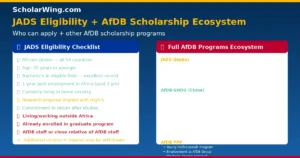
Eligibility — Full Requirements
Nationality: Must be a citizen of an African Development Bank member country. Age Limit: Must be 35 years old or younger.
Full Eligibility Requirements:
1. AfDB Regional Member Country Citizenship All 54 African countries are AfDB regional member countries. Every African citizen is eligible based on nationality.
2. Age: 35 Years or Younger Candidates should be 35 years old or younger, and in good health.
At 35, this is one of the more generous age limits in this scholarship series, younger than most DAAD and Chevening applicants who are 30-35, but significantly more generous than some scholarships that cut off at 29.
3. Bachelor’s Degree in an Eligible Field Should have a minimum of a Bachelor’s degree or its equivalent in energy, agriculture, health, environmental sustainability, engineering studies or related areas; and have excellent academic records.
4. At Least 1 Year Paid Employment Applicants should have at least 1 year of paid employment in their home country or in other African countries after receiving their Bachelor’s degree within the past 3 years.
This is a critical requirement that eliminates fresh graduates. You must have:
- Completed your Bachelor’s degree
- Worked in a paid position in your home country or another African country
- For at least 1 year
- All of this within the past 3 years
A student who graduated 6 months ago is not (insufficient work experience). A student who graduated 5 years ago is not (outside the “past 3 years” window).
Additional:
5. Currently Living in Home Country Not be living or working outside of your home country.
Diaspora professionals African citizens living in Europe, North America, or anywhere outside Africa are not eligible. You must be currently resident and working in an African country.
6. Not Currently Enrolled in a Graduate Program Not already be enrolled in a graduate degree program.
You cannot use JADS to continue or top up a degree you are already pursuing. You must be applying fresh.
7. Not AfDB Staff or Close Relative AfDB employees and their close family members (parents, siblings, children, aunts, uncles, nephews, nieces) are not eligible.
8. Commitment to Return Upon completion of studies, scholars are expected to return to their home countries and contribute to national and continental socio-economic development, using the newly acquired knowledge and skills.
Application Process — Through Partner Universities Only
Applicant requests information and application forms from the chosen JADS partner university. Applicant completes required documents and sends them to the university. University evaluates and selects applicants. University sends selected candidates to the AfDB. AfDB reviews submissions from universities, prepares and approves the final list. AfDB contacts selected awardees and informs the universities.
The critical first step: Contact a JADS partner university in Japan. Visit each university’s international admissions or JADS-specific page.
Step-by-Step:
Step 1: Identify your partner university Visit afdb.org and find the current list of JADS partner universities. Confirmed partners include Ritsumeikan Asia Pacific University (APU), University of Tsukuba, Yokohama National University, and others.
2: Contact the chosen university Request admission information and JADS-specific application guidelines from the university’s international office or JADS coordinator.
Step 3: Apply for university admission For Ritsumeikan APU April 2027 enrollment: apply by September 15, 2026. For September 2027 enrollment: apply by November 5, 2026 or January 8, 2027. Each university has its own deadlines, check each one directly.
4: Prepare the Research Proposal Prepare your Research Proposal in alignment with the indicators of the AfDB’s High 5 priorities.
The research proposal is a critical application component. It must:
- Identify a specific development challenge in Africa
- Align with one or more AfDB High 5 priorities
- Propose a research approach to address that challenge
- Connect to your chosen Master’s program at the Japanese university
Step 5: Receive provisional offer from university The university evaluates your application and issues a provisional offer letter to successful candidates.
6: University nominates you to AfDB The university submits its selected candidates to AfDB’s JADS Program Implementation Unit (PIU).
Step 7: AfDB final selection AfDB evaluates all nominations, approves the final list, and contacts successful scholars directly.
Documents Required
Based on standard JADS requirements across partner universities:
| Document | Notes |
|---|---|
| ✅ Application form | University-specific form |
| ✅ Research proposal | Aligned with AfDB High 5 priorities |
| ✅ CV / Resume | Including all employment history |
| ✅ Academic transcripts | All degrees |
| ✅ Degree certificates | Bachelor’s + any other qualifications |
| ✅ Employment certificate | Proof of 1 year paid employment |
| ✅ Two recommendation letters | Academic + professional references |
| ✅ Medical certificate | Health clearance |
| ✅ Passport | Valid |
| ✅ Statement of purpose | Why Japan, why this program, development impact |
Beyond JADS — Other AfDB Scholarship Streams
AfDB-SHOU (Shanghai Ocean University) Scholarship
The African Development Bank Group and Shanghai Ocean University (SHOU) invite interested and qualified African nationals to apply for the 2026 SHOU Scholarship Programs, focused on sustainable fisheries, aquaculture, and marine resource management.
For African students in fisheries science, marine biology, aquaculture, and ocean governance, the AfDB-SHOU scholarship funds study in China at one of the world’s leading institutions in this field.
AfDB Internship Program
Not a scholarship an internship at AfDB headquarters (Abidjan, Côte d’Ivoire) or regional offices for currently enrolled Master’s students. Opens annually. Stipend-supported.
AfDB Young Professionals Program (YPP)
Employment at the AfDB itself not a scholarship, but a structured early career program for exceptional African graduates at Master’s level or above.
Practical Tips for JADS Applicants
1. Choose your partner university based on program fit — not prestige Different Japanese universities specialize in different fields. APU (Ritsumeikan) is strong in development economics, sustainability, and international business. University of Tsukuba has strong engineering and science programs. Choose the university whose specific program best matches your research proposal and career goals.
2. The research proposal is your most critical document It is strongly recommended that you develop your proposal in alignment with the indicators of the High 5 set by the AfDB. A generic research proposal with no specific Africa connection will not succeed. Your proposal must name a specific African development challenge, connect it to an AfDB High 5 priority, and explain how your proposed research addresses it.
3. Work experience documentation must be clear You need to demonstrate at least 1 year of paid employment in Africa after your Bachelor’s degree within the past 3 years. Employment certificates, contracts, pay slips collect all of this before applying.
4. Being in your home country is not negotiable If you are currently working or studying outside Africa, you must return to your home country before applying. The “not living outside home country” requirement is explicit. Applying from Europe or North America while holding an African passport will not work.
5. Start at the university, not AfDB This bears repeating. Visit afdb.org to find partner universities, then go directly to the university’s international office for JADS application guidance. Do not email AfDB to apply.
6. Stipend is your only income source Plan your budget in Japan around 144,000 JPY/month exclusively. Do not plan to supplement with part-time work evidence of additional income may reduce or eliminate your stipend.
Japan as a Study Destination for African Scholars
Studying in Japan through JADS places African scholars in one of the world’s most technologically advanced societies:
Relevant technology advantages: Japan leads globally in agricultural technology (precision farming, greenhouse systems), energy systems (fuel cells, efficient grids), environmental engineering (waste management, disaster resilience), and public health infrastructure.
Living in Japan: Japanese university cities (Oita/Beppu for APU, Tsukuba, Yokohama) have lower living costs than Tokyo. The 144,000 JPY/month stipend is workable in these locations for student living.
Language: Most JADS programs are taught in English. Japanese language learning is encouraged but not required for the scholarship. Some programs include Japanese language courses as part of the curriculum.
Safety and environment: Japan consistently ranks among the world’s safest countries. Cities are clean, public transport is excellent, and the social environment for international students is increasingly welcoming.
Return investment: A Japanese engineering, agricultural, or health systems degree is recognized globally and carries specific prestige in Asia-Pacific development networks opening doors beyond Africa for future career development.
Quick Reference
| Element | Detail |
|---|---|
| Full name | Japan Africa Dream Scholarship (JADS) |
| Co-funded by | AfDB + Government of Japan |
| Study in | Japan (partner universities) |
| Duration | 24 months (2 years) Master’s |
| Monthly stipend | 144,000 JPY (~$952/month) |
| Tuition | 100% covered |
| Travel | Covered |
| Health insurance | Covered |
| Internship | Post-graduation internship included |
| Eligible | All 54 African countries |
| Age | 35 or younger |
| Work experience | 1 year paid in Africa (within past 3 years) |
| Location | Must be in home country at application |
| Fields | Energy, agriculture, health, environment, engineering |
| Application | Through partner university — NOT AfDB directly |
| Research proposal | Required — aligned with High 5 |
| Additional income | Can result in stipend withdrawal |
FAQ
What is the AfDB-JADS?
The Japan Africa Dream Scholarship Program is a capacity-building initiative jointly funded by the African Development Bank and the Government of Japan, offering high-achieving African students a two-year opportunity to pursue postgraduate studies at the master’s level in energy, agriculture, health, environmental sustainability, and engineering.
Who is eligible?
Citizens of African Development Bank member countries, 35 years old or younger, with at least 1 year paid employment after their Bachelor’s degree (within past 3 years), currently living in their home country, not already enrolled in a graduate program.
How much is the monthly stipend?
144,000 JPY monthly (~$11,420/year) — approximately $952/month.
Do I apply directly to AfDB?
No, all applications must be initiated through JADS partner universities. There is no direct application to the African Development Bank.
What is the research proposal aligned with?
The AfDB’s High 5 strategic priorities: Feed Africa, Light up and Power Africa, Industrialize Africa, Integrate Africa, and Improve Quality of Life.
What happens if I earn additional income during the scholarship?
The JADS stipend may be withdrawn completely or partially if during the scholarship period the program has evidence of additional sources of support.
What other AfDB scholarships exist?
Beyond JADS, AfDB has partnered with Shanghai Ocean University (SHOU) for fisheries/marine scholarships. AfDB also runs an internship program and a Young Professionals Program (employment at AfDB).