
WFSA Fellowship Programme:
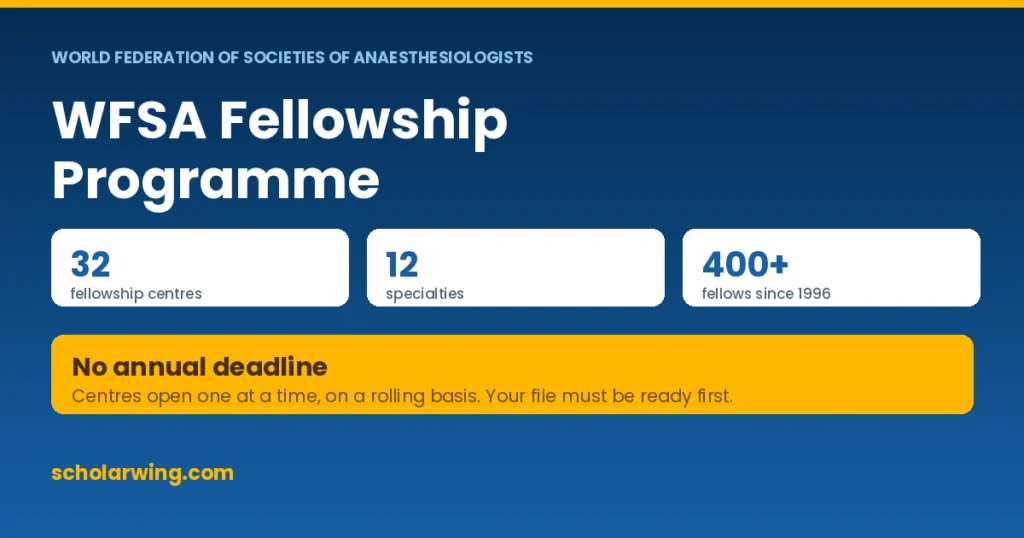
Most fellowship guides start with a deadline. This programme has none, and understanding why changes how you apply.
What WFSA actually runs
The World Federation of Societies of Anesthesiologists funds anesthesiologists from low and middle-income countries to sub-specialize abroad and then lead anesthesia care at home.
The programme began with three fellows in 1996. It has since trained more than 400 fellows from 62 countries across 12 specialties, through 32 fellowship centers on five continents.
The twelve specialties cover regional, pediatric, obstetric, cardiac, thoracic, neuro, intensive care, pain management, onco-anesthesia, general anesthesia, research, and medical education with simulation. Placements run from two months to a full year.
That range is the point. Few funders in any medical field offer this much choice of subspecialty and this much choice of country.
The rolling system, and what it means for you
WFSA states that fellowships open to applicants on a rolling, case-by-case basis, with new openings announced on its Opportunities page.
So there is no single date. A center opens, recruits and closes, and another opens months later in a different country and a different subspecialty.
Two consequences follow, and they decide whether you ever win one of these.
First, finish the preparation before the opening appears. A call that runs for a few weeks is no time to start collecting society letters and certified translations. Build the file now, keep it current, and apply the week a center opens.
Second, you must actually watch the page. Nobody emails you. Check WFSA’s Opportunities page monthly, and note that the center table can lag behind the news announcements, so read both.
The status today, and the awkward part
Reading WFSA’s own center table on 20 October 2026, the picture is sober. One center shows as accepting: Onco-Anesthesia at Tata Medical Center, Kolkata, for twelve months. Six sit on hold, including research at Groote Schuur in Cape Town, pediatrics in Santiago and Mexico City, pain management in Buenos Aires, regional in Fortaleza, and research at Ohio State. The other twenty-five show as not accepting.
That is normal for a rolling programme rather than a sign of collapse. Centers cycle.
Now the awkward part for readers in Pakistan. Nine of WFSA’s 32 centers sit in India, including the only one currently open, and for a Pakistani doctor India is the single hardest destination in the directory. Our guide to studying in India sets out what that visa actually involves and why professional training there is so restricted.
So read the directory with your own passport in hand, and build your plan around the centers you can realistically reach: Thailand, Morocco, Tunisia, Ghana, Nigeria, Kenya, Uganda, Zambia, Serbia, Brazil, Colombia, Chile, Argentina, Mexico, South Africa and the USA.

The gate that stops most applicants
Every WFSA fellowship requires support from your National Anesthesiology Society, and that society must be a WFSA member society.
For doctors in several countries this single line ends the application. It does not end yours.
WFSA’s own member list records the Pakistan Society of Anesthesiologists (Centre) as a member society since 1976, at PMA House, Agha Khan III Road, Garden, Karachi, reachable at info@psacentre.org.
So the letter you need exists, from an organization that has belonged to WFSA for fifty years. Write to them before you need it, not during a three-week application window.
Eligibility criteria
1. A qualified physician, fully trained in anesthesia under your own country’s regulations.
2. Support from your National Anesthesiology Society, which must be a WFSA member.
3. Support from your current workplace, meaning your head of department or hospital management.
4. A recognized post to return to in your home country.
5. Early-career anesthesiologists preferred, and a post at a teaching hospital preferred.
6. A valid passport for travel abroad.
7. Registration eligibility in the host country, where the host requires it.
What the file looks like
WFSA’s call for its Nairobi pediatric fellowship sets out the pattern, and the documents repeat across centers. That call asked for a CV with a recent photograph and two referees’ names, a letter from the national anesthesiology society, a letter from the head of department or hospital management, a copy of the medical degree, a copy of the specialist anesthesiology qualification, and a copy of the passport photograph page.
Two of those come from other people, and they are the slow part. Our guide on asking a supervisor for a reference letter covers briefing them so the letter says something specific, and the free CV builder handles the CV itself.
One warning from that same call. The host university ran its own separate application, with certified degree and transcript copies, verification of foreign qualifications, school certificates, a certificate of good standing, police clearance, and evidence of yellow fever and hepatitis B vaccination. The WFSA application and the host’s application are two different files, and missing the second one costs you the place.
Step-by-step application process
Step 1, this week: write to the Pakistan Society of Anesthesiologists. Ask how they handle WFSA fellowship endorsements and who signs. Do this before any opening appears, because this letter sets your timeline.
Step 2, this week: speak to your head of department. WFSA needs their support and your assurance of a post to return to, which means an honest conversation about a six to twelve month absence.
Step 3, November: read the center directory properly and shortlist three centers by subspecialty, duration and country you can actually enter.
Step 4, November: build the core file now. CV with photograph and two referees, medical degree, specialist qualification, passport page. Scan everything properly and keep it in one folder.
Step 5, November: arrange certified English translations of anything not already in English.
Step 6, from December: check WFSA’s Opportunities page monthly. Read the news announcements as well as the center table, because the two can disagree.
Step 7, when a center opens: apply through WFSA’s online platform, selecting the fellowship chapter and the specific category for that center.
Step 8, same week: start the host institution’s own application if it has one. Police clearance and vaccination records take weeks.
Step 9: watch your email closely after the closing date. That Nairobi call gave successful applicants two days to confirm before the place passed to the next applicant.
Step 10, on acceptance: deal with host-country medical registration, which several hosts require before you arrive.

What the funding covers
WFSA’s programme page does not state a universal figure, and the amounts differ by center.
The Nairobi call stated that successful applicants receive funding for tuition, accommodation and subsistence living expenses, without naming an amount. We print no figure here, because WFSA publishes none, and any site quoting you a WFSA stipend has taken it from somewhere other than WFSA.
Ask the center coordinator directly what the fellowship pays, what it excludes, and whether it covers flights, before you accept a place. Those three answers decide whether a twelve-month fellowship is affordable for your family.
FAQ
What is the WFSA Fellowship Programme?
Funded anesthesia fellowships for doctors from low and middle-income countries, run by the World Federation of Societies of Anesthesiologists across 32 centers worldwide.
How many fellows has it trained?
More than 400 fellows from 62 countries since 1996, across 12 specialties.
When is the deadline?
There is none. Fellowships open on a rolling, case-by-case basis, announced on WFSA’s Opportunities page.
Which subspecialties are available?
Regional, pediatric, obstetric, cardiac, thoracic, neuro, intensive care, pain management, onco-anesthesia, general, research, and medical education with simulation.
How long are the fellowships?
From two months to a full year, depending on the center.
Can Pakistani anesthesiologists apply?
Yes. WFSA requires a letter from a member national society, and the Pakistan Society of Anesthesiologists (Centre) has been a WFSA member since 1976.
Which center is open right now?
On 20 October 2026, WFSA’s table showed Onco-Anesthesia at Tata Medical Center, Kolkata, as accepting. Check the page before you act, since the status changes.
What does it pay?
WFSA publishes no universal figure. One call described funding for tuition, accommodation and subsistence. Ask the center.
What documents do I need?
A CV with photograph and two referees, a national society letter, a head of department letter, your medical degree, your specialist qualification and your passport page.
Is one application enough?
Often not. Several hosts run their own separate application with its own documents, including police clearance and vaccination records.
How fast must I respond if selected?
One call gave two days to confirm before the place moved to the next applicant.
Where else should I look?
Our medical and health sciences scholarships page carries the rest of the field.