
Hidden Scholarships for Radiology, Nuclear Medicine and Medical Physics
Search for radiology scholarships and you will find the same twenty government awards every site lists. Fulbright, Chevening, DAAD, MEXT.
Meanwhile the largest funder of radiology, nuclear medicine, radiotherapy and medical physics training for Pakistani professionals runs a programme that no scholarship website covers at all.
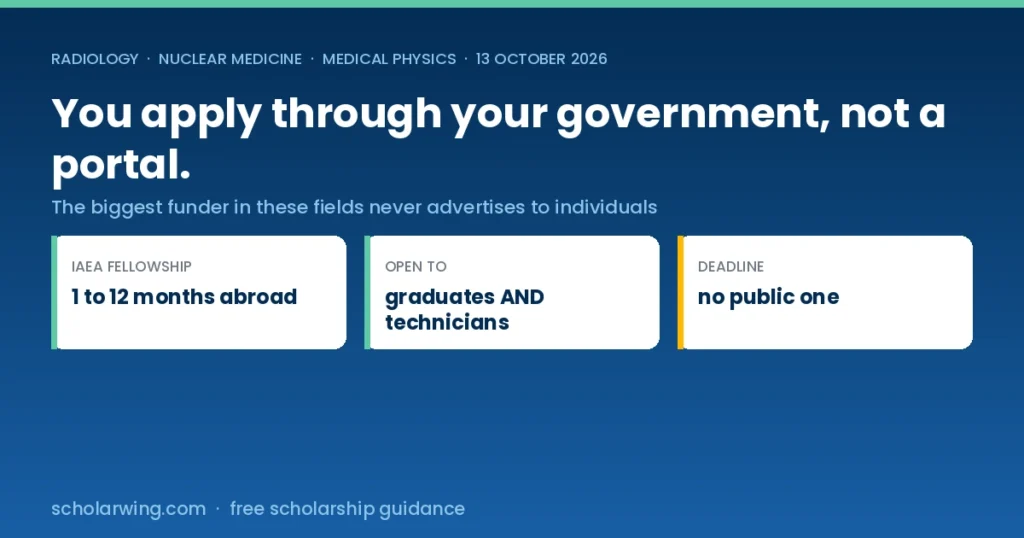
That funder is the International Atomic Energy Agency, and the reason it stays invisible is simple. The IAEA gives training to countries, not to individuals. There is no public portal, no advertisement, no deadline announcement. Applications travel through your government. Nothing exists for a scholarship blog to copy, so nothing gets copied.
This guide covers that route and two others that work the same quiet way.
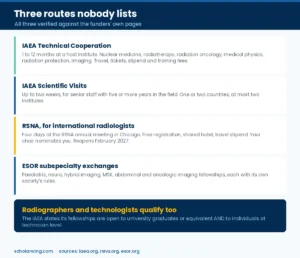
Route one: IAEA Technical Cooperation fellowships
The IAEA funds training in the peaceful application of nuclear science, which in medicine means nuclear medicine, radiotherapy, radiation oncology, medical physics, radiation protection and diagnostic imaging.
It runs two separate things, and people confuse them constantly.
Fellowships last from one month to twelve months, usually at least a month, and the IAEA says it normally awards them for periods of up to one year. Training happens at a host institute, mostly as project-oriented, on-the-job work. The IAEA also runs long-term academic training, sandwich training split between the host country and home, and e-learning delivered in your own country.
Scientific Visits last a maximum of two weeks, cover one or two countries in the same region and at most two institutes, and target senior people rather than trainees.
The fellowship is the one most readers want. The scientific visit is the one a head of department wants.
Route two: RSNA’s programme for international radiologists
The Radiological Society of North America runs Introduction to Research for International Young Academics, built specifically for radiologists outside the United States and Canada.
It is a four-day seminar held during the RSNA annual meeting at McCormick Place in Chicago, running 30 November to 3 December 2026 for the current cycle. Successful candidates receive complimentary registration, shared hotel accommodation for the duration, and a stipend to help reduce travel expenses.
The 2026 cycle has closed. RSNA states it reopens in February 2027.
This is not a degree and not a long fellowship. It is a four-day door into academic radiology, and the people who walk through it meet the editors and researchers who decide what gets published in the field.
Route three: ESOR subspecialty exchange fellowships
The European School of Radiology runs exchange programmes with Europe’s subspecialty societies, each one a fellowship in a specific area: paediatric radiology, neuroradiology, hybrid imaging, musculoskeletal radiology, abdominal radiology and oncologic imaging, under a visiting scholarship structure.
If you already know your subspecialty, this is the most targeted route of the three.
Eligibility criteria, route by route
IAEA fellowships
- University graduates or equivalent, and individuals at technician level, in the requested field. The IAEA states both, which means radiographers and technologists qualify alongside doctors and physicists.
- Junior professionals form the intended group for fellowships.
- Your nomination must align with an existing IAEA Technical Cooperation project work plan in your country. This is the condition that decides most applications, and we explain it below.
- Language proficiency counts in selection, and the IAEA names it explicitly.
- Academic credentials and proof of language proficiency form part of the file.
IAEA scientific visits
- At least five years in the project or field, and an appropriate advisory or management position.
- At least two years of experience in the project or field, a university degree or equivalent, and suitable academic or technical qualifications.
- Age limit: five years below the retirement age in your home country.
RSNA Introduction to Research for International Young Academics
- An RSNA member from outside the United States or Canada, fluent in English.
- In a radiology residency or fellowship, or a radiologist no more than two years out of training.
- Starting or considering an academic career.
- Nominated by your department chair or training director. You cannot nominate yourself.
How the selection actually works at the IAEA
Three factors decide an IAEA fellowship, and only one of them is about you.
Your qualifications, educational and professional.
The needs of your member state. The IAEA funds what the country’s programme requires, not what an individual would enjoy.
How many fellowships your country has already received. The IAEA balances allocation across member states, so a country that has drawn heavily recently competes differently from one that has not.
That is why the Technical Cooperation project matters so much. If Pakistan runs an active project on, say, radiotherapy quality assurance, training in that area has a route. A request that sits outside every active project has no route at all, however strong the candidate.
So the first question to ask is not “am I eligible” but “which IAEA projects is my country running right now, and does my field sit inside one”.
The application process, step by step
For an IAEA fellowship
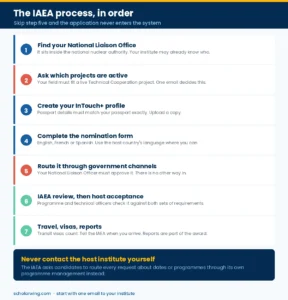
Step one. Find your National Liaison Office. Every member state has one, and it sits inside the national nuclear authority. For Pakistan, start with the Pakistan Atomic Energy Commission, which signs the agreements with the IAEA, and confirm the current National Liaison Officer through the IAEA’s own official member state contacts listing. Your hospital or institute may already know who this is, because institutions that have sent people before keep the contact.
Step two. Ask which Technical Cooperation projects are active, and whether your field fits one. One email, and it decides everything that follows.
Step three. Create your InTouch+ profile. The IAEA runs applications through its InTouch+ portal. Your passport details must match your passport exactly, and you upload a copy.
Step four. Complete the nomination form. Forms come in English, French and Spanish, and the IAEA advises completing them in the host country’s language where possible.
Step five. Get it through government channels. The IAEA states that application forms must reach it through government channels, and your National Liaison Officer must approve the form. This is the step people skip, and a form that arrives any other way does not get processed.
Step six. Wait through the IAEA’s internal review. Programme management and technical officers check it against both host country and IAEA requirements, then the IAEA secures host country acceptance.
Step seven. Arrange travel, visas and payment once the IAEA confirms. Transit visas count. Tell the IAEA when you arrive, including your accommodation address.
Step eight. Report on schedule. Training reports and a final report are part of the award, and fellows receive a certificate at the end.
One rule worth memorising. Do not contact the host institute directly to change dates or programme details. The IAEA instructs candidates to route every such request through its own programme management, and going around that causes real problems.
For RSNA
Speak to your department chair or training director, since they submit the nomination. Join RSNA as an international member if you have not. Watch for the cycle to reopen in February 2027, and write to international@rsna.org with any question — they answer.
For ESOR
Go to the exchange programme for your subspecialty on the European School of Radiology site and read that programme’s own rules, since each subspecialty society sets its own.
Frequently asked questions
Is the IAEA fellowship fully funded?
The IAEA arranges travel, air tickets, a stipend and training fees, and its process documents list all four. It does not publish the stipend amount publicly, because rates depend on the host country. Ask your National Liaison Officer for the current figure rather than trusting any article.
Can I apply to the IAEA directly, without my government?
No. The IAEA states that application forms must be submitted through government channels and that the National Liaison Officer approves them. An application sent any other way does not enter the system.
I am a radiographer, not a doctor. Can I apply?
Yes. The IAEA states that fellowships are available to university graduates or their equivalent and to individuals at technician level. Very few funders say that, and most radiographers never find out.
Is there a deadline?
Not a public one. IAEA fellowships run against project work plans rather than an annual call, which is exactly why no scholarship site can list them. The practical answer is to ask your National Liaison Office when the next cycle of nominations is being collected.
What is sandwich training?
Training split between the host country and your home country, which the IAEA offers as one of its formats. For people who cannot leave their post for twelve continuous months, it is often the realistic option.
Is there an age limit?
For fellowships, the guidance we read states none, and describes the target group as junior professionals. For scientific visits there is one: five years below the retirement age in your home country.
Can I choose my own host institute?
Not freely. The IAEA secures host country acceptance as part of its own process, and asks candidates not to approach institutes directly about dates or programmes.
What if my country already received many fellowships this year?
It counts against you. The IAEA weighs the number of fellowships a member state has previously received when it allocates. Nothing you can do about it, but worth knowing before you read a rejection as a judgement on your work.
Who should pursue this
If you work in nuclear medicine, radiotherapy, radiation oncology or medical physics in Pakistan, the IAEA route is the strongest and least crowded option available to you, and almost nobody around you knows it exists. Start with one email to your institute about the National Liaison Office.
If you are a radiology resident aiming at an academic career, prepare for the RSNA programme to reopen in February 2027, and speak to your chair now, since they nominate.
If you already know your radiology subspecialty, read the ESOR exchange programme for that subspecialty.
And if you want a full research degree rather than training, remember that across Europe a PhD is salaried employment with no tuition fee and no nationality restriction — our DTU Denmark post and ORFeus guide explain that market, and medical imaging research sits squarely inside it.
This guide is part of our complete guide to scholarships for medical students.
We checked every claim on this page on 13 October 2026.