
Microsoft Research PhD Fellowship: The Money Goes to Your University, Not to You
Microsoft runs this programme today as the Microsoft Research Fellowship, and the design differs from what most people picture when they search for a PhD fellowship.
Two things surprise almost everyone who reads the official page carefully.
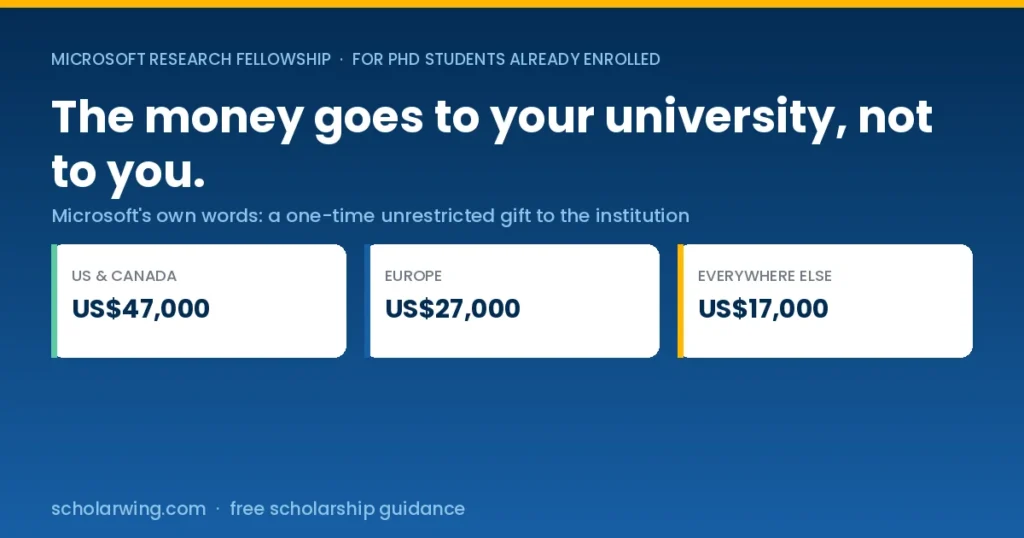
The award goes to your institution, not to you. Microsoft’s own wording calls it a one-time unrestricted gift paid to the university. Your department decides how it reaches you, if it reaches you directly at all.
The amount depends on where your university sits, not on your work, your field or your need. The same fellowship pays US$47,000 at a Canadian university and US$17,000 at an Indian one.
Neither fact makes it a bad opportunity. Both change how you should think about it.
What it pays, by region
Microsoft publishes three bands, and the money includes travel funding for working with Microsoft Research in person.
US$47,000 for institutions in the United States and Canada.
US$27,000 for institutions in Europe.
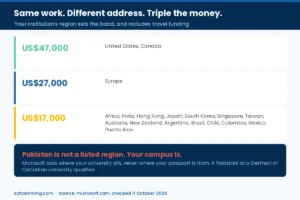
US$17,000 for institutions in Africa, Australia and New Zealand, India, Hong Kong, Japan, South Korea, Singapore, Taiwan, Argentina, Brazil, Chile, Colombia, Mexico and Puerto Rico.
Microsoft says it reviews these rates each year, so treat the figures as current rather than permanent. Payments for the most recent round were scheduled for March and April.
The region list, read carefully
Here is Microsoft’s full list of eligible regions: Africa; Australia and New Zealand; Canada; Europe; India; Hong Kong; Japan; South Korea; Singapore; Taiwan; Argentina; Brazil; Chile; Colombia; Mexico; Puerto Rico; the United States.
Pakistan does not appear on that list, and neither does any other part of South Asia except India. The Middle East does not appear either.
But read the rule that governs it, because this one works in your favor in a way the last two fellowships we covered did not.
Eligibility follows your university, not your passport. Microsoft’s requirement is that everyone named on a proposal sits at a degree-granting university in an eligible region. It says nothing about citizenship.
So a Pakistani student doing a PhD at a German, Canadian, Singaporean or South African university is eligible. A Pakistani student at a university in Pakistan is not, however strong the work.
That distinction is worth understanding properly, because it applies to a surprising number of corporate research programmes.
Who can actually apply
Three groups, and the rules differ for each.
PhD students may apply on their own behalf. You must be actively pursuing a PhD at an accredited, degree-granting institution. No nomination, no head of department signing you off.
Faculty may apply, as professors, assistant professors or associate professors holding a terminal degree. A faculty proposal must name a PhD student or equivalent collaborator, and if the proposal wins, both of them become Fellows. So if your supervisor applies and names you, you are a Fellow too.
Postdocs may apply with an attestation of support from a faculty adviser or department chair.
Notice who is missing. You must already be doing a PhD. This is not a route into one, and no amount of preparation makes an applicant eligible before they enroll.
What makes this different from a scholarship
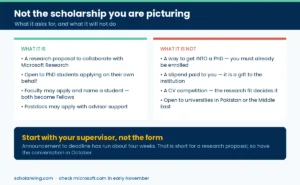
Most scholarships ask who you are. This one asks what you want to work on.
Microsoft frames the programme around open research challenges and invites proposals to collaborate with Microsoft Research on them. The selection turns on the research, the fit with Microsoft’s own work, and the collaboration you propose.
So the application is a proposal, not a personal statement, and your supervisor matters enormously. A student whose adviser already works in an area Microsoft Research cares about starts a long way ahead of a student with an excellent CV and no overlap.
If you are two years into a PhD in a relevant field, the practical first step is to read what the Microsoft Research teams in your area are publishing, and build the proposal around a real intersection.
The India route, which runs separately
Microsoft Research India operates its own PhD Award, distinct from the global fellowship.
It gives a one-time unrestricted grant of ₹10 lakhs , which the page says can top up stipends and cover conference travel, computing equipment and other development. Winners may also get a co-mentor from Microsoft Research India, and internship or collaboration opportunities where they fit.
It targets graduate students in areas MSR India works on, including algorithms and theory, machine learning and AI, systems and networking, human-computer interaction and technology for social good.
Nominations are currently closed, in the page’s own words, and it publishes no dates.
What this means for a Pakistani researcher
The honest summary runs in three parts.
If you are doing a PhD in Pakistan, this programme is not open to you, and no workaround exists. The eligibility rests on your institution’s region.
If you are doing a PhD abroad in an eligible region, your nationality is irrelevant and you should treat this as genuinely available. Talk to your supervisor about whether your group’s work touches Microsoft Research’s interests.
If you are still trying to start a PhD, this is not your programme yet, but it is one more reason to aim for a funded position in Europe, Canada or the Asia-Pacific. A salaried doctoral post opens doors like this one that a self-funded place at home does not. Our DTU Denmark post, ORFeus guide and Örebro guide cover that route, and the Hong Kong PhD Fellowship Scheme takes any nationality with no age limit.
On the dates, and why we are careful
Microsoft announced its most recent round in early November with a 2 December proposal deadline, and the programme page carries the year 2026.
Several sites now print “2 December 2026” for the same programme. We cannot tell from Microsoft’s own page whether that reflects a new round or a copied year, and we will not guess, because a wrong deadline costs you a month.
So do this instead. Open Microsoft’s academic programmes page in early November and look for the announcement yourself. That has been the pattern, and the window between announcement and deadline runs to roughly four weeks, which is short for a research proposal.
Start the conversation with your supervisor in October, not December.
We checked every claim on this page on 11 October 2026.