
Faculty for the Future: US$50,000 a Year for Women in STEM, and the Country List You Must Check First
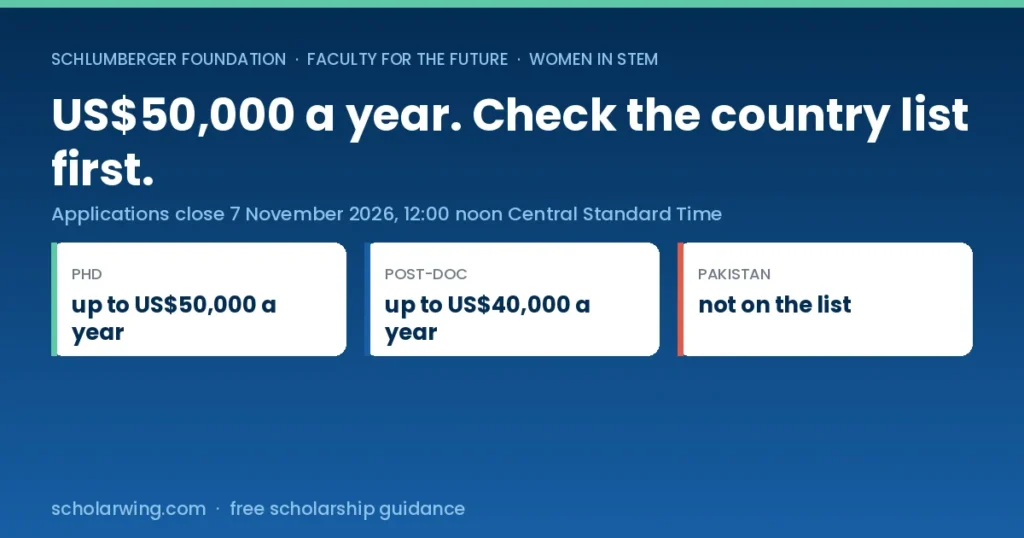
The Schlumberger Foundation funds women from developing countries to do a PhD or post-doctoral research abroad, and the amounts are serious: up to US$50,000 a year for a PhD and up to US$40,000 a year for a post-doc.
Applications for the 2027 fellowships close on 7 November 2026 at 12:00 noon Central Standard Time, UTC-6. Reference letters follow a week later, on 14 November 2026.
Before you read another line, open the Foundation’s eligible country list. That one page decides whether the rest of this post applies to you, and it does not include every country people assume it does.
What the fellowship actually gives you
The Foundation pays a maximum of US$50,000 a year for PhD study and a maximum of US$40,000 a year for post-doctoral research.
Read “maximum” carefully. The Foundation’s own wording is that grants rest on actual costs for eligible expenses, so this works as a reimbursement ceiling rather than a flat cheque. Two fellows at different universities will receive different amounts.
The grant runs for one year and you reapply for each further year. Renewal is not automatic. The Foundation says so in those words. It weighs your performance, your self-evaluation, your plan for returning home, your supervisors’ recommendations and the funding it has available. If you have already had one renewal, it expects evidence that you looked for other funding too.
Since 2004 the programme has funded women from 93 countries.
Who can apply
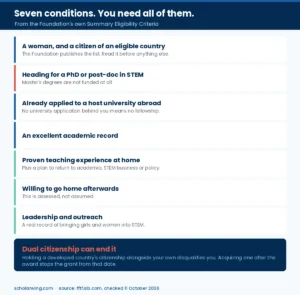
Seven conditions, and you need all of them.
You must be a woman, and a citizen of an eligible low or middle income country where women are under-represented in STEM.
You must be heading for a PhD or post-doctoral research in a STEM field. The Foundation particularly encourages physical sciences, engineering, computer science and mathematics. It does not fund master’s degrees at all.
You must already be enrolled in, admitted to, or have applied to a well-ranked host university or research institute abroad. An application with no university application behind it goes nowhere. On a sandwich course, the host university must award the final degree, or award it jointly.
You need an excellent academic record.
Your need proven teaching experience in your home country, plus a commitment to return to an academic or research post, to STEM entrepreneurship, or to evidence-based STEM policy work in the public sector.
You must be willing to go home after your studies and contribute there.
You need leadership and outreach behind you, a real record of encouraging young people, especially girls and women, into STEM.
One rule catches people out every year. Dual citizenship disqualifies you if one of those citizenships belongs to a developed country. Worse, if you acquire developed-country citizenship after winning the award, the Foundation discontinues the grant from that date.
The country list, and the hard news
The Foundation publishes a Summary Eligibility Criteria document with the full list of eligible countries. We opened it on 11 October 2026 and read every name.
Pakistan does not appear on it. Neither does India, nor Sri Lanka.
Bangladesh, Nepal and Afghanistan do appear, along with Bhutan, Cambodia, Indonesia, Myanmar, Laos, the Philippines, Timor-Leste, Kyrgyzstan, Tajikistan, Uzbekistan, Iraq, Syria, Yemen, Palestine, Libya, Morocco, Sudan, and most of sub-Saharan Africa, the Pacific islands, and parts of Latin America and the Caribbean.
We know that disappoints a large share of our readers, and we would rather you learn it today than after assembling three reference letters.
The list is not fixed. The Foundation builds it from indicators including the UN Human Development Index and the Gender Inequality Index, and it updates the list every year. Its own page warns that a country can move on or off between cycles. So if Pakistan matters to you, check that document again next September rather than treating this paragraph as permanent.
What the selection panel is really reading for
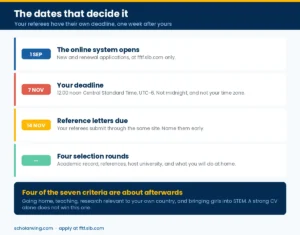
Applications pass through four selection rounds, and the criteria the Foundation publishes tell you where to put your effort.
Academic performance and the quality of your references carry weight, as does the quality of your host university. Those parts surprise nobody.
The rest is where most applications quietly lose. The panel assesses your commitment to returning home, your commitment to teaching, STEM entrepreneurship or policy making, the relevance of your research to your home country, and your commitment to inspiring girls and women into STEM.
Four of the seven criteria concern what you will do after the degree, not the degree itself.
So an application that reads as “this research interests me and I want to work abroad” scores badly here even with a strong CV. An application that explains which problem in your own country this research addresses, which institution you intend to teach at, and which girls you have already mentored, speaks the Foundation’s language.
This is not a general excellence award. It is a programme designed to build STEM faculty in countries that lack them, and it funds women who intend to become that faculty.
How to apply
Everything happens through the online system at fftf.slb.com. There is no email application and no paper route.
New applicants register for an account. Renewal applicants log in with their existing details. A move from PhD to post-doctoral research counts as a new application rather than a renewal, which trips people up.
Referees submit letters through the same site, using a login that reaches them by email once you name them. Give them the full week: the reference deadline is 14 November 2026, one week after yours.
The Foundation also runs online information sessions. Write to faculty4future@slb.com stating your citizenship and whether you are a candidate, a university, a government or an NGO representative.
If you are not on the list
Plenty of funding exists for women in STEM from countries the Foundation does not cover, and none of it requires you to be on this particular list.
Across Europe a PhD is salaried employment, with no tuition fee, no nationality restriction and no scholarship application at all. You apply to an advertised position and, if you win it, you are an employee. Our DTU Denmark post, ORFeus guide and Örebro guide explain how that market works.
In Hong Kong, the PhD Fellowship Scheme takes any nationality with no age limit.
For China, the CSC scholarship funds full PhD’s for Pakistani and Indian students every year.
And OWSD, the Organization for Women in Science for the Developing World, runs PhD and early-career fellowships for women specifically. It uses its own country list, which differs from this one, so check it directly.
The one thing to do today
Open the Summary Eligibility Criteria document on fftf.slb.com and find your country on the list.
If it is there and you are a woman heading for a STEM PhD, you have under a month, and you should be writing to referees this week rather than next.
If it is not there, close the tab and spend that hour on a route that is open to you. That decision costs you five minutes and saves you a month.
We checked every claim on this page on 11 October 2026.