
TOP USA Scholarships for International Students
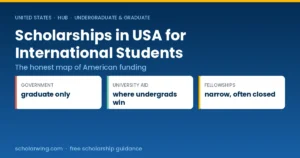
Most pages about American scholarships make the same mistake, and it sends thousands of students down a road that ends nowhere.
They list Fulbright, Humphrey and Knight-Hennessy under a heading like “fully funded scholarships in USA for international students”. A seventeen-year-old reads it, builds a two-year plan around Fulbright, and finds out far too late that Fulbright does not fund undergraduate study at all. Neither does Humphrey. Neither does Knight-Hennessy.
Meanwhile the money that would have funded that student sits in a place the listing sites barely mention: university financial aid. Harvard covers full tuition for families earning up to USD 200,000 and asks nothing at all from families below USD 100,000. Berea charges no tuition to anybody. Dartmouth, Amherst and MIT meet the full assessed need of every admitted international student.
This page maps all of it, by the route that applies to you. Each section links to our full guide, where we check the official rules and update them when they change.
The three routes, and who each one is for
Route one: United States government programmes. Fulbright and Humphrey. Prestigious, genuinely generous, and graduate or professional only. You apply through your own country, never directly to America.
Route two: university financial aid. Where undergraduate money lives. A small group of American universities meet the full assessed need of every admitted student, including international ones, as a grant you never repay.
Route three: private fellowships and merit awards. Knight-Hennessy at Stanford for graduate study, and merit scholarships at universities that are not need-blind, such as Clark.
Read your route and ignore the other two.
Route one — the US government programmes
Fulbright Foreign Student Program
Around 4,000 awards a year across more than 160 countries, for graduate students, young professionals and artists.
What nearly every listing site gets wrong: there is no single global deadline and no direct application. The programme runs through binational Fulbright Commissions or United States Embassies in your own country, and eligibility, selection and deadline all differ by country. A page printing one worldwide Fulbright date is describing something that does not exist.
Fulbright also offers two placement models. Under IIE placement the programme applies to American universities on your behalf; under self-placement you apply yourself. Which applies depends on your country’s commission.
Undergraduates: this is not for you. Read route two.
→ Full guide: Fulbright Scholarship
Route two — the universities that fund undergraduates
This is the part of the American system students outside the country rarely understand, and it moves the largest sums. Five of them, each with its own guide.
Harvard
The most generous terms of any university on this list, and the clearest about international students: “International students are eligible for exactly the same aid as American students,” and “your financial need and your aid application will never affect your chance of being admitted.”
The thresholds matter. For families with incomes up to USD 200,000, aid covers at least full tuition. For families with incomes below USD 100,000, the expected parent contribution is zero. Harvard meets 100 per cent of demonstrated need and never requires a loan. A quarter of Harvard families pay nothing at all.
→ Full guide: Harvard University financial aid for international students
MIT
MIT states that it is “committed to meeting 100% of demonstrated financial need for international students, just as we are for domestic students.” The same assessment, the same formula, no separate international pot.
→ Full guide: MIT financial aid for international students
Dartmouth
Dartmouth extended its need-blind admissions policy to all international citizens beginning with the Class of 2026, and meets the demonstrated need of all admitted undergraduates, including those from other countries. Its aid includes an allowance for travel to the United States, which few universities fund.
One detail worth planning for: international students have no summer earnings requirement in the first year, but contribute USD 1,500 a year afterwards, alongside an estimated USD 2,450 of term-time work income built into the award.
→ Full guide: Dartmouth College international financial aid
Amherst
Amherst is need-blind for international applicants — it “will not take into account whether you have applied or intend to apply for financial aid in the admission process” — meets 100 per cent of calculated need, and packages no student loans in its initial offer.
→ Full guide: Amherst College international financial aid
Berea
The most unusual institution in American higher education, and the one most worth knowing about if your family can contribute nothing.
Berea charges no tuition to anyone. Its funded package covers tuition, housing, meals, fees and supplies, plus a laptop the student keeps after graduation, a USD 400 stipend for professional clothing, and an average of USD 4,000 towards internships. Students pay zero, with no loans. From Fall 2027 the college guarantees covering all tuition costs for admitted students.
Two honest cautions. Berea selects on financial need as well as academic potential, so students from comfortable families do not qualify. And it admits a very small number of international students each year, which makes it among the most competitive places on this page despite its modest public profile.
→ Full guide: Berea College scholarship for international students
What all five have in common
There is often no scholarship to apply for. Princeton, which runs the same model, says it plainly: it offers no academic or athletic merit scholarships at all. At universities like these, the financial aid application is the funding application. A student who writes a brilliant admission essay and skips the aid forms receives an offer they cannot afford to accept.
So stop searching for scholarships at these universities. Start preparing the aid application, the financial documents, and the CSS Profile where a university requires one, to the same deadlines as the admission file.
And learn the difference between need-blind and need-aware. A need-blind university decides admission without looking at whether you need money. A need-aware one considers it, which means asking for aid can reduce your chance of getting in. Very few American universities are need-blind for international applicants, and the lists online name far more than actually are. Confirm the policy on each university’s own page, for your own applicant category.
Route three — fellowships and merit awards
Knight-Hennessy Scholars, Stanford
Funding and a leadership programme for graduate students across every Stanford school.
The current status, which most sites have not updated: the 2027 cohort application closed on 6 October 2026, and the 2028 cohort application opens in summer 2027. Any page telling you to apply now is describing a door that has shut.
The structure catches people out. You submit two separate applications — one to Knight-Hennessy and one to a Stanford graduate degree programme — and both must land in time. MBA applicants must use Round 1; no other round qualifies.
→ Full guide: Knight-Hennessy Scholars at Stanford
Clark Global Scholars Program
Clark takes the opposite approach to the five universities above. It is not need-blind for international students, and it offers merit money rather than full need-based funding — which makes it a realistic target for strong students whose families can contribute something but not everything.
→ Full guide: Clark Global Scholars Program
What to do, by level
Applying for a bachelor’s degree. Build your list around the five universities above and any others you verify yourself. Treat the financial aid application as part of the admission application. Government scholarships will not fund you at this level.
Applying for a master’s or PhD. Start with your own country’s Fulbright commission, then look at departmental funding, because American PhD programmes in many fields fund their students through assistantships as a matter of course — often a surer route than any named scholarship.
A working professional with five or more years behind you. The Humphrey Fellowship is non-degree and aimed at mid-career public service professionals, with a narrower pool than Fulbright’s.
Where to get free, official help
The United States government runs a free advising network, EducationUSA, with centres in most countries. Trained advisers staff them, the advice costs nothing, and nobody there has a financial stake in where you apply. Their own guidance is blunt: international students receive significant assistance each year, “however, competition is high.”
Find your nearest centre before you pay anybody for advice about American applications. Between EducationUSA and our free tools, nothing here requires a consultant’s fee.
The mistakes that cost students years
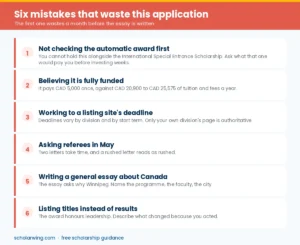
Planning an undergraduate degree around Fulbright. It funds graduate study only.
Searching for scholarships where only aid exists. At the five universities above, the aid application is the funding application.
Assuming a university is need-blind for internationals. Very few are. At a need-aware university, asking for aid can affect admission.
Trusting a single global Fulbright deadline. There is none. Your country’s commission or the US Embassy sets your rules and your date.
Applying to Knight-Hennessy without the Stanford application. Two applications, both required, and the programme deadline often falls earlier than you expect.
Paying an agent for information that is free. EducationUSA advising costs nothing and comes from the same government that funds Fulbright.
Frequently asked questions
Can international students get full scholarships in the USA?
Yes. At undergraduate level the money comes from universities that meet full need — Harvard, MIT, Dartmouth, Amherst and Berea among them. At graduate level it comes from Fulbright and from departmental funding.
Does Fulbright cover undergraduate study?
No. The Foreign Student Program is for graduate students, young professionals and artists.
How do I apply for Fulbright?
Through the binational Fulbright Commission or United States Embassy in your own country. Your national page is the only authority on eligibility and dates.
Which US universities are need-blind for international students?
Only a small group, and online lists overstate it. Harvard states your aid application will never affect admission. Dartmouth extended need-blind admission to all international citizens from the Class of 2026. Amherst states it is need-blind for international applicants. Confirm any other university on its own page.
Which university gives the most to a family that can pay nothing?
Harvard asks nothing from families earning below USD 100,000. Berea charges no tuition at all and covers housing, meals, fees and supplies, though it admits very few international students.
Is Knight-Hennessy open now? No. The 2027 cohort closed on 6 October 2026; the 2028 cohort opens in summer 2027.
Do I need SAT or ACT?
Policies vary by university and have changed repeatedly. Check each university’s current requirement for international applicants.
Are there USA scholarships that need no IELTS?
English requirements come from the university, not the scholarship. Some accept a medium of instruction letter instead of a test; our free MOI generator produces the request letter for your registrar.
What to do this week
Undergraduates: open the guides for Harvard, MIT, Dartmouth, Amherst and Berea, and write down two things for each — whether it is need-blind for international applicants, and which financial aid forms it requires. That list is worth more than any scholarship search.
Graduate applicants: read our Fulbright guide, find your own country’s commission, and look at departmental funding in your field.
Everyone: find your nearest EducationUSA centre.
When you reach the writing stage, our tools cost nothing and need no account — the personal statement generator for American applications, the CV reviewer to check your academic CV line by line, and the email reviewer before you write to a professor. The full set sits on our free tools page.
For funded routes outside America, see our hub on scholarships in Australia.
We checked every figure on this page against the official sources in October 2026 — the Fulbright Foreign Student Program, Knight-Hennessy Scholars, EducationUSA, and the financial aid pages of Harvard, MIT, Dartmouth, Amherst and Berea. American admission and funding rules change often, and listing sites update slowly. If you find something here that no longer matches the official page, write to us at scholarwingofficial@gmail.com and we will correct it.
Sources: Harvard College Financial Aid · MIT Student Financial Services · Dartmouth Financial Aid · Amherst College Financial Aid · Berea College · Fulbright Foreign Student Program · Knight-Hennessy Scholars, Stanford · EducationUSA