
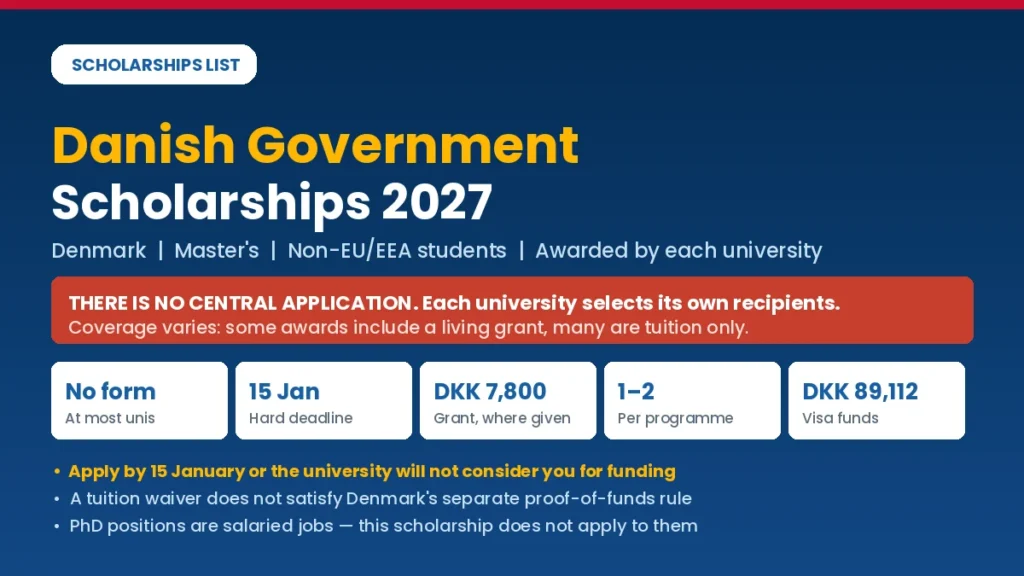
Danish Government Scholarships
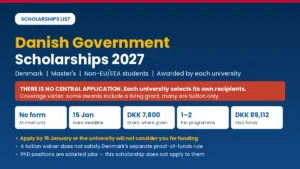
Most pages about the Danish Government Scholarship describe it as a single fully funded programme you apply to. It is neither.
There is no central Danish scholarship application. The Danish Ministry of Higher Education and Science allocates a limited pot of state scholarship money to universities each year, and each university decides who gets it, how much, and whether a monthly living grant comes with the tuition waiver. Aarhus offers “typically only one or two scholarships on each Master’s programme”. Roskilde attaches DKK 7,800 a month to its awards but runs them on four named programmes. Copenhagen, DTU and the rest each do something different.
That structure changes how you apply. You are not competing in a national round. You are competing inside one department, against the other applicants to that programme, and the thing that decides your chances is the strength of your admission application itself.
This guide covers what the scholarship actually pays, which universities do what, the 15 January deadline that decides everything, the residence permit money Denmark requires separately, and where applicants from Pakistan, India, Nigeria and Bangladesh lose their chances. We quote figures exactly as the official sources give them, and we say plainly where nobody publishes a number.
What the Danish Government Scholarship Actually Is
The formal name is the Danish State Scholarship, sometimes written as the Danish Government Scholarship for non-EU/EEA students. Study in Denmark, the official national portal, describes it as “full or partial tuition fee waivers and/or grants towards covering your living costs”, administered by the universities themselves.
Read that sentence carefully, because every ambiguity in it matters.
“Full or partial” means a waiver might cover your whole tuition or a fraction of it. “And/or” means a grant towards living costs may or may not accompany the waiver, and at several universities it does not. “Administered by the Danish universities, who each select the students” means there is no ministry to appeal to and no national form to fill in.
The portal also states the government distributes “a limited number of government scholarships each year”. It does not publish how many, and neither do most universities.
Who can apply
You qualify if you hold citizenship of a country outside the EU, the EEA and Switzerland, you pay tuition fees at Danish universities, and you are applying for a full degree programme rather than an exchange or a single course.
You fall outside the scheme if you hold a legal claim to the rights of a Danish citizen, if you already qualify for Danish state education grants, or if you are applying to an artistic higher education institution — the conservatories and art academies run under different rules.
One point that reassures many applicants: financial need is not assessed. Roskilde states its selection rests on “academic performance, motivational letter and work experience” rather than family or social circumstances, and the other universities follow the same principle. Describing hardship in your application spends words on a criterion nobody scores.
What It Is Worth
Danish tuition for non-EU students runs roughly EUR 8,000 to 18,000 a year, depending on the university and the subject.
| University | Approximate annual tuition (EUR) |
|---|---|
| University of Southern Denmark | 6,000–14,000 |
| Aarhus University | 8,000–16,000 |
| Technical University of Denmark | ~15,000 |
| Copenhagen Business School | ~16,000 |
| Danish universities generally | 8,000–18,000 |
Confirm the fee on your own programme page before relying on any of this. Fees are set per programme and revised between intakes.
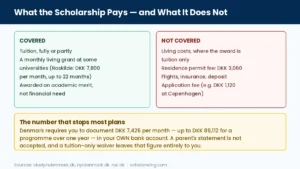
A full waiver on a two-year Master’s therefore saves somewhere between EUR 16,000 and EUR 36,000. Where a living grant comes with the waiver, Roskilde’s rate of DKK 7,800 per month for up to 22 months adds roughly DKK 171,600, about EUR 23,000, on top.
That combination — full tuition plus a living grant — is the version people mean when they call this scholarship “fully funded”. It exists. It is also the rarest version, and plenty of Danish State Scholarship holders receive a tuition waiver alone.
The Money Denmark Requires Separately
This is the part that ends more Danish plans than any rejection letter, so read it before you fall in love with a programme.
Winning a scholarship does not satisfy the Danish immigration authority. To obtain a student residence permit through SIRI, you must document funds of DKK 7,426 per month. For studies longer than a year you document a maximum of twelve months, which comes to DKK 89,112 — roughly EUR 12,000.
| Requirement | Amount |
|---|---|
| Funds to document, per month | DKK 7,426 |
| Maximum documented for a programme over one year | DKK 89,112 |
| Residence permit application fee | DKK 3,060 |
| Typical processing time | 2 months, 3 if further information is requested |
| Work allowed during term | 90 hours per month, September to May |
| Work allowed in summer | Full time in June, July and August |
The rules on that money are strict. Funds must sit in liquid assets — an accessible bank account in your own name, or a documented scholarship or loan. Bank statements from someone else’s account are not accepted. A parent’s account showing a healthy balance does not satisfy SIRI; the money has to sit in your own account.
A living grant counts towards this requirement, which is precisely why the distinction between a tuition-only waiver and a waiver-plus-grant matters so much. A student with a DKK 7,800 monthly grant has effectively met the requirement. A student with a tuition waiver alone still has to produce DKK 89,112 from somewhere.
Living costs in practice
Monthly living costs run around EUR 800 to 950 in most Danish cities and up to EUR 1,200 in Copenhagen, with rent taking EUR 600 or more of that. Housing is the binding constraint: Copenhagen and Aarhus both have genuine shortages, and student housing queues are long. Apply for accommodation the day you accept your place, not the month before you fly.
The work allowance helps but should never be your plan. Ninety hours a month at Danish student wages is real money, yet SIRI will not accept projected earnings as documented funds, and you need the permit before you can earn anything.
Which University Does What
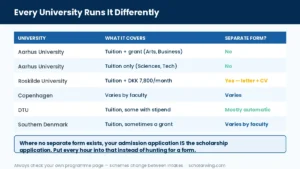
Because each institution runs its own scheme, the single most useful thing you can do is read the scholarship page of the specific university you are applying to. Here is how several of them differ, as a demonstration of why a general answer is useless.
| University | Coverage | Separate application? | Notes |
|---|---|---|---|
| Aarhus University | Tuition waiver; a monthly living grant on Arts and Business programmes, tuition only on Natural and Technical Sciences | No — automatic with admission | “Typically only one or two scholarships on each Master’s programme” |
| Roskilde University | Tuition waiver plus DKK 7,800 per month, up to 22 months | Yes — motivational letter and CV through the portal | Runs on four named programmes for the September intake |
| University of Copenhagen | Varies by faculty | Varies | Application fee of DKK 1,120 for non-EU Master’s applicants |
| Technical University of Denmark | Tuition waiver, some with a stipend | Automatic for most | Highly competitive in engineering |
| University of Southern Denmark | Tuition waiver, sometimes with a grant | Varies by faculty | Lower base tuition than Copenhagen |
Two conclusions follow. First, a student applying to Aarhus for a Natural Sciences Master’s should not expect a living grant, and should plan the DKK 89,112 accordingly. Second, at universities where the scholarship is automatic, there is no scholarship application to strengthen — your admission application is the scholarship application, and every hour you would have spent on a separate essay belongs in that instead.
The Timeline That Decides Everything
The deadline is the single most common reason applicants from our region lose this scholarship, and it is earlier than most people expect.
| Stage | Date | Where |
|---|---|---|
| Applications open | Early November | The university’s own portal |
| Deadline for scholarship consideration, summer intake | 15 January | University portal |
| Deadline, winter intake where offered | 15 September | University portal |
| Admission decisions | Late April to May | Email from the university |
| Scholarship decisions | Usually with or shortly after admission | |
| Residence permit application | Immediately after acceptance | nyidanmark.dk |
| Studies begin | Late August or early September | Denmark |
Dates shift slightly between universities and intakes. Confirm on your own programme page before acting.
Aarhus states the rule plainly: only applicants who apply by 15 January for summer admission, or 15 September for winter admission, are considered for Danish State Scholarships. Applying on 20 January may still get you admitted. It will not get you funded.
Work backwards from that date. Transcripts certified and translated by November. English test booked by October, because scores take two weeks to arrive and a retake needs a further month. Documents uploaded in the first week of January rather than the last, since portals slow badly under deadline load.
What Actually Decides Your Application
At most Danish universities the scholarship follows the admission decision, which means the committee is choosing between applicants it has already decided to admit. Three things separate them.
Academic record, read as a trajectory
Danish departments read transcripts rather than averages. An upward trend across your degree is read differently from a decline, and a thesis in the area of the programme carries weight that a general high average does not. Where your CGPA is modest, our CGPA calculator will tell you what your figure converts to, though the honest advice is to write the transcript figure on the form rather than your own conversion.
The motivation letter, where a programme wants one
Roskilde requires a motivational letter and a CV, and names them as selection criteria. Where a programme wants a letter, it decides more than the transcript does, because every shortlisted applicant already has a good transcript.
Danish academic culture rewards directness. State what you intend to study, why this programme rather than a similar one elsewhere, and what you will do with it. Name a research group, a course, a laboratory. Avoid praise for the university, avoid childhood anecdotes, and avoid the word “passionate” entirely. Our free motivation letter generator produces a structured first draft, and our SOP generator covers the longer form where a programme asks for one.
Relevant experience
Roskilde lists work experience explicitly. Research assistance, a publication, fieldwork, an internship with real responsibility or a tool you built all count, and they count most when you explain what came out of them rather than listing them. Build the document with our free CV builder, which follows the European academic convention: no photograph, no date of birth, no marital status and no national ID number.
Language Requirements
Danish Master’s programmes taught in English require documented English proficiency, typically IELTS 6.5 overall or TOEFL iBT 83 to 88, with some programmes asking for more. Several universities also accept a degree taught fully in English as evidence, properly documented.
Denmark additionally applies its own school-level English requirement, usually called English B or English A depending on the programme. This is a Danish upper-secondary level, and applicants from outside Europe satisfy it through a recognised test rather than a school certificate. Read the specific wording on your programme page, because a programme asking for English A wants a higher score than one asking for English B.
If your degree was taught in English, check whether your university will exempt you before paying a test fee. Our free MOI certificate generator produces the wording most institutions accept, though your own university must issue and stamp the final document.
Practice free with our IELTS and TOEFL practice tool, which runs full-length reading passages with a timer rather than short extracts.
Seven Mistakes That Cost Applicants This Scholarship
1. Searching for a national application form. There is none. Time spent looking for one is time not spent on the admission application that actually decides the outcome.
2. Missing 15 January. The scholarship deadline sits months before the programme’s general deadline at several universities. Calendar it in October.
3. Assuming a living grant comes with the waiver. At several faculties it does not, and the difference is DKK 89,112 you must then document yourself.
4. Relying on a parent’s bank statement. SIRI does not accept an account in someone else’s name. Transfer the funds to your own account, well before you apply, and keep them there.
5. Applying to a programme without checking whether it participates. Roskilde runs its scheme on four named programmes. Applying to a fifth and hoping is a wasted application.
6. Writing a motivation letter about the university. Danish committees want to read about your work, not their reputation.
7. Leaving housing until the offer arrives. Copenhagen and Aarhus have real shortages. Join the queues the week you accept.
Realistic Odds and How to Improve Them
Nobody publishes an overall success rate, and anyone who quotes one is guessing. What the universities do publish tells you enough: Aarhus awards “typically only one or two” per Master’s programme, and the ministry calls the national pot limited.
Against odds like that, several things remain within your control.
Choose a programme you genuinely fit rather than the best-known one, because when a department has one scholarship to give it goes to the applicant whose background matches the programme most closely. Apply early in the window, with complete documents, so no part of your file waits on a missing transcript. Where a programme asks for a motivation letter, write it about your own work in specific terms. And apply in parallel to other Nordic schemes on similar calendars — Uppsala’s IPK scholarships, the Lund Global Scholarship and the Swedish Institute’s SISGP, which covers living costs and travel as well as tuition.
Denmark also allows graduates six months to look for work after finishing a degree, which changes the arithmetic on a two-year investment. Check the current rules on nyidanmark.dk, since post-study conditions have changed more than once.
Denmark Compared With the Other Nordic Options
Applicants rarely apply to one Nordic country alone, and the four systems differ in ways that should shape where you put your effort.
| Country | Scheme | Covers | Central application? |
|---|---|---|---|
| Denmark | Danish State Scholarship | Tuition, sometimes a living grant | No — each university decides |
| Sweden | Swedish Institute SISGP | Tuition, living costs, travel, insurance | Yes, one national round |
| Sweden | University schemes (Lund, Uppsala, KTH) | Tuition only | Per university, after the programme deadline |
| Norway | No tuition at public universities for anyone | Nothing to apply for on tuition | Not applicable |
| Finland | University scholarships | 50–100% of tuition, occasionally a stipend | With the admission application |
Three practical conclusions come out of that table.
Norway charges no tuition at public universities, including for non-EU students, which sounds like the obvious answer until you price Norwegian living costs and the proof of funds its immigration authority demands. The tuition saving simply moves the problem to the maintenance requirement, and Oslo is more expensive than Copenhagen.
Sweden’s SISGP is the only scheme in the region that solves the living-cost problem outright, which is exactly why it is the hardest to win. It runs on its own national calendar, separate from any university, and holding it changes everything about a Nordic plan.
Denmark sits between the two. Its scholarship is easier to be considered for than SISGP, because at most universities you need take no separate action at all, and harder to win at any given programme, because there may be only one award.
The practical strategy follows: apply to Danish programmes where your background fits closely, apply to SISGP in parallel if your profile suits it, and treat Norway as the fallback that removes tuition but demands savings.
What Studying in Denmark Is Actually Like
Three things shape the experience for international students, and none of them appears in a scholarship announcement.
The teaching style will surprise you.
Danish universities run on group work, project reports and oral examinations to a degree that few other systems match. Students arriving from a lecture-and-final-exam tradition often find the first semester disorienting: less direction from the lecturer, more responsibility for organizing your own group, and an oral exam where you defend your work in conversation rather than writing for three hours. Aalborg and Roskilde build entire programmes around project work. This suits some students enormously and unsettles others, and it is worth knowing before you choose.
Housing is the real logistical problem. Copenhagen and Aarhus both have genuine shortages, and the queues for student housing are measured in months rather than weeks. Register the day you accept your place. Several universities guarantee housing for international students in the first year, which is a meaningful reason to prefer one offer over another, so check that before you decide.
Danish is not needed for the degree, and matters for everything else. Your programme runs in English and daily life accommodates that easily. Part-time work and staying after graduation are different questions: Danish moves you from competing for the small pool of English-language student jobs to the whole market. Most universities offer free or heavily subsidized Danish courses to international students, and taking them from the first semester rather than the third is the difference between conversational and useless.
On the research side, Denmark’s pull is concentrated: life sciences and pharmaceuticals around Copenhagen, wind energy and sustainability engineering at DTU and Aalborg, design at Kolding, and a strong tradition in public health and welfare-state social science. If one of those is your reason for applying, say so specifically in your application, because that is exactly the fit a department with one scholarship to give is looking for.
If the Scholarship Does Not Come Through
A rejection at one Danish university does not end a Danish plan, and several routes remain open.
Apply again next intake. Nothing prevents a second application in a later round, and an applicant with an extra year of research, a publication or relevant employment behind them is materially stronger than the year before. Danish committees read that improvement.
Look at the university’s own funds. Beyond the state scholarship, several institutions run their own smaller grants, and some faculties hold money that is advertised only on departmental pages rather than central scholarship pages. Read the department’s site, not just the admissions site.
Consider the tuition-free routes. Norway charges no tuition at public universities. Germany’s public universities charge no tuition in most states, and DAAD funds living costs separately. Both remove the largest number from the calculation, leaving maintenance as the problem to solve.
Check whether you qualify for fee exemption in Denmark itself. Students holding permanent EU or EEA residency, a Nordic country residence permit, or certain Danish residence permits pay no tuition at all. This catches more people than expected, particularly those with family already settled in Europe.
Reconsider the programme rather than the country. A department where your background matches closely will read your application more generously than a higher-ranked one where you are a marginal fit. Where a university has one scholarship per programme, fit is not a soft factor, it is the deciding one.
Frequently Asked Questions
Is the Danish Government Scholarship fully funded?
Sometimes. It covers tuition fully or partially, and a living grant may or may not come with it depending on the university and faculty. Denmark separately requires you to document DKK 7,426 per month for the residence permit.
Do I apply for the scholarship separately?
At most universities, no — the university considers you automatically once you apply for admission by the deadline. A few, including Roskilde, require a motivational letter and CV through their portal. Check your own university’s page.
What is the deadline?
15 January for summer admission at universities following the standard calendar, and 15 September where a university runs a winter intake. Applying later may still get you admitted but not funded.
How many scholarships does each university give?
Neither the ministry nor most universities publish a figure. Aarhus states that it typically offers only one or two on each Master’s programme.
Can PhD students apply?
No. A Danish PhD position is salaried employment carrying no tuition fee, so this scholarship does not apply to it.
Is financial need considered?
No. Selection rests on academic performance and, where a programme asks for a letter, on motivation and experience.
How much money do I need to show for the visa?
DKK 7,426 per month, up to a maximum of DKK 89,112 for a programme longer than a year, held in your own name in an accessible account.
Can I work while studying?
Yes — 90 hours per month from September to May, and full time in June, July and August. Never count this towards the funds you must document.
Do I need to speak Danish?
Not for an English-taught programme. Danish matters for part-time work and for staying after graduation, and most universities offer free or subsidized Danish courses to international students.