
African University (PAU) Scholarship
The African Union Scholarship Keeps African Talent in Africa — On Purpose
The Pan African University (PAU) Scholarship is Africa’s continental scholarship, the only postgraduate funding program established by African heads of state specifically to train Africans at African institutions, for African development. Understanding this philosophy is essential to understanding why the PAU exists and what it offers.
The Pan African University (PAU) is an initiative of the Heads of State and Government of the African Union. It is a premier continental university network whose mission is to provide quality postgraduate education geared towards the achievement of a prosperous, integrated, and peaceful Africa.
Every other scholarship in this guide sends African students abroad to the UK, USA, Germany, Japan, or China. The PAU specifically and deliberately does the opposite. Its four institutes are located in Kenya, Nigeria, Cameroon, and Algeria. Its student community is drawn from across Africa’s 55 countries, and ts research focuses on problems that matter to Africa water scarcity, energy access, governance, biodiversity, agricultural productivity.
The PAU scholarship provides full financial support, covering tuition fees, a monthly stipend, and in some cases, accommodation and travel, depending on the host institute.
But before everything else, one operational reality must be stated clearly:
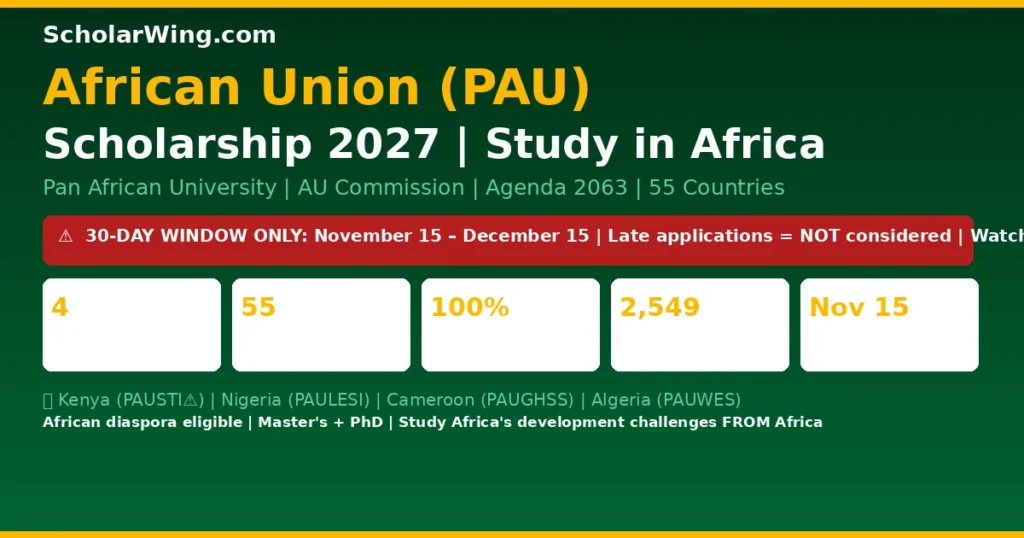
The Call will be launched on November 15th and will close on December 15th. Applications received after this deadline will NOT be considered.
Thirty days. The PAU scholarship window opens and closes in one month. Applications submitted one day after December 15 are permanently rejected. Most applicants who miss the PAU scholarship miss it because they weren’t watching for the November 15 announcement. Set a reminder now.
The 2027-28 cycle is expected to open November 15, 2026.
What Is the Pan African University — Africa’s Continental Graduate Network
The Pan African University (PAU) is a continental initiative designed to provide high-quality postgraduate education aligned with the African Union’s Agenda 2063. The university operates through four specialized institutes, each focused on thematic areas critical to Africa’s development.
The PAU was established in 2011 as part of the African Union’s broader strategy to build African human capital, reduce brain drain, and create a generation of researchers and professionals equipped to lead Africa’s transformation. It is not a single university, it is a network of four thematic institutes, each hosted at an existing African university, each specializing in a specific cluster of fields essential to Africa’s development.
Since 2014, the PAU has awarded 2,549 postgraduate certificates to students from 50 African Union Member States, including 856 women and 1,693 men.
The AU Agenda 2063 the continent’s 50-year development blueprint adopted in 2013, envisions “An Integrated, Prosperous and Peaceful Africa, driven by its own citizens.” PAU is the educational arm of this vision: training the scientists, engineers, governance specialists, and social scientists who will implement Africa’s development agenda from within the continent.
The Four PAU Institutes — Where You Will Study
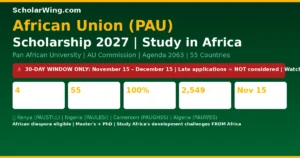
The university operates through four specialized institutes: PAUSTI in Kenya for Basic Sciences, Technology and Innovation; PAULESI in Nigeria for Life and Earth Sciences; PAUGHSS in Cameroon for Governance, Humanities, and Social Sciences; PAUWES in Algeria for Water and Energy Sciences.
Institute 1: PAUSTI — Kenya
Pan African University Institute for Basic Sciences, Technology and Innovation Host: Jomo Kenyatta University of Agriculture and Technology (JKUAT), Nairobi, Kenya
Fields: Mathematics, physics, chemistry, computer science, bioinformatics, pure and applied sciences, engineering and technology.
⚠️ Important: PAUSTI will not admit new students in 2026. For the 2026-27 cycle, PAUSTI was not accepting new applications. Check the current call (2027-28) at au.int to confirm whether PAUSTI has reopened admissions.
Institute 2: PAULESI — Nigeria
Pan African University Institute for Life and Earth Sciences (including Health and Agriculture) Host: University of Ibadan, Nigeria
Fields: Geosciences (mining exploration and petroleum geosciences), life sciences, health sciences, agriculture, veterinary vaccine production and quality control, environmental sciences.
The University of Ibadan is Nigeria’s oldest and most prestigious university, a major research institution with significant capacity in medical, agricultural, and environmental sciences.
Institute 3: PAUGHSS — Cameroon
Pan African University Institute for Governance, Humanities and Social Sciences Host: University of Yaoundé II (Soa) + University of Buea, Cameroon
Confirmed programs include Governance and Regional Integration, Conference Interpretation, Translation, and Cross-Border Languages and Intercultural Communication.
Fields: Governance, public administration, regional integration, African studies, social sciences, conference interpretation, translation, linguistics, intercultural communication.
Cameroon’s bilingual French-English character makes it particularly well-suited to the translation and intercultural communication programs and the PAUGHSS governance focus directly addresses Africa’s most critical development challenge.
Institute 4: PAUWES — Algeria
Pan African University Institute for Water and Energy Sciences (including Climate Change) Host: University of Tlemcen, Algeria
Programs include Water Sciences (Engineering or Policy tracks), Energy Sciences (Engineering or Policy tracks), and a PhD in the Water-Energy-Climate Change Nexus.
Fields: Water resources engineering, water policy, energy engineering, renewable energy policy, climate change, environmental management.
Africa’s water-energy-climate nexus is among the continent’s most pressing development challenges. PAUWES exists specifically to train the engineers and policy specialists who will tackle water scarcity, energy access, and climate adaptation across Africa.
Full Financial Package
Location: Across Africa (Kenya, Nigeria, Cameroon, and Algeria). Value and Coverage: Fully funded, covers tuition, accommodation, stipends, and travel costs.
The PAU offers full scholarships covering tuition, travel and living expenses for the entire duration of the program.
| Benefit | Detail |
|---|---|
| Full tuition | 100% — all academic fees |
| Monthly stipend | Covered — amount varies by institute |
| Travel | To and from host institution |
| Accommodation | Covered in some institutes |
| Duration | Full program length (2yr Master’s, 3-4yr PhD) |
Note: Specific stipend amounts vary by institute and are confirmed at time of offer. Contact individual institutes or pau.scholarships@africa-union.org for current rates.
Eligible Countries — All 55 AU Member States + Diaspora
The scholarship is open to students from all 55 African Union member states, as well as members of the African diaspora.
All 55 African Union member countries: Algeria, Angola, Benin, Botswana, Burkina Faso, Burundi, Cabo Verde, Cameroon, Central African Republic, Chad, Comoros, Congo-Brazzaville, DRC, Côte d’Ivoire, Djibouti, Egypt, Equatorial Guinea, Eritrea, Eswatini, Ethiopia, Gabon, Gambia, Ghana, Guinea, Guinea-Bissau, Kenya, Lesotho, Liberia, Libya, Madagascar, Malawi, Mali, Mauritania, Mauritius, Morocco, Mozambique, Namibia, Niger, Nigeria, Rwanda, São Tomé and Príncipe, Senegal, Seychelles, Sierra Leone, Somalia, South Africa, South Sudan, Sudan, Tanzania, Togo, Tunisia, Uganda, Zambia, Zimbabwe
African Diaspora: Members of the African diaspora (Africans living outside the continent) are also eligible to apply. This extends access to Africans in Europe, North America, and beyond who want to pursue their postgraduate education on the continent.
Eligibility Requirements
For Master’s Programs:
Applicants for master’s degree programs must meet the following criteria: Be not older than 25 years for male and 28 years for female applicants. Hold an undergraduate degree from a recognized university, with at least a second-class upper division or its equivalent, in a relevant field.
| Requirement | Male | Female |
|---|---|---|
| Age limit | ≤25 years | ≤28 years |
| Degree | 2nd Class Upper (2:1) minimum | 2nd Class Upper minimum |
| Field | Relevant to chosen institute | Relevant to chosen institute |
For PhD Programs:
Maximum age of 28 years old for male applicants and 30 years old for female applicants. A Master’s degree in a relevant field from PAU or any internationally recognized university.
| Requirement | Male | Female |
|---|---|---|
| Age limit | ≤28 years | ≤30 years |
| Degree | Master’s from recognized institution | Master’s from recognized institution |
| Research | 3-4 page Research Concept Note required | Research Concept Note required |
Note: Age requirements may vary slightly between cycles and between institutes. Always check the specific annual call for exact requirements.
Application Process
Applications are submitted exclusively online through the PAU application portal. Create an account on the PAU application portal using a valid username and email address.
Step-by-Step:
Step 1: Watch for the November 15 announcement The PAU call is announced on au.int every November 15. Subscribe to AU Commission updates or bookmark au.int/en/pau to be notified the moment the call opens.
Step 2: Choose your institute and program Research PAULESI, PAUGHSS, and PAUWES (check if PAUSTI has reopened). Choose the institute and specific program that matches your academic background.
Step 3: Create PAU portal account Register immediately when the call opens at the PAU application portal.
Step 4: Prepare documents
Standard documents required:
- Certified copies of academic certificates and transcripts (university and high school)
- Passport or national ID card (personal details page)
- Colored passport-size photograph (2 cm × 2 cm)
- Research Concept Note (3-4 pages, PhD applicants only)
- Names of 3 referees (PhD applicants)
Step 5: Submit before December 15 Applications received after this deadline will NOT be considered. No exceptions.
Contact for inquiries: pau.scholarships@africa-union.org | student.panafrican@gmail.com
The Pan-African Student Experience — What Makes PAU Distinctive
Studying at PAU is not the same as studying at a domestic African university. Every PAU institute admits students from across the continent, your cohort includes engineers from Nigeria, governance specialists from Ethiopia, water scientists from Morocco, linguists from DRC.
This continental cross-pollination is intentional. The AU believes that Africa’s development challenges require African collaboration and that the first step is building a generation of African professionals who have lived, studied, and built friendships across the continent’s linguistic and cultural divides.
Working languages: PAU programs operate in English and/or French depending on the host country and program. PAUGHSS in Cameroon specifically trains in conference interpretation and cross-border languages reflecting the continent’s linguistic diversity.
Research relevance: Every PAU research program is explicitly oriented toward African challenges. A PAUWES PhD on the water-energy-climate nexus addresses problems directly applicable across the Sahel, East Africa, and the Horn. A PAULESI geosciences student researches African mineral resources. A PAUGHSS governance student analyzes African integration challenges.
PAU vs Studying Abroad — The Case for African Scholarship
The honest comparison applicants must make:
| Factor | PAU | Scholarship Abroad (UK/EU/USA) |
|---|---|---|
| Location | Africa | Europe/North America |
| Network | Pan-African (55 countries) | International (often Western-centric) |
| Cost of living | Lower (African cities) | Higher (London, Paris, Tokyo) |
| Brain drain risk | Lower — based in Africa | Higher — many stay abroad |
| Research relevance | Africa-focused | Varies |
| Languages | English + French in Africa | Usually one European language |
| Career after | Strong in African institutions | Strong in international institutions |
| Alumni community | Growing pan-African network | Established global network |
PAU is not a second choice to studying abroad, it is a different proposition. Applicants who specifically want to build careers in African institutions, African governments, the African Union, African development banks, and continental NGOs often find PAU more directly relevant than a generic degree from a European university.
Quick Reference
| Element | Detail |
|---|---|
| Program | Pan African University (PAU) Scholarship |
| Administered by | African Union Commission (AUC) |
| Study in | Africa — Kenya, Nigeria, Cameroon, Algeria |
| Institutes | PAUSTI (Kenya⚠️), PAULESI (Nigeria), PAUGHSS (Cameroon), PAUWES (Algeria) |
| Coverage | Tuition + travel + stipend + accommodation |
| Countries | All 55 AU member states + African diaspora |
| Level | Master’s + PhD |
| Master’s age | ≤25 (male) |
| PhD age | ≤28 (male) |
| Master’s degree | 2nd Class Upper minimum |
| PhD degree | Master’s required |
| Application window | ⚠️ November 15 – December 15 ONLY (30 days) |
| 2027-28 opens | November 15, 2026 |
| Contact | pau.scholarships@africa-union.org |
| Total alumni | 2,549 from 50 AU member states (since 2014) |
| Aligned with | AU Agenda 2063 |
FAQ
What is the Pan African University?
The PAU is an initiative of the Heads of State and Government of the African Union, a continental university network providing quality postgraduate education aligned with Africa’s development needs.
What does the scholarship cover?
Fully funded, covers tuition, accommodation, stipends, and travel costs. Exact amounts vary by institute.
Which countries are eligible?
All 55 African Union member states and members of the African diaspora.
Is PAUSTI Kenya accepting students?
PAUSTI will not admit new students in 2026. Check the 2027-28 call for current status.
What are the age limits?
Master’s: Not older than 25 (male) and 28 (female). PhD: Maximum 28 (male) and 30 (female).