
The Mandela Rhodes Scholarship Asks a Specific Question — And Every Part of Your Application Must Answer It
The Mandela Rhodes Scholarship is a prestigious leadership and postgraduate scholarship for young African citizens who want to pursue a one-year Honors degree or two-year Master’s degree at a recognized South African university. It combines full study-related funding with a structured leadership development program designed to build ethical, capable, and impact-driven African leaders.
The Mandela Rhodes Scholarship was established in 2003, named after two iconic South African figures, Nelson Mandela and Cecil Rhodes. It is widely recognized as one of Africa’s most prestigious postgraduate scholarships, open to citizens of all 54 African countries for study at any recognized South African university.
But before everything else, there is one thing every serious applicant must understand:
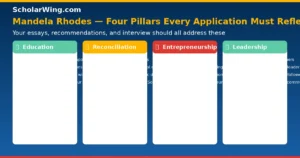
The Mandela Rhodes Scholarship is not primarily a financial award. The program focuses on education, reconciliation, entrepreneurship, and leadership, the four pillars that define what a Mandela Rhodes Scholar is expected to embody.
Your essays, your recommendation letters, and your interview, everything in the selection process asks one version of the same question: How do you embody these four pillars, and what will you do with the scholarship to advance them?
A student with a 90% GPA but no discernible commitment to African leadership, reconciliation, or entrepreneurship will struggle. A student with a 72% GPA who has genuinely led community transformation, demonstrated entrepreneurial thinking, and can articulate a credible post-scholarship contribution to Africa will compete.
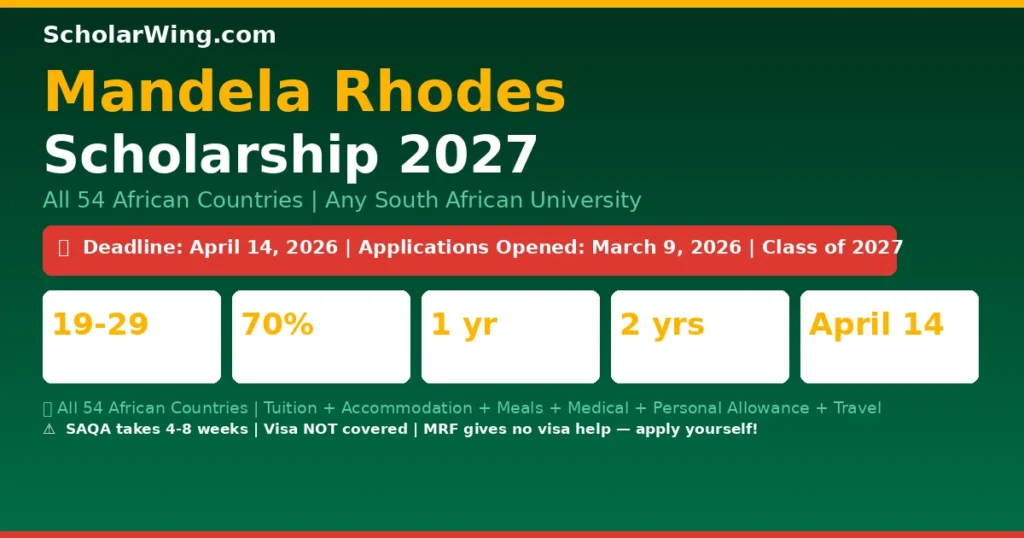
The 2027 scholarship deadline is April 14, 2026.
Applications for the Mandela Rhodes Scholarship Class of 2027 close on 14 April 2026.
Who Are the Scholarship’s Two Namesakes
Nelson Mandela (1918-2013)
Nelson Mandela was South Africa’s first democratically elected president (1994-1999), a Nobel Peace Prize laureate, and the global symbol of reconciliation, ubuntu philosophy, and dignified resistance to oppression. He spent 27 years in prison on Robben Island and emerged without bitterness choosing national reconciliation over retribution, and establishing South Africa’s post-apartheid democratic order.
Mandela’s philosophy embodied in the scholarship centers on education as liberation, reconciliation across divisions, servant leadership, and Africa’s shared future.
Cecil Rhodes (1853-1902)
Cecil Rhodes is a deliberately controversial choice for a co-namesake. A British colonial capitalist who built De Beers (the diamond empire), became Prime Minister of Cape Colony, and founded Rhodesia (now Zimbabwe and Zambia), Rhodes was a quintessential 19th-century empire builder driven, brilliant, and deeply imperialist.
The Rhodes connection brings the Rhodes Trust (which funds the Oxford Rhodes Scholarships), but it also carries deliberate symbolic weight: the Mandela Rhodes Foundation is explicitly post-apartheid, post-colonial, and reconciliation-focused, combining the most important name in African freedom history with the most prominent symbol of colonial extraction in Southern Africa.
This combination is intentional. It is itself a statement about reconciliation.
What the Scholarship Covers — Full Package
The Mandela Rhodes Scholarship covers tuition fees, accommodation, meals, and travel costs. In addition to financial support, it also offers a leadership development program.
It provides comprehensive study-related funding, including tuition, accommodation, meals, study materials, medical aid, and personal allowances.
Full Coverage:
| Benefit | Detail |
|---|---|
| Full tuition fees | 100% — Honors or Master’s at any recognized South African university |
| Accommodation | University housing covered |
| Meals | Food provision throughout the scholarship period |
| Study materials | Books, materials for your program |
| Medical aid | Health insurance during study period |
| Personal allowance | Monthly personal expenses allowance |
| Travel costs | Travel to/from South Africa and within SA for LDP activities |
What Is NOT Covered:
However, it does not cover university application fees, SAQA accreditation (if needed), or visa-related costs.
- University application fees: You pay these directly to the South African university
- SAQA accreditation: You pay for your own SAQA evaluation if required (see section below)
- Visa costs: The South African study visa application fee is your responsibility
- MRF provides no visa assistance: The MRF does not provide assistance with visa applications. Candidates must ensure that they apply for their study visa in time, it is advised to apply for a visa as soon as you receive acceptance from your university. Students who do not get their visas in time to begin the academic program and Leadership Development Program, could end up forfeiting the scholarship award.
The Four Pillars — Understanding What Mandela Rhodes Looks For
Every part of your Mandela Rhodes application the essays, the recommendations, the interview should reflect engagement with these four pillars:
Pillar 1: Education
Not just academic achievement, but education as empowerment and liberation. The Mandela philosophy treats education as the most powerful weapon for changing the world. Applications should reflect how education has shaped your values, how you have shared knowledge with others, and how you intend to use further education for broader impact.
Pillar 2: Reconciliation
This is the most distinctively South African of the four pillars. Reconciliation means bridge-building across divisions racial, ethnic, socioeconomic, political, religious. For non-South African applicants, reconciliation translates to cross-community engagement, healing of divisions in your own context, bringing together groups that are typically separated. Applications should show where you have actively worked to build bridges rather than reinforce divisions.
Pillar 3: Entrepreneurship
Entrepreneurship in the Mandela Rhodes framework means much more than starting a business. It encompasses innovation, initiative-taking, problem identification, and designing solutions. Social entrepreneurship, community enterprise, and civic innovation all count. The question is: where have you identified a problem and built something to address it?
Pillar 4: Leadership
The program is designed for young leaders who want to grow academically while also developing the values, courage, and skills needed to create equal opportunities across Africa.
Leadership means demonstrated influence on others, through community initiatives, student leadership, professional impact, or social organizing. The Mandela Rhodes conception of leadership is ethical and community-oriented, not hierarchical position-holding. A class president who did nothing is not a leader. A student who organized a community library with no title but measurable community impact is.
Eligibility — Full Requirements
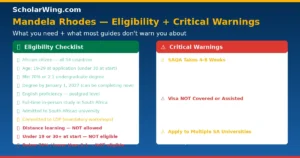
1. African Citizen All citizens of all 54 African countries are eligible. There is no restriction to sub-Saharan Africa only, North African countries (Egypt, Morocco, Tunisia, Algeria, Libya) are included.
2. Age: 19-29 Applicants must be 19 to 29 years old at the time of application and must still be under 30 when the scholarship begins.
Both conditions must be met: 19-29 at time of application AND under 30 at scholarship start. The gap matters, if you apply at 29 and the scholarship starts months later, you must still be under 30.
3. Undergraduate Degree — 70% or 2:1 Minimum Academic Excellence: You must have an undergraduate degree with a minimum average of 70% or a strong Second Class Upper (2.1) by January 1, 2027.
Currently completing your undergraduate degree? You can still apply, provided your degree is completed by January 1 of the scholarship year.
4. English Proficiency Language: You must be able to study at a postgraduate level in English. South African universities teach predominantly in English. No separate English test is required at application, but post-selection, English ability will be demonstrated through your study performance.
5. Full-Time In-Person Study in South Africa No. The scholarship requires full-time, in-person study in South Africa. Distance learning and study in your home country are not allowed.
6. Admission to a South African University You must gain admission to your chosen South African university program. The scholarship funds your study there, but admission is your responsibility. Apply to the university in parallel with the scholarship application.
The Leadership Development Program — Mandatory Participation
Scholars participate in week-long residential workshops designed to strengthen self-awareness, critical thinking, and innovation. The full scholarship program also builds a strong network of young African changemakers and encourages meaningful discussions on leadership and social impact.
The Leadership Development Program (LDP) is not optional. It is a mandatory component of the Mandela Rhodes Scholarship. Scholars who win the scholarship but decline to participate in the LDP effectively forfeit the award.
LDP features:
- Residential workshops: Week-long intensive sessions bringing all scholars together in South Africa
- Self-awareness: Deep personal reflection on values, assumptions, leadership identity
- Critical thinking: Challenging conventional wisdom on Africa’s challenges
- Entrepreneurial thinking: Innovation and problem-solving frameworks
- Peer network: The scholarship cohort becomes a lifelong network of African leaders
The LDP is the mechanism through which the Mandela Rhodes Foundation builds the alumni community, the “Mandela Rhodes family” that continues to collaborate, support, and challenge each other after the scholarship year ends.
Application Documents — What You Need
Upload the necessary documents and required essays through the application system. Applications cannot be submitted without the recommendation letters, and incomplete applications will not be considered.
| Document | Detail |
|---|---|
| Academic transcripts | Official results for all degrees |
| Degree certificate | Undergraduate degree certificate (or current enrollment proof) |
| Passport / national ID | Clear copy |
| Essay 1 | Personal journey — background, challenges overcome |
| Essay 2 | Related to the foundation’s four principles |
| 3 Recommendation letters | Submitted BY referees through the platform — not by you |
The Two Essays:
Essay 1 — Personal Journey This essay asks you to share your background where you come from, what challenges you have overcome, what shaped your values. It is not a list of achievements. It is a narrative of formation, what made you the person who is applying for this scholarship.
Essay 2 — Foundation’s Principles This essay engages with the four pillars Education, Reconciliation, Entrepreneurship, Leadership. Reflect on how these principles connect to your experience and how you plan to embody them. Do not address all four superficially. Focus deeply on one or two with specific examples.
Recommendation Letters:
Three letters of recommendation submitted by recommenders through the application platform.
The recommenders submit directly — you provide their contact information through the platform. Brief your recommenders on the four pillars and on your specific leadership, community, and academic contributions. Generic “good student” letters do not serve Mandela Rhodes applications well referees should speak to leadership, reconciliation, and impact specifically.
South African Universities — Where to Apply
Any recognized South African university is eligible for Mandela Rhodes study. You choose your university and program the scholarship follows you there.
Common choices among Mandela Rhodes Scholars:
| University | Location | Known for |
|---|---|---|
| University of Cape Town (UCT) | Cape Town | Africa’s top-ranked, law, medicine, humanities |
| University of the Witwatersrand (Wits) | Johannesburg | Engineering, medicine, economics, humanities |
| Stellenbosch University | Stellenbosch | Sciences, engineering, MBA, agriculture |
| Rhodes University | Makhanda | Small, high-quality, journalism, humanities |
| University of Pretoria (UP) | Pretoria | Engineering, sciences, law, education |
| University of KwaZulu-Natal (UKZN) | Durban/PMB | Medicine, sciences, humanities |
| University of Johannesburg (UJ) | Johannesburg | Business, sciences, humanities |
Masters programs in South Africa may require several years of work or clinical experience as an admission requirement. Research admission requirements for your chosen program before applying, some postgraduate programs in medicine, clinical psychology, and certain professional fields have experience requirements beyond a degree.
The SAQA Warning — Most Critical Operational Alert
SAQA accreditation can take between 4 and 8 weeks, therefore it is advisable to apply ASAP. The MRF does not provide assistance with SAQA applications.
If you are shortlisted, your degree must be verified by the South African Qualifications Authority (SAQA). This process routinely takes 4 to 8 weeks (and sometimes up to 90 days for foreign qualifications). Do not wait until the last minute.
For non-South African applicants, SAQA verification is a bureaucratic hurdle that has cost some scholars their scholarship. The sequence is:
- Win the scholarship
- Apply to a South African university
- University requires SAQA verification of your degree
- SAQA takes 4-8 weeks (sometimes 90 days)
- Without SAQA clearance, university admission is delayed
- Without university admission, you cannot take up the scholarship
- Scholarship forfeited
What to do: When shortlisted, begin the SAQA process immediately, the same day you receive the shortlisting notification. Do not wait for final selection to start SAQA. The cost and the process time are both non-trivial. saqa.org.za is where you begin.
Application Timeline 2027
Applications for the Class of 2027 opened on 9 March 2026.
| Event | Date |
|---|---|
| Applications open | March 9, 2026 |
| Applications close | April 14, 2026 |
| Selection process | April-November 2026 |
| Final cohort announced | Late 2026 |
| Studies begin | Late 2026 or early 2027 |
For 2028 cycle: Expected March 2027 (open), April 2027 (close). Monitor mandelarhodes.org from February 2027.
Common Mistakes
Mistake 1: Generic leadership claims without specific examples “I am a leader” is not sufficient. “I founded a peer tutoring network serving 200 students in my secondary school, reducing failure rates by 30%, and trained 15 tutors to run sessions independently” is the kind of specificity that works.
Mistake 2: Essays that don’t engage with the four pillars Your Essay 2 must directly and specifically engage with Education, Reconciliation, Entrepreneurship, and/or Leadership with concrete examples. Generic essays about “wanting to improve Africa” fail.
Mistake 3: Not starting SAQA early if shortlisted Begin SAQA the day you receive shortlisting notification. 4-8 weeks can mean the difference between studying and forfeiting.
Mistake 4: Letting your recommenders write generic references Brief your three recommenders specifically on the four pillars. Ask them to address your leadership, your community impact, your entrepreneurial thinking. “Excellent student” letters are insufficient for this scholarship.
Mistake 5: Applying to only one South African university Apply to multiple universities in parallel. If your first choice rejects your application, you need alternatives, the scholarship cannot be taken up without a South African university admission.
Mistake 6: Delaying visa application Students who do not get their visas in time to begin the academic program and Leadership Development Program could end up forfeiting the scholarship award. Apply for the visa the day you receive university acceptance.
Quick Reference
| Element | Detail |
|---|---|
| Eligible countries | All 54 African countries |
| Age | 19-29 at application; under 30 at start |
| Academic minimum | 70% average or 2:1 |
| Levels | 1-year Honors OR 2-year Master’s |
| Study destination | Any recognized South African university |
| Deadline | April 14, 2026 (for 2027 cohort) |
| Four pillars | Education, Reconciliation, Entrepreneurship, Leadership |
| Essays | 2 (personal journey + principles) |
| Recommendations | 3 (submitted by referees via platform) |
| LDP | MANDATORY residential workshops |
| SAQA | 4-8 weeks — start immediately if shortlisted |
| Visa | NOT covered, NOT assisted by MRF — apply yourself |
| Distance learning | Not allowed — full-time in-person only |
| Application fee | FREE |
FAQ
What does the Mandela Rhodes Scholarship cover?
Comprehensive study-related funding, including tuition, accommodation, meals, study materials, medical aid, and personal allowances. It does NOT cover SAQA costs, university application fees, or visa costs.
Who is eligible?
Citizens of African countries, aged 19-29, with a minimum 70% undergraduate average or 2:1 equivalent. All 54 African countries are eligible.
What is the deadline for 2027?
Applications for the Class of 2027 close on 14 April 2026.
Is the Leadership Development Program mandatory?
Yes, participation in the LDP residential workshops is mandatory. Scholars who decline to participate effectively forfeit the award.
Do I need SAQA verification?
SAQA accreditation can take between 4 and 8 weeks. Non-South African applicants may need to complete SAQA verification to confirm degree equivalency. Start it immediately if shortlisted.
Does MRF help with visas?
No, the MRF does not provide assistance with visa applications. Apply for your visa as soon as you receive university acceptance.
Can I do distance learning?
No. The scholarship requires full-time, in-person study in South Africa. Distance learning is not allowed.
Which South African universities can I choose?
Any recognized South African university, UCT, Wits, Stellenbosch, Rhodes, University of Pretoria, UKZN, UJ, NWU, UFS, and others. You choose based on your field and program.
Free Application Tools
- Motivation Letter: Motivation Letter Generator
- SOP / Study Plan: SOP Generator
- CV: Free CV Builder
- Reference Letter: Reference Letter Generator
- MOI Certificate (if needed): MOI Generator
- Research Proposal (PhD): Research Proposal Generator