
One Scholarship. Up to $50,000. Two Countries to Study In. Only Four or Five Winners Per Year.
The Africa London Nagasaki (ALN) Fund is not a scholarship most students encounter in general scholarship guides. It doesn’t appear on standard Chevening or DAAD lists and it is not administered through a government embassy or a large institutional portal.
It is a highly specialized, deeply impactful scholarship designed for a very specific type of applicant: African scientists working on infectious disease control in Africa.
The ALN scholarship fund supports African scientists wishing to undertake a Master’s degree related to the control of infectious diseases in Africa. Each year, around four scientists will receive a maximum award of US$50,000 each to cover tuition fees, travel and living expenses.
Four or five awards. Up to fifty thousand dollars each. Two world-class study destinations: the London School of Hygiene & Tropical Medicine (LSHTM) consistently ranked the world’s top institution for public health and epidemiology, or the Institute of Tropical Medicine at Nagasaki University in Japan (NEKKEN), one of Asia’s premier tropical disease research centers.
Both residential and distance learning MSc courses are available at LSHTM. Candidates offered a course at the Institute of Tropical Medicine, Nagasaki will be required to reside in Japan for the duration of the course.
If you are an African scientist working in public health, epidemiology, tropical medicine, or infectious disease and you have at least two years of research experience in a relevant field, the ALN Fund may be the most precisely targeted scholarship available to you.
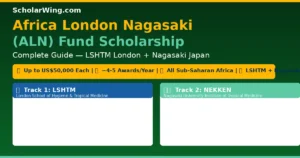
What Is the ALN Fund — Full Overview
| Detail | Information |
|---|---|
| Full Name | Africa London Nagasaki (ALN) Scholarship Fund |
| Purpose | Support African scientists for MSc in infectious disease control |
| Award Amount | Up to US$50,000 per scholar |
| Awards Per Year | ~4-5 per year |
| Covers | Tuition fees + travel + living expenses |
| Study Destinations | LSHTM, London, UK OR Nagasaki University, Japan |
| Distance Learning | Available at LSHTM only |
| Who Can Apply | African nationals resident in sub-Saharan Africa |
| Degree Required | BSc (First/2:1) in science OR MB ChB medical degree |
| Experience Required | Usually at least 2 years relevant research experience |
| Focus Area | Control of infectious disease in Africa |
| Official Site | alnscholarshipfund.org |
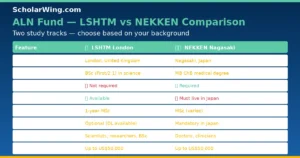
The Two Study Tracks — Choose Your Institution
Track 1: London School of Hygiene & Tropical Medicine (LSHTM), London, UK
LSHTM is the world’s leading public health and tropical medicine university. Founded in 1899, it has trained the scientists who discovered the mechanisms of malaria transmission, developed vaccines for multiple diseases, and shaped global health policy at WHO, UNICEF, and national health ministries across Africa and Asia.
Why LSHTM specifically for this scholarship: Infectious disease control in Africa requires understanding disease ecology, epidemiology methodology, vaccine science, health systems, and field research skills, all of which LSHTM teaches at the graduate level with faculty who have direct Africa field experience.
Two options at LSHTM:
- Residential (London): Study on campus in London — full immersion in LSHTM’s research environment, access to its library, labs, and global health network
- Distance Learning: Study from your location in Africa — complete the MSc online without relocating. This is unique among major scholarships — most require physical presence.
For LSHTM, candidates must be of African nationality and normally resident in sub-Saharan Africa, and be fluent in English. If the applicant’s first language is not English or studies at university have not been conducted wholly in English, candidates must take and pass an approved test: IELTS, TOEFL, or Pearson Test of English.
Degree requirement for LSHTM: Have a first or upper second class BSc degree or equivalent from an established university in a relevant area of science, a medical degree is not essential.
This is significant: you do not need to be a doctor to apply for the LSHTM track. A BSc in biology, biochemistry, microbiology, public health, environmental science, or a related field is sufficient.
Research experience: Usually at least two years’ prior research experience in a relevant area.
Track 2: Institute of Tropical Medicine, Nagasaki University (NEKKEN), Japan
The Institute of Tropical Medicine at Nagasaki University (known as NEKKEN) is one of Asia’s leading tropical medicine research institutions with decades of field experience in Africa and Southeast Asia.
Candidates offered a course at the Institute of Tropical Medicine, Nagasaki will be required to reside in Japan for the duration of the course.
No distance learning option for NEKKEN — this is residential only. You must relocate to Nagasaki, Japan.
Degree requirement for NEKKEN: Have obtained an MB ChB or equivalent medical qualification from a recognised university.
Unlike LSHTM, NEKKEN requires a medical degree — MBBS, MBChB, or equivalent. This is the doctor’s track.
What the ALN Fund Covers
Successful applicants will receive a maximum of US$50,000 each to cover tuition fees, travel and living expenses.
Tuition fees: Full MSc tuition at LSHTM or NEKKEN covered.
Travel: International flights from your home country to London or Nagasaki and return.
Living expenses: Monthly living allowance for the duration of the MSc program.
Completion requirement: Successful candidates are required to write a formal report on completion of their course. This report documents what you learned and how you intend to apply it to infectious disease control in your home country.
Maximum award: US$50,000, this is the ceiling, not a guaranteed flat amount. The actual award depends on the cost structure of the specific MSc program at your chosen institution.
Eligibility — LSHTM Track (Full Criteria)
Candidates applying for a Scholarship at LSHTM must meet the following criteria:
1. African Nationality + Sub-Saharan Residence Be of African nationality and normally be resident in sub-Saharan Africa.
This means:
- You must be a citizen of an African country
- You must currently live in sub-Saharan Africa (not North Africa)
- Diaspora Africans living in the UK, Europe, or Americas are not eligible
Eligible sub-Saharan African countries include: Nigeria, Kenya, Ghana, Tanzania, Uganda, Ethiopia, Cameroon, Zambia, Zimbabwe, Malawi, Mozambique, Namibia, Botswana, South Africa, Senegal, Sierra Leone, Liberia, Guinea, Mali, Niger, Burkina Faso, Congo, DRC, Angola, Rwanda, Burundi, Somalia, Sudan, Togo, Benin, Côte d’Ivoire, Madagascar, and all other sub-Saharan African nations.
2. First or 2:1 BSc Degree Have a first or upper second class BSc degree or equivalent from an established university in a relevant area of science. A medical degree is not essential.
Relevant degree fields: Biology, Biochemistry, Microbiology, Parasitology, Epidemiology, Public Health, Environmental Science, Pharmacology, Immunology, Veterinary Science, or related sciences.
3. Research Experience Usually at least two years’ prior research experience in a relevant area.
This is not a scholarship for fresh graduates. The ALN Fund targets working scientists who are already in the field, laboratory researchers, field epidemiologists, public health officers, disease surveillance officers, and similar professionals.
4. English Language Proficiency Be fluent in English. If the applicant’s first language is not English or studies at university were not conducted in English, candidates must take and pass one of the approved tests: IELTS, TOEFL, or Pearson Test of English.
Anglophone African scientists are naturally positioned for this.
Eligibility — NEKKEN Track (Nagasaki)
Requirements differ significantly from LSHTM:
- African nationality + resident in sub-Saharan Africa (same)
- MB ChB or equivalent medical degree (different — medical degree required)
- Willingness to reside in Nagasaki, Japan for the program duration
- Fluent in English
The NEKKEN track is specifically for medical doctors working in infectious disease not for BSc-level scientists.
Focus Areas — What “Infectious Disease Control in Africa” Means
The ALN Fund funds MSc degrees relevant to the control of infectious disease in Africa. This covers a broad but specific set of disciplines:
Epidemiology and Disease Surveillance Tracking how diseases spread, identifying outbreaks, designing surveillance systems, analyzing case data. Directly relevant to Ebola response in DRC/Sierra Leone/Guinea, cholera monitoring, COVID-19 surveillance.
Tropical Medicine Clinical and scientific study of diseases predominantly affecting tropical regions malaria, dengue, sleeping sickness (trypanosomiasis), leishmaniasis, schistosomiasis, lymphatic filariasis, and others.
Vaccinology and Immunology Development and deployment of vaccines in African contexts cold chain management, vaccine coverage analysis, immunization program design.
Medical Entomology Study of insects as disease vectors, mosquito control for malaria and dengue, tsetse fly control for sleeping sickness, sandfly control for leishmaniasis.
HIV/AIDS Science Epidemiology, treatment programs, prevention strategies, and health systems for HIV management in high-prevalence contexts.
Tuberculosis Control TB is one of Africa’s largest infectious disease burdens. MDR-TB (multi-drug resistant) and the TB-HIV co-infection are of particular research significance.
One Health Approaches The interface between human, animal, and environmental health, particularly relevant for zoonotic diseases like Ebola, Rift Valley Fever, Lassa, and brucellosis.
Why Only Four or Five Awards? — Understanding the Exclusivity
The ALN Fund awards approximately 4-5 scholarships per year across all eligible sub-Saharan African countries. This makes it one of the most selective scholarships covered on ScholarWing, far fewer awards than Chevening (hundreds), DAAD (thousands), or GKS Korea (hundreds).
The implication: the ALN Fund is not a general scholarship. It is a specialized grant for scientists at a specific career stage (2+ years post-BSc research experience) in a specific field (infectious disease control) from a specific region (sub-Saharan Africa).
If you meet that profile precisely, the exclusivity works in your favor, the pool of eligible, qualified applicants is much smaller than general postgraduate scholarship pools.
If you are a fresh BSc graduate without research experience, the ALN Fund is not your scholarship, look at Chevening, DAAD, or GKS Korea instead. Build your research record first.
Additional LSHTM Scholarships — Full Overview
Beyond the ALN Fund, LSHTM administers several other scholarships that African scientists should know about:
LSHTM Fund Scholarship (All Nationalities)
One LSHTM Fund Scholarship is available for 2026-27. The scholarship award comprises: 2026-27 tuition fees (at the overseas fee rate), including any mandatory field trip fees, and a tax-free stipend (living allowance) of GBP 22,000.
Open to ALL nationalities — not Africa-specific. For London-based MSc programs. One award per year.
GSK Scholarships for Future Health Leaders (Sub-Saharan Africa)
To be eligible, applicants must be nationals of, and resident in, countries in sub-Saharan Africa, intend to return to sub-Saharan Africa on completion, and confirm they would not be able to pay without this fund.
Preference for applicants demonstrating potential to make significant contributions to public health and health-related research in Africa. Deadline: 16:00 GMT on Wednesday 04 March 2026.
SRHPP Scholarships (Sexual and Reproductive Health — Sub-Saharan Africa)
Available for 2026-27 for the MSc in Sexual and Reproductive Health Policy and Programming. Applicants must have worked in sexual and reproductive health or other health-related fields in any sub-Saharan African country for a minimum of two years. Deadline: 16:00 BST on Sunday 22 March 2026.
Note: SRHPP scholarship does not provide a living allowance or stipend — tuition only.
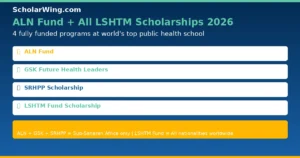
Summary: LSHTM Scholarships at a Glance
| Scholarship | Amount | Who | Deadline |
|---|---|---|---|
| ALN Fund | Up to US$50,000 | Sub-Saharan Africa (infectious disease) | Check alnscholarshipfund.org |
| LSHTM Fund | £22,000 stipend + tuition | All nationalities | Check lshtm.ac.uk |
| GSK Future Health Leaders | Full tuition + living | Sub-Saharan Africa | March 4, 2026 (2026 cycle) |
| SRHPP Scholarship | Tuition only | Sub-Saharan Africa (SRH/health field) | March 22, 2026 (2026 cycle) |
How to Apply for the ALN Fund
Register to create an account with ALN. You must have an account before you can apply. Log in to download the application form. Complete and submit the application form. No supporting documentation is required at this stage. Applications will be considered by a selection committee and four candidates will be offered scholarships. Successful candidates then apply for the MSc course at the specified university.
Step-by-step process:
Step 1: Register at alnscholarshipfund.org Create your ALN account. Without an account, you cannot access the application form.
Step 2: Download and complete the application form The initial application does not require supporting documentation, this is unusual and makes the first stage accessible.
Step 3: Submission and committee review A selection committee reviews all applications. Approximately 4 scholars are selected.
Step 4: MSc application Successful ALN scholars then apply to the specific MSc program at either LSHTM or NEKKEN. The ALN scholarship offer precedes (or is conditional on) the university admission.
Step 5: Completion report After finishing your MSc, you are required to write a formal report on what you studied and how you will apply it to infectious disease control in Africa.
Practical Tips for ALN Fund Applicants
1. Build your research record first The ALN Fund is not for students, it is for scientists. Two or more years of research experience is the standard. If you are a recent graduate, apply for other scholarships now (DAAD EPOS, GKS Korea, Chevening) and apply for ALN when your research record is stronger.
2. Connect your work to infectious disease in Africa explicitly The selection committee is evaluating whether your background and your proposed study are specifically relevant to controlling infectious disease in Africa. Generic public health interest is not sufficient. Name the disease(s) you have worked on. Name the specific control challenge you will address.
3. Consider the distance learning option at LSHTM If relocating to London is a barrier family, work obligations, cost of living, LSHTM’s distance learning MSc option means you can complete the degree while remaining in Africa. This is a rare feature among major scholarships.
4. NEKKEN is Japan — prepare for full relocation The Nagasaki track requires living in Japan for the full program. If you choose NEKKEN, you must be prepared for the cultural and logistical adjustment of living in Japan. The scholarship covers living expenses, but the personal adjustment is significant.
5. Verify current cycle deadlines at alnscholarshipfund.org The ALN Fund has had different active periods. Always verify the current cycle’s deadline and whether applications are currently being accepted at the official website before investing time in your application.
FAQ
What does ALN stand for?
Africa London Nagasaki, the three geographic identifiers: Africa (where scholars come from), London (LSHTM, one study destination), Nagasaki (NEKKEN, the other study destination).
Do I need to be a doctor to apply?
For the LSHTM track: No, a medical degree is not essential. A BSc (First or 2:1) in a relevant science is sufficient. For the NEKKEN (Nagasaki) track: Yes, an MB ChB or equivalent medical qualification is required.
How many scholarships are awarded per year?
Each year, around four scientists will receive a maximum award of US$50,000 each.
Can I study from home (distance learning)?
Both residential and distance learning MSc courses are available at LSHTM. Distance learning is NOT available at NEKKEN (Nagasaki), that track requires residency in Japan.
What is the maximum award amount?
Successful applicants will receive a maximum of US$50,000 each to cover tuition fees, travel and living expenses.
What countries are eligible?
Candidates must be of African nationality and normally be resident in sub-Saharan Africa. All sub-Saharan African countries are eligible.
What happens after I win the scholarship?
Successful candidates apply for the MSc course at the specified university and are required to write a formal report on completion of their course.
Related ScholarWing Resources
Use these free tools to prepare your ALN Fund application materials:
- Personal Statement: Personal Statement Generator
- SOP / Study Plan: SOP Generator
- CV: Free CV Builder
- Research Proposal: Research Proposal Generator
- Reference Letter (for your referees): Reference Letter Generator