
The Beit Trust Has Funded Scholars From Three Countries Since 1906 — And It Still Only Accepts Those Three Countries
By Act of Parliament, the Beit Trust supports only applicants who are nationals of Zambia, Zimbabwe, or Malawi. Are permanent residents of one of these countries. Live in and/or intend to return to their country after completing their studies.
This restriction is not a policy preference. It is enshrined in legislation, the Beit Trust was reconstituted by Act of Parliament specifically to serve education, health, welfare, and the environment in these three countries.
The Beit Trust was established in 1906 by the will of Mr Alfred Beit, a financier and a director of the British South Africa Company. The Trust initially existed solely to create railways in Northern and Southern Rhodesia, but was later reconstituted to benefit education, health, welfare and the environment in Malawi, Zimbabwe and Zambia.
Alfred Beit made his fortune in the diamond fields and gold mines of what is now Zimbabwe and Zambia. His wealth built part of the infrastructure of colonial Rhodesia. The scholarship that bears his name has since 1906 channeled that wealth back into the education of students from those same territories, now as independent nations.
In 2025, the Beit Trust awarded 21 scholarships. The next application window will open during September 2026 for study beginning at UK universities in September 2027 and South African universities in January 2028.
If you are from Malawi, Zambia, or Zimbabwe, this is the most country-specific fully funded scholarship in this entire Africa scholarship series. No other country competes for it.
Three Beit Scholarship Routes — Know Which One to Apply For
The Beit Trust offers three distinct scholarship pathways. Each has its own profile:
Route 1: General Beit Trust Scholarship
The main scholarship open to all eligible fields and all listed partner universities in both the UK and South Africa. This is what most applicants mean when they say “Beit Trust Scholarship.”
Route 2: Beit Cambridge Scholarship
A specific partnership with the University of Cambridge — one of the world’s top universities, available to Master’s applicants normally resident in Zambia, Zimbabwe or Malawi in any subject, tenable at any College at Cambridge.
Applying for Beit Cambridge means competing in a pool of only three countries for placement at Cambridge. The application process runs alongside the main Beit Trust process.
Route 3: Beit Strathclyde (BStrath) — Engineering Only
The Beit Strathclyde Scholarships were set up in 2016 to attract and select Engineering students from Malawi, Zambia and Zimbabwe who demonstrate the greatest potential to become leaders, decision-makers and opinion-formers in their home countries.
BStrath is specifically for the Faculty of Engineering at the University of Strathclyde in Glasgow, one of Scotland’s leading technical universities. One award for three countries. Engineering students from Malawi, Zambia, and Zimbabwe should apply for both the general Beit Trust AND BStrath simultaneously.
What the Beit Trust Covers — Full Funding Breakdown
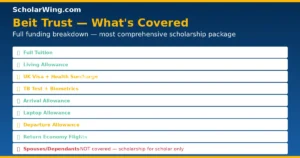
Full tuition and academic fees, paid directly to the university. Living allowance. UK Visa and Health Surcharge, TB test and Biometric costs. Additional allowances for Arrival, Laptop, Departure. Economy-class flights to and from your study destination. They do not provide support for spouses and dependents.
Breaking this down specifically:
Full tuition and academic fees — paid directly to the partner university. You never handle tuition money — the Beit Trust pays the university.
Living/personal allowance — a personal allowance, index-linked in accordance with guidance from an independent authority, covering maintenance support. Index-linked means it adjusts for cost of living, UK and South Africa have different allowance levels.
UK Visa + Health Surcharge + TB test + Biometrics — this is exceptional. Most scholarships cover tuition and living but leave visa costs to the scholar. The Beit Trust covers the full UK immigration cost package — visa fee, the NHS Health Surcharge (which can be £1,000+ for a year), the required TB test, and biometric appointment fees.
Arrival allowance — a lump sum on arrival to help with initial settlement.
Laptop allowance — a laptop grant to ensure you have the equipment needed for your studies.
Departure allowance — support when you return home after completing your studies.
Economy-class return flights — from your home country to the study destination and back.
What is NOT covered: Spouses and dependants. The scholarship is for the scholar only.
Partner Universities — Where You Can Study
UK Partner Universities (1-year Master’s)
| University | Location | Notes |
|---|---|---|
| University of Oxford | Oxford, England | World’s #1 ranked |
| University of Cambridge | Cambridge, England | World’s #2-3 ranked |
| University of Edinburgh | Edinburgh, Scotland | Top-10 UK |
| University of Glasgow | Glasgow, Scotland | Russell Group |
| University of Leeds | Leeds, England | Russell Group |
| Blavatnik School of Government | Oxford | Public policy focus |
| University of St Andrews | St Andrews, Scotland | Top-5 UK |
| University of Strathclyde | Glasgow, Scotland | Engineering (BStrath route) |
The Beit Trust and the University of Edinburgh Scholarships jointly fund postgraduate students from Malawi, Zambia and Zimbabwe to undertake a Masters program.
South African Partner Universities (2-year Master’s)
| University | Location | Notes |
|---|---|---|
| University of Cape Town (UCT) | Cape Town | Africa’s top-ranked university |
| Stellenbosch University | Stellenbosch | South Africa’s research leader |
| Rhodes University | Makhanda (Grahamstown) | Small, high-quality |
UK vs South Africa — which to choose?
| UK (1-year) | South Africa (2-year) | |
|---|---|---|
| Duration | 1 year | 2 years |
| Start | September 2027 | January 2028 |
| Travel distance | Far | Close (within SADC) |
| Cultural adjustment | Greater | Less |
| SAQA required | No | Yes |
| University prestige | Oxford/Cambridge/Edinburgh level | UCT (Africa’s #1) |
Eligibility — Read Every Point
1. Nationality and Residency
By Act of Parliament, the Beit Trust supports only applicants who are nationals of Zambia, Zimbabwe, or Malawi, are permanent residents of one of these countries, and live in and/or intend to return to their country after completing their studies.
Note: You must be currently living in Malawi, Zambia, or Zimbabwe. Diaspora applicants living in the UK, South Africa, or elsewhere are not eligible under the residency criterion.
2. Academic Grade
The applicant must have obtained Honors — First or Upper Second or equivalent — at undergraduate level.
A First Class (Distinction) or Upper Second Class (Merit / 2:1) is required. A Lower Second (2:2) or below is not sufficient at the basic eligibility level.
But can a 2:1 compete? There will be occasions when a strong and relevant work record and employer’s reference will add substance to a degree that is not a Distinction. Every application received will go through the same sifting process and be read thoroughly and completely.
In other words: a 2:1 can compete if your professional experience and employer reference are strong.
3. Course Not Already Started
The Trust cannot consider applications from those who have already begun a course. You cannot apply retrospectively for a course you are already enrolled in.
4. Development Field Alignment
Course relevance: Alignment with developmental disciplines like Medicine, Engineering, Education, Economic Growth, Agriculture, and Conservation.
The Beit Trust prioritizes fields that directly benefit Malawi, Zambia, and Zimbabwe’s development. Pure arts or unrelated fields may be less competitive. The key question: how does your proposed study benefit your home country?
5. Commitment to Return
You must intend to return to your home country after the scholarship and apply your education there. The Beit Trust scholarship is explicitly not an immigration pathway.
The Application — What You Must Prepare
Applicants should submit a single online application, attaching all required documents. These include: Degree certificates and transcripts. A concise Curriculum Vitae (CV). A 300-word personal statement outlining how their studies will benefit their country. A clear recent photograph and valid passport copy. Three completed references (academic, character, and employer). Applicants to South African universities must also provide a SAQA Certificate of Evaluation.
Document 1: Degree Certificates and Transcripts
All undergraduate degrees, diplomas, and academic qualifications with transcripts. If you have postgraduate qualifications, include those too.
Document 2: CV
Concise — not long. Focus on academic achievements, relevant professional experience, and community contributions. Use ScholarWing’s free CV builder.
Document 3: 300-Word Personal Statement
This is the heart of your application. Three hundred words to answer one question: How will your proposed studies benefit your home country?
Not “how will I benefit personally.” Not “why I want to study this subject.” Specifically: what problem exists in Malawi/Zambia/Zimbabwe, how does your proposed Master’s program give you the tools to address it, and what will you do when you return?
300 words is not many. Every word must earn its place. Be specific, name your home country’s challenge, name the course, name what you will bring back.
Document 4: Photograph and Passport
A clear, recent photograph and a valid passport. Ensure your passport has sufficient validity — at least 18 months from your intended travel date.
Document 5: Three References
This is where many applications fall short. The Beit Trust requires THREE references — one of each type:
- Academic Reference: A professor, supervisor, or lecturer who can speak to your intellectual ability and academic potential
- Character Reference: Someone who knows you personally outside an academic or employment context — community leader, religious figure, mentor
- Employer Reference: Your current or most recent employer. This is compulsory — even if you have not worked long, you need an employer reference.
Action: Contact all three referees BEFORE the September 2026 window opens. Brief them on the Beit Trust’s mission, what the 300-word personal statement says, and ask them to submit before the deadline.
Document 6: SAQA Certificate (South Africa applicants only)
If applying to UCT, Stellenbosch, or Rhodes, you must provide a South African Qualifications Authority (SAQA) evaluation certificate confirming your foreign degree’s equivalence. This takes time and costs money — start this process immediately.
Critical Warning — Application Cannot Be Saved
Applications must be completed in one session; documents cannot be saved and returned to later.
This is the most operationally important fact about the Beit Trust application. Unlike most scholarship portals that allow you to save progress and return:
The Beit Trust application must be completed in a single sitting.
If you close the browser, lose internet connection, or run out of time, your work is lost.
Preparation required before opening the application:
- All documents scanned and ready in the correct file format
- CV written and finalized
- 300-word personal statement written, reviewed, and finalized
- All three references arranged (or submitted in advance if the system allows)
- Passport scan ready
- Photograph ready
Open the Beit Trust application only when everything above is in front of you, you have a stable internet connection, and you have at least 2-3 uninterrupted hours.
Application Timeline — September 2026 Window
The next application window will open during September 2026.
| Event | Date |
|---|---|
| Application window opens | September 2026 |
| Previous deadline | February 13, 2026 at 17:00 CAT |
| Expected next deadline | Around February 2027 |
| Interviews | April 2027 (in Lusaka, Harare, and Blantyre) |
| UK studies begin | September 2027 |
| South Africa studies begin | January 2028 |
How to prepare NOW (before September 2026):
| Action | When |
|---|---|
| Start SAQA evaluation (SA applicants) | Immediately |
| Apply to partner UK/SA universities for admission | July-October 2026 |
| Write and refine 300-word personal statement | August 2026 |
| Brief and confirm all three referees | August 2026 |
| Scan and organize all documents | August 2026 |
| Renew passport if needed | Immediately |
| Check beittrust.org.uk for exact window open date | Weekly from August 2026 |
The Interviews — What to Expect
Shortlisted candidates are interviewed in their home country:
- Lusaka (for Zambian applicants)
- Harare (for Zimbabwean applicants)
- Blantyre (for Malawian applicants)
This means you do not pay for interview travel — the interview comes to you.
What interviewers assess:
- Clarity of your development impact plan
- Understanding of your chosen course and university
- Commitment to return and contribute
- Professional maturity and leadership potential
- Knowledge of your home country’s development challenges
Prepare:
- Know your 300-word statement perfectly — you will expand on it in person
- Research your chosen partner university’s specific program
- Be ready to name specific ways your study will help your country
- Know the Beit Trust’s history and mission
Common Mistakes That Eliminate Applications
1. Applying from abroad (diaspora) You must be resident in Malawi, Zambia, or Zimbabwe. Applications from citizens living in the UK, South Africa, or elsewhere are ineligible under the residency criterion.
2. Applying for a course already started The Trust explicitly cannot consider applicants who have already begun the course. Apply before you start, not after.
3. Submitting without an employer reference Three references are required: academic, character, AND employer. Missing one type means your application is incomplete. Even early-career applicants need an employer reference from any formal employment, internship, or organization where you have worked.
4. A personal statement that focuses on personal benefits “I have always wanted to study at Oxford” is the wrong answer. The statement must answer: how will your country benefit? Name the problem, name the solution and name your role.
5. Opening the application before all documents are ready Because the application cannot be saved, starting without all documents ready means losing your work.
6. Not starting SAQA early (South Africa applicants) SAQA evaluations take weeks and cost money. Starting after the application window opens in September is too late.
Beit Trust FAQ
Who is eligible for the Beit Trust scholarship?
Only nationals of Zambia, Zimbabwe, or Malawi who are permanent residents of one of these countries and live in and/or intend to return after completing their studies.
When does the next application window open?
The next application window will open during September 2026. Monitor beittrust.org.uk weekly from August 2026.
Can I apply if my degree is a 2:1 (not Distinction)?
There will be occasions when a strong and relevant work record and employer’s reference will add substance to a degree that is not a Distinction. Yes, but your professional experience must compensate.
Can I apply to multiple partner universities?
Submit only one application. Choose one university/country and apply to that one.
Does the scholarship cover visa fees?
Yes, UK Visa and Health Surcharge, TB test and Biometric costs are all covered.</cite> This is unusually comprehensive.
Does the scholarship cover family members?
They do not provide support for spouses and dependents. The scholarship is for the scholar only.
Can I apply if I am currently abroad?
The eligibility requires you to be a permanent resident of Malawi, Zambia, or Zimbabwe and to live there. Diaspora applicants are not eligible.
Is there a PhD option?
In rare cases, PhD extensions may be considered for outstanding Beit Scholars. PhD is not an initial application option, it is only a possible extension for current Beit Scholars who are excelling.
How many scholarships are awarded?
In 2025, the Trust awarded 21 scholarships across all partner universities and countries.
Is the Beit Cambridge scholarship separate?
Yes, the Beit Cambridge scholarship specifically for the University of Cambridge is a separate route within the Beit Trust system. It can be applied for simultaneously.
Free Tools for Your Beit Trust Application
- 300-word Personal Statement: SOP Generator or Personal Statement Generator
- CV: Free CV Builder
- Reference Letter template for your referees: Reference Letter Generator
- Research Proposal (if needed): Research Proposal Generator