
Most Students Try to Apply Directly to the Eiffel Scholarship. That Is Not How It Works.
The France Excellence Eiffel Scholarship is one of the most searched international scholarships globally and one of the most misunderstood in terms of how to actually get it.
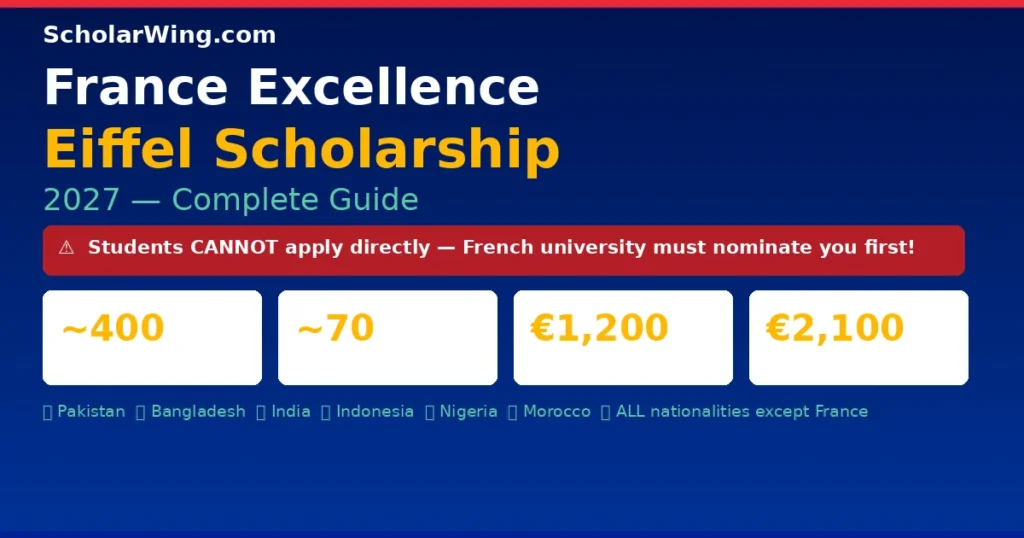
Students cannot apply directly. Only French higher education institutions can nominate candidates.
This single fact is the most important thing to understand before doing anything else. There is no application form on Campus France’s website that you the student can fill out and submit. The Eiffel Scholarship does not work like Chevening, DAAD, or GKS Korea where you go to a portal, create an account, and apply.
The process is: you apply to a French university → the French university decides whether to nominate you → the French university submits your application to Campus France → Campus France selects from the universities’ nominations.
If you spend hours on Campus France’s website trying to find a student application portal, you will not find one because it does not exist for students. The portal is for French universities only.
Understanding this changes everything about how you pursue the Eiffel Scholarship. The real work is getting a French university to want you enough to nominate you.
The France Excellence Eiffel program, coordinated by the Ministry for Europe and Foreign Affairs, enables French institutions to recruit top international talent. It funds about 400 master’s and 70 doctoral scholarships each year.
470 scholarships per year. Every nationality in the world (except France) can benefit. €1,200 per month for Master’s students, €2,100 per month for PhD students plus travel, healthcare, and cultural activities. Study at France’s best universities: Sorbonne, Sciences Po, Paris-Saclay, Polytechnique, and hundreds more.
This guide explains exactly how to get there.
What Is the Eiffel Excellence Scholarship — Full Overview
| Detail | Information |
|---|---|
| Official Name | France Excellence Eiffel Scholarship Program |
| French Name | Programme de bourses d’excellence Eiffel |
| Funded by | French Ministry for Europe and Foreign Affairs |
| Managed by | Campus France |
| Named after | Gustave Eiffel (designer of the Eiffel Tower) |
| Level | Master’s (M1, M2, Engineering) + PhD |
| Awards per year | ~400 Master’s + ~70 PhD = ~470 total |
| Master’s amount | €1,200/month |
| PhD amount | €2,100/month |
| Who can apply | All nationalities except France |
| Age limit (Master’s) | Under 29 years |
| Age limit (PhD) | Under 35 years |
| Application | Via French university (NOT direct to Campus France) |
| 2027 deadline | January 8, 2027 (institutions submit) |
| Official site | campusfrance.org/en/france-excellence-eiffel-scholarship-program |
What the Eiffel Scholarship Covers — Full Package
For the Master’s level: Eiffel scholarship holders receive a monthly allowance of €1,200, to which is added direct payment of several services. For the Doctorate level: Eiffel doctoral scholarship holders receive a monthly allowance of €2,100, to which is added direct payment of several services.
Monthly Stipend (Master’s): €1,200 Paid monthly for the duration of the scholarship — 12 to 24 months for M1/M2, up to 36 months for engineering degrees.
Monthly Stipend (PhD): €2,100 Paid monthly for 12 to 36 months of doctoral research in France.
Travel Costs: One-way trip (to France) and final return trip (home) — economy class.
Healthcare: Medical and hospitalization insurance coverage during the scholarship period in France.
Cultural Activities: Campus France organizes cultural events and activities for Eiffel scholars — visits, seminars, France discovery programs.
Registration Fees (Engineering degrees only): For students enrolled in grandes écoles engineering programs where registration fees apply, Eiffel covers these.
What is NOT included:
- Family members (spouses, children)
- Accommodation (must arrange yourself — French universities help)
- Laptop or equipment allowance
- French language courses (assumed you meet the program’s language requirements)
Who Is Eligible — Every Country Except France
Candidates from all nationalities can apply (except France). Candidates with dual nationality, one of whose nationalities is French, are not eligible.
This means students from ALL of the following are eligible:
🌏 Asia: Pakistan, Bangladesh, India, Indonesia, China, Vietnam, Philippines, Sri Lanka, Nepal, Myanmar, Thailand, Malaysia, Cambodia, Laos, Kazakhstan, Uzbekistan, Kyrgyzstan, Tajikistan, Azerbaijan, Georgia, Japan, South Korea, Taiwan, and all other Asian countries.
🌍 Africa: Nigeria, Kenya, Ghana, Tanzania, Uganda, Ethiopia, Morocco, Algeria, Tunisia, Egypt, Senegal, Mali, Guinea, Côte d’Ivoire, Cameroon, Madagascar, Malawi, Zambia, Zimbabwe, South Africa, Mozambique, Namibia, Rwanda, and all other African countries.
🌎 Americas: USA, Canada, Brazil, Argentina, Colombia, Mexico, Peru, Chile, and all other American countries.
🌍 Middle East: Turkey, Saudi Arabia, UAE, Jordan, Lebanon, Egypt, Iran, Iraq, and all other MENA countries.
🌍 Europe (non-French): UK, Germany, Spain, Italy, Poland, Ukraine, Georgia, and all non-French European countries.
Key exclusions:
- French nationals (even if living abroad)
- Dual nationals where one nationality is French
- Students already studying in France at Master’s level (PhD students currently in France are lower priority but not excluded)
Age Limits
Maximum age (2026 rule): 29 for Master’s; 35 for Doctorate.
Master’s: You must be under 29 years old at the time of the selection committee. For the 2026 cycle, this meant born after March 31, 1996.
PhD: You must be under 35 years old at the time of the selection committee. For the 2026 cycle, this meant born after March 31, 1990.
Practical implication: If you are 28 or younger, both tracks are open. If you are 30-34, only the PhD track is available. If you are 35 or older, you are not eligible.
Two Scholarship Tracks — Master’s vs PhD
Track 1: Master’s Scholarship
Duration:
- M2 only: 12 months
- M1 + M2: 24 months
- Engineering degree: up to 36 months
Key rule: It is reserved for students studying in France for the first time. For Master’s applications: the program funds stays of 12 to 24 months, depending on the year of enrolment.
You must not already be studying in France when you apply for the Master’s track. If you are currently in France as a student, you are not eligible for the Master’s track.
Priority for Master’s: Candidates up to 29 years old from developing countries to undertake a 12 to 36 months stay at Masters level.
Track 2: PhD Scholarship
Duration: 12 to 36 months
Key rule: For PhD applications: the program funds stays of 12 to 18 months, depending on the year of enrolment, and as part of a cotutelle or joint supervision agreement (a cotutelle agreement must be signed).
A cotutelle agreement is a formal joint supervision arrangement between your French university and a partner university in your home country. If you do not already have a co-supervisor at both institutions, you need to establish this before applying.
Priority for PhD: Candidates for the Doctorate level studying abroad are given priority over those who are already living in France.
If you are in your home country applying for a France-based PhD, you are in a higher priority category than someone already living in France.
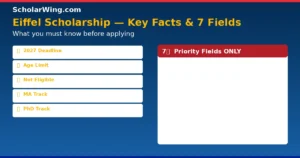
Priority Fields — Seven Areas
The France Excellence Eiffel Scholarship Program covers two major disciplinary fields encompassing seven areas of study.
The seven priority fields are:
Sciences & Technology:
- Engineering Sciences — Civil, mechanical, electrical, computer, chemical, aerospace
- Exact Sciences — Mathematics, physics, chemistry, computer science
- Life Sciences & Environment — Biology, ecology, environmental science, agriculture
- Medicine & Public Health — Medicine, pharmacy, public health, epidemiology
Humanities & Social Sciences: 5. Economics & Management — Economics, finance, business, accounting 6. Law & Political Science Law, international relations, political science, governance 7. Humanities History, literature, linguistics, philosophy, cultural studies
Outside these seven fields, applications are not eligible. Pure arts (fine arts, music performance) and purely vocational programs do not qualify. Check with your target French university whether your specific program falls within these areas.
The Application Process — Step by Step
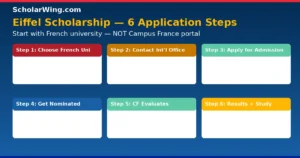
Step 1: Choose Your French University Identify the French university where you want to study. This is your starting point not Campus France. Research Master’s programs or PhD supervisors at French universities in your field.
Useful starting points:
- Sorbonne Université (sorbonne-universite.fr)
- Université Paris-Saclay (universite-paris-saclay.fr)
- Sciences Po Paris (sciencespo.fr)
- École Polytechnique (polytechnique.edu)
- Université Paris Cité
- Université Grenoble Alpes
- Any of the 100+ French universities participating in the Eiffel program
Step 2: Contact the International Relations Office Contact the chosen university’s International Relations Department (Direction des Relations Internationals / Bureau des Bourses). Ask:
- Does your university participate in the Eiffel scholarship?
- What is your internal deadline for Eiffel nominations? (This is typically October or November — well before the January 8 Campus France deadline)
- What documents do you need for an Eiffel nomination?
Many institutions have internal deadlines in October or November, well before the Campus France deadline.
Step 3: Apply for Admission to the University Simultaneously (or before the Eiffel process), apply for actual admission to your chosen Master’s program or PhD. You typically need:
- Educational Docs
- CV
- Motivation letter / SOP
- LOR
- Language proficiency proof (French or English depending on program)
- Research proposal (for PhD)
Step 4: Request Eiffel Nomination Provide the university’s International Relations office with all documents they require for Eiffel consideration. The university’s own selection committee evaluates your file and decides whether to nominate you.
Step 5: University Submits to Campus France If nominated, the university assembles your complete dossier and submits it to Campus France by January 8 (for the 2027 cycle, this means January 8, 2027).
You do not submit anything to Campus France yourself.
Step 6: Campus France Evaluation Campus France convenes an independent committee of academic experts who evaluate all nominations based on academic excellence, coherence of study path, and development impact.
Priority Countries by University — The Inside Knowledge
Different French universities have different priority countries for their Eiffel nominations. This is critical information most guides don’t mention.
Paris-Saclay University prioritizes master’s level applications from the following countries for Eiffel: Asia-Oceania: Australia, China, India, Indonesia, Japan, Kazakhstan, South Korea, Taiwan, Vietnam. Europe: any country (special attention to EUGLOH Alliance + Georgia + Ukraine). Sub-Saharan Africa: Benin, Cameroon, Côte d’Ivoire, DRC, Ghana, Kenya, Madagascar, Nigeria, Senegal, South Africa.
Practical implication: If you are from Pakistan, Bangladesh, Morocco, or another country not on Paris-Saclay’s priority list, you should approach OTHER French universities where your country may be a higher priority. Different universities have different geographic priorities, find the one where your country is most welcome.
Action: When contacting French universities, specifically ask: “Is [your country] among your priority countries for Eiffel nominations?”
What Makes a Strong Eiffel Application
Campus France evaluates nominations on these criteria:
1. Academic Excellence The Eiffel is not for average students. A First Class or Distinction-equivalent undergraduate result is the baseline expectation. The program explicitly targets future “decision-makers of the private and public sectors.”
2. Coherent Study Path Your undergraduate background, professional experience (if any), and proposed Master’s/PhD must form a logical, clear progression. A biologist applying for an economics program needs to explain why.
3. Development Impact Particularly for Master’s candidates from developing countries, how will your studies benefit your home country? This is where students from Pakistan, Bangladesh, Nigeria, Kenya, Senegal, and other developing countries have a natural narrative advantage — your return plan has clear national development context.
4. Field Alignment Your chosen program must fall within the seven priority fields. Outside these, your nomination will be rejected.
5. Age Compliance Under 29 for Master’s, under 35 for PhD — non-negotiable.
Common Mistakes That Prevent Selection
Mistake 1: Trying to apply directly to Campus France There is no student portal on campusfrance.org for Eiffel applications. Trying to apply directly wastes time. Go to French universities.
Mistake 2: Missing the university’s internal deadline The Campus France deadline is January 8. But most universities close their internal Eiffel nomination process in October or November. Contacting a French university in December is too late for most institutions.
Mistake 3: Not having a university admission offer The Eiffel is awarded to students who are admitted (or being admitted) to a specific program. You cannot win Eiffel for a theoretical study plan — you need an actual French university that is enrolling you.
Mistake 4: Applying for a non-priority field Business administration, fine arts, music, or programs outside the seven priority areas are not eligible. Confirm your field with the university before investing in applications.
Mistake 5: Applying from within France (Master’s track) Already studying in France? The Master’s track requires you to be studying France for the first time. You are not eligible if you are already a student there.
Mistake 6: PhD without cotutelle agreement The PhD track requires a formal cotutelle (joint supervision) agreement between a French university and a partner institution in your home country. No cotutelle agreement = no PhD Eiffel.
Mistake 7: Ignoring language requirements The Eiffel program itself has no language test requirement but the French university’s specific program does. French-medium programs require French (typically DELF B2 or TCF). English-medium programs require IELTS or TOEFL. Confirm with your target university.
Country-Specific Guidance
🇵🇰 Pakistan
Pakistan is eligible. Approach French universities that target South Asian countries for Eiffel nominations. Université Grenoble Alpes, Sorbonne, and Sciences Po have active Pakistan connections. Contact the Institut Français du Pakistan (Alliance Française) in Karachi, Lahore, and Islamabad for guidance on which French universities welcome Pakistani Eiffel candidates.
🇧🇩 Bangladesh
Bangladesh is eligible. As a developing country, Bangladeshi applicants have natural priority for the Master’s track. Approach French universities in engineering, public health, and environmental science where Bangladesh’s development context strengthens applications.
🇮🇳 India
India is explicitly listed as a priority country at Paris-Saclay. Multiple French universities have active India partnerships. India is one of the largest Eiffel recipient countries historically.
🇮🇩 Indonesia
Indonesia is listed as a priority country at Paris-Saclay. As an OIC member and large developing country, Indonesia’s development context is compelling for Eiffel applications.
🇲🇦 Morocco
Morocco is a Francophone country — French universities are familiar with Moroccan academic credentials. Morocco is among the most represented Eiffel scholarship countries historically. Campus France has an active office in Morocco.
🇳🇬 Nigeria
Nigeria is listed as a priority country at Paris-Saclay and is eligible at all French universities. As an Anglophone country, Nigerian students must demonstrate French or English program requirements depending on their chosen course.
🌍 African Countries (Francophone)
Francophone African countries — Senegal, Mali, Guinea, Côte d’Ivoire, Cameroon, Togo, Benin, Madagascar, DRC have a natural advantage. French university International Relations offices are familiar with Francophone African academic systems and many have specific Africa partnerships.
Timeline for 2027 Eiffel Application
| Action | When |
|---|---|
| Research French universities in your field | June-August 2026 |
| Contact French university International Relations | September 2026 |
| Ask for university’s internal Eiffel deadline | September 2026 |
| Apply for university admission | September-October 2026 |
| Submit Eiffel nomination documents to university | October-November 2026 |
| University submits to Campus France | By January 8, 2027 |
| Results published | From March 30, 2027 |
| Studies begin | September-November 2027 |
Most important action: Contact French universities in September 2026 not January 2027. By January, internal nomination deadlines have already passed at most institutions.
Quick Comparison: Eiffel vs Other French Scholarships
| Scholarship | Amount | Who | Process |
|---|---|---|---|
| Eiffel Excellence | €1,200-2,100/mo | All nationalities (except FR) | Via French university nomination |
| IsDB-France | Full support | 42 OIC + Francophone countries | Via Campus France IsDB program |
| ARES Belgium | €1,150/mo | Francophone developing countries | Via ARES portal (student applies) |
| French Embassy | Varies | Bilateral (country-specific) | Via French Embassy in your country |
| Erasmus Mundus | €1,100-1,400/mo | All nationalities | Student applies directly to consortium |
FAQ
Can I apply directly to the Eiffel Scholarship?
No, students cannot apply directly. Only French higher education institutions can nominate candidates.
How many Eiffel scholarships are awarded per year?
About 400 master’s and 70 doctoral scholarships each year — approximately 470 total.
What is the monthly amount?
Master’s: €1,200/month. Doctorate: €2,100/month, plus travel, healthcare, and cultural activities.
What is the age limit?
Under 29 for Master’s, under 35 for Doctorate.</cite>
Can students from Pakistan, Bangladesh, India, Nigeria apply?
Yes, candidates from all nationalities can apply except France. Every country is eligible.
What is the 2027 deadline?
The deadline for Campus France is January 8 of the scholarship year January 8, 2027 for the 2027 cycle. But most French universities have internal deadlines in October or November 2026 contact universities in September 2026.
Do I need to speak French?
Eiffel itself has no French requirement. But your chosen program at the French university may be French-medium or English-medium. Check with your specific university and program.
Can I apply for Eiffel if I am already studying in France?
For Master’s: It is reserved for students studying in France for the first time so no. For PhD: Students studying abroad have priority, but those already in France are not explicitly excluded.
Free Application Tools at ScholarWing
- Motivation Letter / SOP: SOP Generator
- CV: Free CV Builder
- Personal Statement: Personal Statement Generator
- Reference Letter (for your professors): Reference Letter Generator
- Research Proposal (PhD): Research Proposal Generator
- MOI Certificate (if needed): MOI Generator