
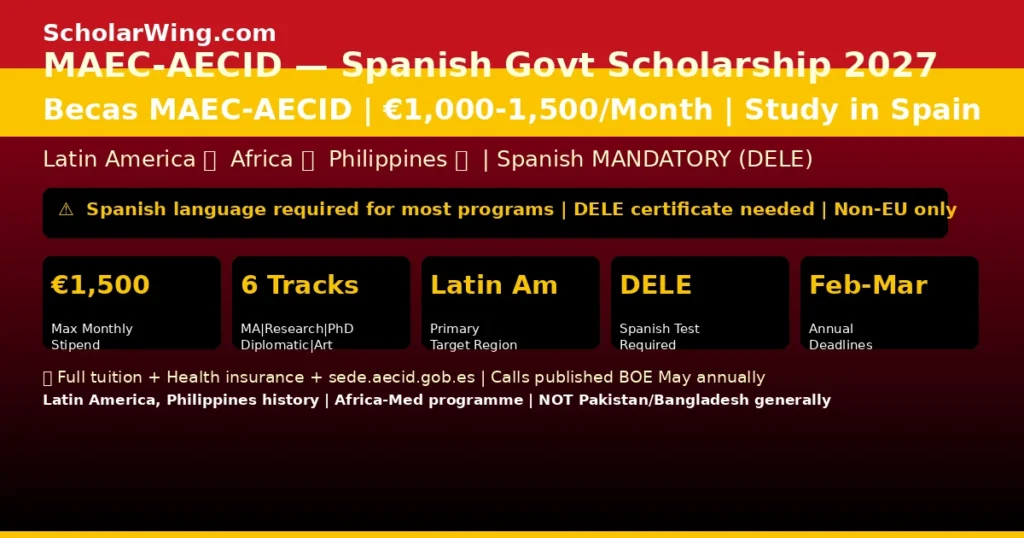
The Spanish Government Scholarship Requires Spanish — And Most Guides Forget to Say So
The Spanish Government scholarship program (Becas MAEC-AECID) is frequently listed alongside Chevening and DAAD as a flagship European government scholarship. What most guides fail to prominently state:
Proficiency in the Spanish language is required for many programs, often demonstrated through the DELE certificate. Applicants who cannot demonstrate Spanish language proficiency will not be competitive for most MAEC-AECID scholarship modalities.
Spain’s scholarship programs are instruments of Spanish language and cultural diplomacy, they exist to promote Spanish internationally, to build connections between Spain and its development cooperation partner countries, and to train the next generation of Spanish-speaking professionals in those countries. Spanish is not a detail, it is the central requirement.
For applicants from Latin America and the Philippines, where Spanish is widely spoken, this is not a barrier. For applicants from Africa-Med (Morocco, Tunisia, Algeria), where French and Arabic dominate and Spanish is a third language significant Spanish preparation is required.
MAEC-AECID Scholarships
The MAEC-AECID Scholarships are Spain’s main international cooperation scholarships, awarded by the Spanish Agency for International Development Cooperation (AECID), an agency of the Ministry of Foreign Affairs, European Union and Cooperation (MAEC). For the 2026-2027 academic year, AECID has reopened its call across several distinct programs that together support international students, professionals and creators to study, train or carry out residencies in Spain.
The 2027-28 cycle calls are expected to be published in the Spanish Official State Gazette (BOE) in May 2027, with application deadlines February-March 2027.
MAEC and AECID — Two Entities, One Scholarship
Understanding the institutional structure helps navigate the application:
MAEC (Ministerio de Asuntos Exteriores, Unión Europea y Cooperación, Ministry of Foreign Affairs, European Union and Cooperation) is Spain’s foreign ministry. It sets the strategic direction for Spain’s international cooperation and cultural diplomacy.
AECID (Agencia Española de Cooperación Internacional para el Desarrollo, Spanish Agency for International Development Cooperation) is the executive agency under MAEC responsible for implementing Spain’s development cooperation. It administers the scholarships operationally.
When you see “MAEC-AECID scholarship,” it means: strategic priority set by the Foreign Ministry + administered by the development cooperation agency. Both names appear because both institutions are involved.
The scholarship reflects Spain’s dual purpose: promoting Spanish language and culture globally (cultural diplomacy) while supporting human capital development in Spain’s partner countries (development cooperation).
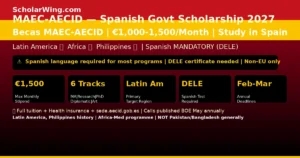
The Six MAEC-AECID Program Modalities
AECID scholarships cover a wide range of academic and cultural modalities, including Master’s degrees, doctoral studies, research stays at Spanish universities and research centres, postdoctoral fellowships, specialized diplomatic training, and artistic residencies.
Modality 1: Programa Máster (Master’s Program)
The flagship modality a full Master’s degree at a Spanish public university.
| Element | Detail |
|---|---|
| Level | Master’s degree |
| Duration | 1-2 academic years |
| Monthly stipend | €1,000-1,500/month |
| Tuition | Full waiver at participating Spanish universities |
| Health insurance | Covered |
| Travel | Round-trip in some cases |
| Target | Latin America, Philippines, Africa-Med |
| Language | Spanish (DELE) mandatory |
Modality 2: SCHOLARSHIPS AFRICA-MED
The SCHOLARSHIPS AFRICA-MED program targets citizens from Africa and Mediterranean countries. Applicants must have knowledge of Spanish and meet specific conditions.
Specifically designed for North African and sub-Saharan African applicants. Focus on development-relevant fields. Spanish language required.
Modality 3: Specialized Diplomatic Training
Specialised diplomatic training for future diplomats, public employees and future diplomats from eligible partner countries. Programs hosted in Spain, and also in Rome, Bruges, Natolin and Tirana.
Not a general academic scholarship targets civil servants and aspiring diplomats in government employment.
Modality 4: Research Stays
Short-term research visits at Spanish universities and research centers for established researchers. Typically 3-12 months. For academics with demonstrated research track record.
Modality 5: Postdoctoral Fellowships
For post-PhD researchers seeking to continue their research in Spain. Requires PhD completion and a Spanish host institution.
Modality 6: Artistic and Cultural Residencies
For creators (artists, musicians, writers, filmmakers) seeking creative residencies at Spanish cultural institutions. Some programs hosted at Spanish cultural centers in other European cities.
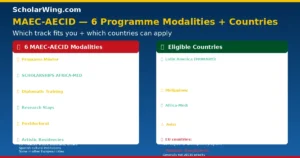
Eligible Countries — Strong Latin America Focus
The scholarship targets non-EU countries, particularly from Latin America, Africa, Asia, and Eastern Europe.
Primary Target — Latin America & Caribbean:
Latin America and the Caribbean are the primary target region, consistent with Spain’s historical and linguistic ties.
All Latin American countries, Argentina, Bolivia, Brazil (limited Portuguese-speaking), Chile, Colombia, Costa Rica, Cuba, Dominican Republic, Ecuador, El Salvador, Guatemala, Honduras, Mexico, Nicaragua, Panama, Paraguay, Peru, Uruguay, Venezuela, and Caribbean nations.
Why Latin America is primary: Spain’s development cooperation budget historically prioritizes Latin America due to shared language, colonial history, cultural ties, and Spain’s significant diplomatic and commercial presence.
Philippines:
The Philippines is included due to historical bilateral relationship. Spain colonized the Philippines for over 300 years (1565-1898). The MAEC-AECID scholarship reflects this historical relationship and the residual Spanish-language community in the Philippines.
Africa (Africa-Med Program):
Morocco ✅, Tunisia ✅, Algeria ✅, Egypt ✅ North Africa most strongly. Sub-Saharan Africa has more limited representation but is growing through the Africa-Med track. Equatorial Guinea (Spanish-speaking African country) ✅.
Asia (Limited):
Some Asian countries with bilateral cooperation agreements. Less coverage than Latin America or Africa.
NOT Eligible:
- EU country nationals (MAEC-AECID targets non-EU developing countries)
- Applicants currently residing in Spain
- Countries without AECID bilateral agreements
- Pakistan, Bangladesh, most South Asia generally not AECID priority countries for this program (check annual call for current list)
Full Financial Package
The Spanish Government Scholarships provide: full tuition fee coverage at a public Spanish university, monthly stipend of €1,000 to €1,500 depending on program and location, comprehensive health insurance during the period of stay in Spain, and round-trip travel allowance in some cases and for specific regions.
Coverage Breakdown:
| Benefit | Detail |
|---|---|
| Monthly stipend | €1,000-1,500/month (program and location dependent) |
| Tuition | Full waiver at participating Spanish universities |
| Health insurance | Comprehensive — for entire stay in Spain |
| Travel | Round-trip in some cases (region/program dependent) |
| Visa support | Some programs include visa assistance |
| Duration | 1-2 academic years for Master’s; varies for research |
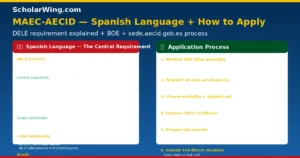
The Spanish Language Requirement — The Central Condition
For most MAEC-AECID programs, Spanish language proficiency is not optional, it is a condition of eligibility.
DELE Certificate (Diploma de Español como Lengua Extranjera): The Spanish government’s official Spanish language certification. Issued by the Instituto Cervantes. Different programs require different levels:
- Master’s programs: typically B2 minimum
- Research stays: B1-B2 depending on program
- Diplomatic training: C1 typically required
Where to take DELE: The Instituto Cervantes has exam centers worldwide. In Pakistan (Karachi, Islamabad), in Kenya (Nairobi), in Nigeria (Lagos), in Morocco, Egypt, and most countries where MAEC-AECID operates.
DELE exam costs and schedule: Exams are held in April, May, July, October, and November. Costs range from €70-120 depending on level and location. Register at cervantes.es.
For Latin American applicants: If Spanish is your first language (all of Latin America except Brazil/Guyana/Suriname), you do not need a DELE certificate native Spanish speakers are automatically exempt from the language test requirement.
Brazil: Brazilian applicants may need Spanish proficiency despite geographic proximity, check the specific call requirements.
For African applicants: Moroccan, Algerian, and Tunisian students who speak French and Arabic will need to invest in Spanish preparation. Equatorial Guinea (Spanish-speaking) is automatically exempt.
Application Process — BOE + AECID Electronic Office
Deadlines vary by program. Many MAEC-AECID scholarship calls open in the first quarter of the year around February-March for studies starting in the fall/winter semester. Applications are submitted via the online portals of the Spanish ministries and the AECID scholarship office.
How to Track the Call:
2026-2027 calls were published in the Spanish Official State Gazette (BOE) in May 2026.
BOE (Boletín Oficial del Estado) is Spain’s official state gazette, the legal publication where all government scholarship calls must be published. The MAEC-AECID scholarship call for each academic year is first published in the BOE.
To track the 2027-28 call:
- Visit boe.es and search “becas AECID” or “MAEC-AECID”
- Or visit aecid.gob.es → Scholarships section
- Expected publication: May 2027
Application Steps:
Step 1: Find the official call in BOE The BOE publication is the authoritative source. It specifies eligible countries, which modality is offered, specific requirements, and deadlines for that academic year.
Step 2: Register on AECID electronic office Create an account on the AECID scholarship portal and complete the online application form at sede.aecid.gob.es.
Step 3: Choose your modality and Spanish institution Research which Spanish university’s programs match your field. Apply to the Spanish university for admission while simultaneously preparing the AECID scholarship application.
Step 4: Prepare documents Typically required:
- Valid passport (non-EU)
- Academic transcripts and degree certificates (translated to Spanish)
- Motivation letter (in Spanish)
- Research proposal (for PhD/research/postdoc tracks)
- CV (in Spanish)
- DELE certificate or Spanish language proof
- Two reference letters
- For Africa-Med: compliance with specific Annex III conditions
Step 5: Submit before February-March deadline Most Master’s program calls close February-March for fall semester start. Research/postdoc deadlines vary. Check the specific BOE call for exact dates.
Spain as a Study Destination
Spain is the 4th largest EU economy and home to some of Europe’s most internationally respected universities:
| University | City | Strengths |
|---|---|---|
| Universidad Complutense Madrid | Madrid | Largest Spain — all fields |
| Universidad de Barcelona | Barcelona | Sciences, humanities, law |
| Universidad Autónoma de Madrid | Madrid | Sciences, social sciences |
| Universidad de Sevilla | Seville | Engineering, humanities |
| Universidad de Granada | Granada | Humanities, law, sciences |
| Universidad Politécnica de Madrid | Madrid | Engineering, architecture |
| Universidad de Valencia | Valencia | Sciences, law, economics |
Living costs in Spain:
- Madrid/Barcelona: €900-1,300/month
- Seville, Valencia, Granada: €700-950/month
- Smaller cities: €600-800/month
The €1,000-1,500/month stipend is adequate for comfortable student living in most Spanish cities, particularly outside Madrid and Barcelona.
Spain’s languages: While Spanish (Castilian) is the national language, Spain also has regional languages Catalan (Barcelona/Catalonia), Basque, Galician. Most universities teach in Spanish. Some Catalan universities teach partially in Catalan or English.
Quick Reference
| Element | Detail |
|---|---|
| Full name | MAEC-AECID Scholarships (Becas MAEC-AECID) |
| Ministry | MAEC — Ministry of Foreign Affairs |
| Agency | AECID — Spanish Development Cooperation Agency |
| Target regions | Latin America ✅ Africa ✅ Philippines ✅ Asia (limited) |
| NOT eligible | EU citizens, Spain residents, most South Asia |
| Monthly stipend | €1,000-1,500/month |
| Tuition | Full waiver at Spanish universities |
| Health insurance | Covered |
| Travel | Round-trip — some programs/regions |
| Spanish | MANDATORY for most programs — DELE certificate |
| Levels | Master’s, Research, Postdoc, Diplomatic, Artistic |
| Application portal | sede.aecid.gob.es |
| Calls published | BOE (Spanish Official State Gazette) — May annually |
| Deadlines | February-March for most Master’s programs |
| 2027-28 cycle | Expected BOE May 2027, deadlines Feb-March 2027 |
FAQ
What is the monthly stipend?
Monthly stipend of €1,000 to €1,500, depending on program and location.
Is Spanish required?
Yes, proficiency in Spanish is required for many programs, typically demonstrated through the DELE certificate. Native Spanish speakers (all of Latin America) are exempt from language tests.
Which countries are eligible?
Non-EU citizens from Latin America, Africa, Asia, and other countries with bilateral agreements with Spain. Check the annual BOE call for the specific country list.
Where do I apply?
Through the AECID electronic office at sede.aecid.gob.es.
How do I know when the call opens?
The 2026-2027 calls were published in the Spanish Official State Gazette (BOE) in May 2026. Monitor boe.es or aecid.gob.es from April annually.
What is the deadline?
Many MAEC-AECID calls open in February-March for fall semester start. The exact deadline is in the annual BOE call.
Is Pakistan eligible?
Pakistan is generally not among AECID’s priority development cooperation countries. Check the annual BOE call eligibility changes year to year.
Free Application Tools
- Motivation Letter: Motivation Letter Generator
- SOP / Study Plan: SOP Generator
- CV: Free CV Builder
- Reference Letter: Reference Letter Generator
- MOI Certificate (if needed): MOI Generator
- Research Proposal (PhD): Research Proposal Generator