
The Rotary Peace Fellowship Is Not a Scholarship for Students — It Is a Fellowship for Professionals
Most scholarship guides list the Rotary Peace Fellowship alongside Chevening, DAAD, and Gates Cambridge as if they are comparable programs. They are not. The fundamental difference must be stated immediately:
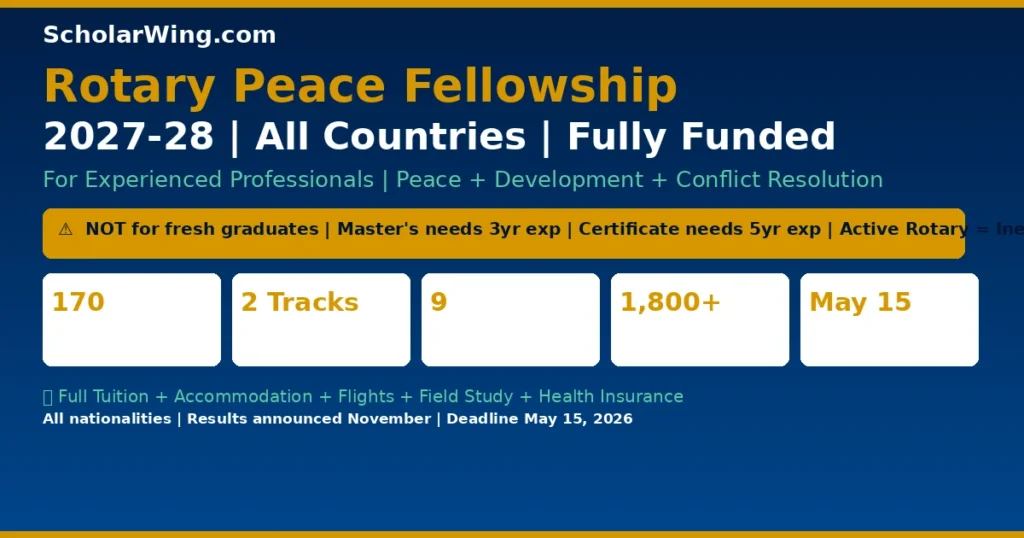
The Rotary Peace Fellowship is a fully funded program for experienced professionals, not a scholarship for recent graduates. It requires a minimum of three years of relevant professional work experience for the Master’s track, and five years for the Certificate track. It is aimed at applicants with a strong academic background, clear leadership potential, and significant relevant work experience in peace, conflict resolution, development, or public service.
If you are a recent graduate with no professional experience, you are not eligible. Come back in three to five years.
If you are a working professional in peace, development, international relations, humanitarian work, public policy, or related fields — this is one of the most transformative fully funded opportunities in the world.
Since its launch in 2002, the program has trained more than 1,800 peace fellows working across 140+ countries in roles within governments, NGOs, UN agencies, research institutions, and global development organizations.
With up to 170 fully funded fellowships awarded annually, this prestigious opportunity allows international applicants to study at leading universities worldwide while gaining practical experience and global networking exposure.
The deadline for the 2027-28 Rotary Peace Fellowship is May 15, 2026.
What Is the Rotary Peace Fellowship
| Detail | Information |
|---|---|
| Funder | The Rotary Foundation (Rotary International) |
| Founded | 2002 |
| Fellowships/year | Up to 170 (2027-28 cycle) |
| Tracks | Master’s degree (15-24 months) + Professional Certificate (11 weeks) |
| Countries eligible | All nationalities worldwide |
| Deadline | May 15, 2026 (annual — same date every year) |
| Results announced | November 2026 |
| Study starts | 2027 |
| Alumni | 1,800+ in 140+ countries |
| Application | rotary.org — online only |
The Rotary Peace Fellowship is administered by The Rotary Foundation, the philanthropic arm of Rotary International, the global service organization with 1.4 million members in 200+ countries. Fellows are placed at one of nine Rotary Peace Centers, specialized academic programs at partner universities specifically focused on peace, conflict, and development.
Two Fellowship Tracks — Choose Carefully
The program offers two tracks: a Master’s degree (15–24 months) at one of Rotary’s partner universities and a professional development certificate (11 weeks) designed for mid-career professionals.
Track 1: Master’s Degree Program
| Element | Detail |
|---|---|
| Duration | 15-24 months (varies by university) |
| Level | Postgraduate Master’s degree |
| Fellowships/year | ~50 |
| Experience required | Minimum 3 years relevant professional experience |
| Degree gap | Minimum 3 years between most recent degree and fellowship start |
| Who it’s for | Early-to-mid career peace/development professionals |
The Master’s track is for professionals with three or more years of experience who want to deepen their academic expertise in peace and conflict while earning a recognized postgraduate degree from a leading international university.
Track 2: Professional Development Certificate Program
| Element | Detail |
|---|---|
| Duration | 11 weeks (approximately 3 months) |
| Level | Professional certificate — not a degree |
| Fellowships/year | ~80-120 |
| Experience required | Minimum 5 years relevant professional experience |
| Who it’s for | Senior mid-career professionals who cannot leave for 15-24 months |
The Certificate track is for more experienced professionals, government officials, senior NGO staff, military officers, diplomats, researchers who have deep experience but limited time. Eleven weeks provides intensive academic and peer immersion without the multi-year commitment.
What the Fellowship Covers — Full Package
The Rotary Peace Fellowship program covers tuition, room and board, round-trip transportation, and internship/field-study expenses.
Coverage commonly includes tuition, room and board or accommodation support, round-trip airfare, internship and field-study expenses, health insurance, and living support.
Full Coverage:
| Benefit | Detail |
|---|---|
| Full tuition | 100% — all academic and enrollment fees |
| Accommodation | Room and board throughout fellowship |
| Round-trip flights | International travel to and from Peace Center |
| Internship costs | All expenses for field study placements |
| Field-study expenses | Research, travel, materials for field components |
| Health insurance | Medical coverage throughout fellowship |
| Living support | Stipend for daily living expenses |
The Nine Rotary Peace Centers — Where You Will Study
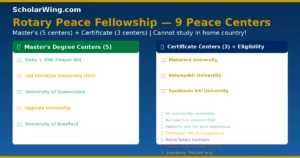
Rotary Peace Centers are hosted at Duke University, University of North Carolina at Chapel Hill, International Christian University, University of Bradford, University of Queensland, Uppsala University, Makerere University, Bahçeşehir University, and Symbiosis International University.
Master’s Program Peace Centers:
1. Duke University + University of North Carolina at Chapel Hill (USA) A joint program between two leading US research universities. Focus: international development, public policy, conflict resolution. Duke’s Sanford School of Public Policy and UNC’s Gillings School of Global Public Health bring complementary strengths. Durham, North Carolina.
2. International Christian University (ICU) — Tokyo, Japan A bilingual (English-Japanese) liberal arts university in Tokyo. Focus: peace studies with an Asia-Pacific orientation. Unique environment for fellows working on East Asian conflicts, Japan’s pacifist constitution, and Asia-Pacific development.
3. University of Queensland — Brisbane, Australia Australia’s third-oldest university, ranked in world top 50. Focus: peace and conflict studies with strong research infrastructure. Brisbane provides proximity to Pacific Island and Southeast Asian conflict contexts.
4. Uppsala University — Uppsala, Sweden One of Scandinavia’s oldest universities (1477) and a global leader in peace and conflict research. Uppsala has the Department of Peace and Conflict Research, one of the world’s most respected academic units in this field. Strong for fellows interested in European security, UN systems, and Nordic peacebuilding models.
5. University of Bradford — Bradford, UK A specialist in peace studies Bradford’s Department of Peace Studies is one of the world’s oldest and most distinguished. Strong track record in arms control, nuclear disarmament, nonviolent conflict resolution, and development.
Certificate Program Peace Centers:
6. Makerere University — Kampala, Uganda East Africa’s most established university, providing the certificate program with an African context for fellows working on conflicts in the Great Lakes region, Horn of Africa, and Sub-Saharan development.
7. Bahçeşehir University — Istanbul, Türkiye A dynamic private university in Istanbul, a city that sits at the intersection of European and Middle Eastern geopolitics. Strong for fellows working on Turkish-adjacent conflicts, Syrian crisis, and EU-Middle East dynamics.
8. Symbiosis International University — Pune, India The newest Rotary Peace Center, bringing an South Asian context for fellows focused on South Asian conflicts, development challenges, and India’s diplomatic role.
⚠️ Critical Rule: Fellowship recipients may not study at a Rotary Peace Center in their home country, except for candidates from Thailand, who may attend the center at Chulalongkorn University.
You must study outside your home country. An Indian national cannot study at Symbiosis. A British national cannot study at Bradford. A Ugandan cannot study at Makerere. Plan your university preference accordingly.
Eligibility — Full Requirements
1. All Nationalities Welcome The peace building fellowship is open to international students worldwide. No country restriction. Citizens of any country may apply.
2. Professional Work Experience — MANDATORY For Master’s program, a minimum of 3 years of relevant experience is required. For the Certificate program, at least 5 years of relevant experience is required.
This is the most important eligibility requirement. “Relevant experience” means professional work in:
- Peace, conflict resolution, or conflict prevention
- International development or humanitarian assistance
- Public policy, governance, or diplomacy
- NGO or civil society work on peace/development issues
- Military or law enforcement with development/peace components
- Education, research, or journalism related to peace/conflict
- Community organizing or grassroots peacebuilding
3. Bachelor’s Degree in Relevant Field An undergraduate degree closely related to peace, development, international relations, or public service. The degree does not need to be titled “peace studies” but your field of study and professional trajectory must align with peace/development.
4. No Active Rotary Membership No active Rotary membership.
Active Rotary International members are NOT eligible. This prevents a perception of favoritism, the fellowship is open to qualified professionals from all backgrounds, not just the Rotary network. If you are currently a Rotary member, you must resign before applying.
5. Cannot Study in Home Country As noted above — except for Thailand.
6. Strong English Proficiency All programs are conducted in English. Proof of English proficiency required at the level set by your chosen Peace Center.
7. Demonstrated Commitment to Peace and Service Not just professional experience, a demonstrated personal commitment to peace, reconciliation, or development visible through your career trajectory, community involvement, and essay responses.
Application Process
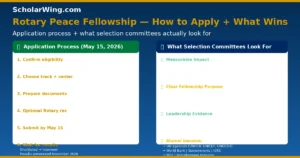
The 2027-28 Rotary Peace Fellowship application is available online. Submit your application between February and May 15. All applications are considered final upon submission. Ensure your academic and/or professional recommendations and Rotary club or district recommendations (optional) are entered prior to submitting your application.
Step-by-Step:
Step 1: Confirm eligibility Check rotary.org/en/our-programs/peace-fellowships for current eligibility guidelines and the list of Peace Centers.
Step 2: Choose your track and universities Decide Master’s vs Certificate based on your experience level and career goals. Research which Peace Centers align best with your focus area.
Step 3: Prepare your application materials
- Essays — explaining your peace/development work and fellowship goals
- CV — detailed professional and academic history
- Academic recommendations (from professors who know your scholarly work)
- Professional recommendations (from supervisors or colleagues who know your work impact)
- Rotary club or district recommendation (optional but can strengthen application)
Step 4: Submit by May 15, 2026 Submit online through rotary.org. All applications are considered final upon submission. No edits after submission. Complete everything before clicking submit.
Step 5: Wait for shortlisting and interview Shortlisted candidates may be interviewed to evaluate communication skills and vision for peacebuilding.
Step 6: Results announced November 2026 If you are selected for a fellowship, you will be notified in November which Rotary Peace Center will be the site for your studies.
What the Selection Committee Looks For
Rotary Peace Centers evaluate academic records, essays, and professional achievements. Selection committees assess leadership qualities, community impact, and alignment with fellowship goals.
The strongest applicants demonstrate:
Measurable Impact: Highlight specific achievements in peace, conflict resolution, or community development with measurable outcomes. Not “I worked on peace” but “I mediated 47 community conflicts in three provinces, resulting in measurable reduction in intercommunal violence in the documented period.” Specificity wins.
Leadership Evidence: Provide examples of leading projects, mentoring teams, or influencing policy decisions.
Clear Fellowship Purpose: Why THIS fellowship, at THIS Peace Center, for THIS research focus, to do THIS work afterward. Vague “I want to contribute to world peace” essays fail. Specific, evidenced, credible plans succeed.
Post-Fellowship Commitment: The program is designed to develop leaders skilled in promoting peace and resolving conflicts globally, fellows are expected to return to their fields and apply their learning. Clear plan for what you will do after the fellowship.
Who Rotary Peace Alumni Are
Since the program began in 2002, the Rotary Peace Centers have trained more than 1,400 fellows who now work in more than 115 countries. Many serve as leaders in governments, NGOs, the military, education, law enforcement, and international organizations like the United Nations and the World Bank.
Past fellows now work in:
- United Nations agencies (UNHCR, UNICEF, UNOCHA, UNDP)
- World Bank and multilateral development banks
- National governments as diplomats, ministers, senior officials
- International Committee of the Red Cross (ICRC)
- Médecins Sans Frontières and other international NGOs
- Peacekeeping missions (AU, UN, regional organizations)
- Academic institutions as researchers and faculty
- Military institutions in peacebuilding roles
The Rotary Peace fellowship alumni network is one of the most field-relevant networks in peace and development globally because every alumnus has been selected for demonstrated impact and is actively working in the sector.
The Rotary Connection — What It Means and Doesn’t Mean
Rotary Foundation funds this fellowship but active Rotary membership disqualifies you from applying.
What the Rotary connection means for your application:
- A Rotary club or district recommendation is optional (but can add value)
- If you have a Rotary connection (a mentor who is a Rotarian, or experience with a Rotary community project), it can be mentioned — but is not required
- The fellowship is genuinely open to candidates with no Rotary connection
What it does NOT mean:
- You do not need to be a Rotarian
- You do not need to know Rotarians to be competitive
- The fellowship selection is based on merit, experience, and peace commitment — not network access
Quick Reference
| Element | Detail |
|---|---|
| Funder | The Rotary Foundation / Rotary International |
| Founded | 2002 |
| Fellowships/year | Up to 170 |
| Countries eligible | ALL nationalities |
| Master’s track | 15-24 months, min 3 years experience |
| Certificate track | 11 weeks, min 5 years experience |
| Coverage | Full tuition + accommodation + flights + field study + health insurance |
| Deadline | May 15, 2026 (annual) |
| Results | November 2026 |
| Active Rotary members | NOT eligible |
| Home country study | NOT allowed (except Thailand) |
| Peace Centers | 9 universities in USA, Japan, Australia, Sweden, UK, Uganda, Turkey, India |
| Application | rotary.org — online only |
| Rotary recommendation | Optional — not required |
| Alumni | 1,800+ in 140+ countries |
FAQ
What does the Rotary Peace Fellowship cover?
The program covers tuition and fees, room and board, round-trip transportation, and all internship and field-study expenses. Plus health insurance and living support.
Is the fellowship open to all nationalities?
Yes, the peace building fellowship is open to international students worldwide.
What experience is need?
For Master’s program, a minimum of 3 years of relevant experience. For the Certificate program, at least 5 years of relevant experience.
Can I apply if I’m a Rotary member?
No, active Rotary membership disqualifies applicants.
Can I study at a Peace Center in my home country?
No, fellowship recipients may not study at a Rotary Peace Center in their home country, except for candidates from Thailand.
What is the deadline?
May 15, 2026 for the 2027-28 academic year.
Do I need to be in a peace-related field?
You do not need a degree titled “peace studies”, but your professional experience must demonstrate substantial work in peace, conflict resolution, development, or humanitarian service.
Free Application Tools
- Motivation Letter: Motivation Letter Generator
- SOP / Study Plan: SOP Generator
- CV: Free CV Builder
- Reference Letter: Reference Letter Generator
- MOI Certificate (if needed): MOI Generator
- Research Proposal (PhD): Research Proposal Generator