
ILDS Dermatology Grants:
Most grant guides tell you how to write a strong application. For this one, the application is the second problem. The first is getting your national society to put your name forward instead of somebody else’s.
The one-slot rule
The International League of Dermatological Societies runs its grants through its Foundation, and the main scheme is DermLink.
Every DermLink application must be made by, or supported by, an ILDS Member in good standing, with a supporting letter and with that member’s fees paid up to date at the deadline. ILDS accepts applications only in partnership with an ILDS Member, Affiliated or Observer Society.
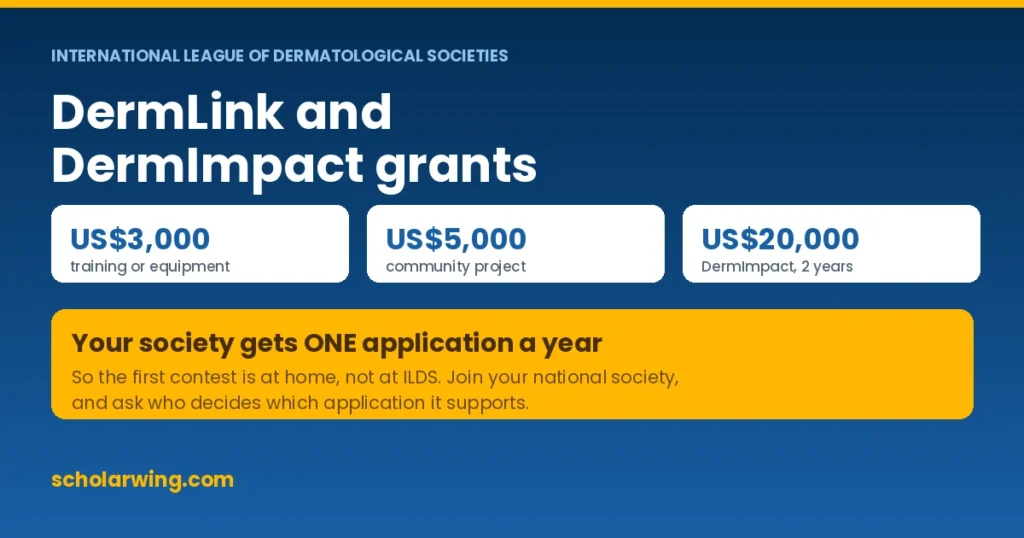
Then the line that reframes everything: each ILDS Member may submit only one application per year.
So before your proposal ever reaches ILDS, it has to win a quieter contest at home. Your national dermatology society has one slot, and it will give that slot to whoever asked first, asked best, and whose name they already know.
That tells you what to do this month, and it has nothing to do with writing. Find your national society. Join it. Go to its meeting. Ask who handles ILDS matters, and ask them directly how the society chooses which application it supports each year.
ILDS lists 242 member organisations across 113 countries as of 1 September 2026, and maintains a membership directory for exactly this purpose. Search it for your own country before anything else, and if you cannot find your national society there, write to ILDS at grants@ilds.org and ask which organisation in your country can support an application.
What DermLink actually pays for
Three distinct things, and people apply for the wrong one.
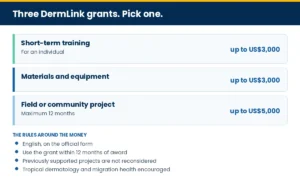
1. Dermatological materials and equipment, up to US$3,000.
2. Short-term dermatological training for an individual, up to US$3,000. This is the one most readers of this page want.
3. Field or community projects in resource-poor regions, up to US$5,000, lasting no more than twelve months.
ILDS assesses on relevance to local needs, potential patient benefit, feasibility and appropriate use of funds, and alignment with the programme’s objectives. It encourages tropical dermatology and migration health work particularly.
The rules around the money. Applications go in English on the official form. Grants must be used within twelve months of award. Previously supported projects will not be considered again.
Look at the assessment list once more. Four of those criteria are about patients, not about you. An application that opens with the skin disease burden in a named district, and the specific gap your training or equipment would close, beats one that opens with a career plan.
DermImpact, the bigger grant with the looser gate
ILDS also runs DermImpact, and it is a different proposition.
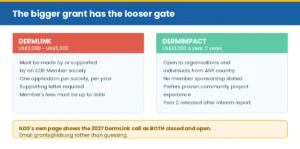
US$10,000 a year, US$20,000 in total, across two years, for projects that build capacity in underserved regions or communities to improve care for people with skin disease. The second year’s funds release only after ILDS receives and reviews an interim report.
ILDS describes it as open to organisations and individuals from any country, and the grants page states no ILDS Member sponsorship requirement for it. It prefers applicants with proven experience running successful community projects, especially alongside other stakeholders.
So the larger grant may not need your society’s single slot at all. If you already run something — a clinic outreach, a school screening programme, a teledermatology link — DermImpact may fit you better than DermLink, and it does not consume your country’s one DermLink application.
Confirm that before relying on it, because the guidelines PDF may carry conditions the web page does not.
The dates, and a contradiction
ILDS’s own grants page gives two different answers about the 2027 DermLink call. One section says it is now closed. Another says it is now open. No closing date appears.
So write to grants@ilds.org and ask, and in the meantime sign up to the ILDS newsletter, which ILDS itself names as the way to hear when applications open.
This is the second funder in a week whose own document disagrees with itself, which is worth remembering as a habit: when a page gives you two answers, the correct response is an email, not a guess.
Where the training centres are
Beyond grants, ILDS’s Foundation runs two training centres.
The Regional Dermatology Training Centre in Moshi, Tanzania, which combines training, research and clinical work and serves a supra-regional area.
The Pacific Dermatology Training Centre at Tamavua Twomey Hospital in Suva, Fiji, serving Pacific Island nations.
ILDS publishes no courses, durations or eligibility rules for either on the page we read, so treat both as leads and write to ask. For a dermatologist whose DermLink training grant would pay up to US$3,000, Moshi is the obvious place to ask about first, since it exists precisely to train for low-resource settings.
Who ILDS has actually funded
ILDS gives examples rather than a full list, and the examples are worth reading because they show the programme’s taste.
Work in Angola, Nigeria, Malawi, Bulgaria, Botswana, Nepal and Tajikistan, covering care for people with albinism, treatment training in refugee camps, teledermatology access and training for pharmacy staff.
Note Nepal and Tajikistan. This is not an Africa-only programme, and a South or Central Asian application sits well within its demonstrated range.
Step-by-step
Step 1, this week: search the ILDS membership directory for your country. Everything depends on this answer.
2, this week: if you find your national society, join it and ask who handles ILDS matters.
Step 3, this week: if you cannot find it, email grants@ilds.org and ask which organisation in your country can support an application.
4, this week: email grants@ilds.org about the 2027 DermLink call, given that the page says both open and closed.
Step 5, this week: sign up to the ILDS newsletter. ILDS names it as the notification route.
6, November: ask your society how it picks its one application, and when it decides. That date, not ILDS’s deadline, is your real deadline.
Step 7, November: decide which of the three DermLink types fits, and do not mix them.
8, November: read both guidelines PDFs before writing anything, since conditions sit there rather than on the web pages.
Step 9, December: write the case around patients. Name the district, the disease burden and the gap. Our guide on writing a research proposal covers building an argument that survives a review panel, and the free CV builder handles the CV.
Step 10: if you already run a community project, look at DermImpact instead, and ask whether it needs member sponsorship.
FAQ
What does ILDS fund?
Two programmes through its Foundation: DermLink for equipment, individual training and community projects, and DermImpact for two-year capacity-building projects.
How much is a DermLink grant?
Up to US$3,000 for materials and equipment, up to US$3,000 for short-term individual training, and up to US$5,000 for a field or community project of up to twelve months.
How much is DermImpact?
US$10,000 a year, US$20,000 over two years, with the second year released after an interim report.
Can I apply directly?
For DermLink, no. Applications must be made by or supported by an ILDS Member in good standing. For DermImpact, ILDS describes it as open to individuals and organisations from any country.
How many applications can my society support?
One per year. That is the real competition.
Which countries can apply?
ILDS welcomes applications worldwide. Funded examples include Angola, Nigeria, Malawi, Bulgaria, Botswana, Nepal and Tajikistan.
Is there a Pakistani member society?
ILDS lists 242 member organisations across 113 countries. Search the ILDS membership directory for your country, and ask ILDS if you cannot find it.
When is the deadline?
ILDS’s own page shows the 2027 DermLink call as both closed and open, with no date. Email grants@ilds.org.
What language?
English, on the official form.
How long do I have to use the grant?
Twelve months from the award.
Can I reapply for the same project?
No. Previously supported projects are not considered again.
Where are the ILDS training centres?
Moshi in Tanzania, and Suva in Fiji.