
An Honest Introduction: Who Should — and Should Not — Consider Studying in Turkmenistan
This guide, like ScholarWing’s coverage of Tajikistan, begins with honesty rather than a promotional pitch — because Turkmenistan is a genuinely unique study destination that suits a very specific type of student, and is unsuitable for many others.
Facts about Turkmenistan that every prospective student must understand:
- Turkmenistan is one of the world’s most isolated countries, with severe restrictions on internet access, freedom of movement, and media
- None of Turkmenistan’s 23 higher education institutions appear in the global top 1,000 university rankings
- Student visas do not permit employment — work opportunities are effectively zero during study
- Travel within Turkmenistan requires permits for certain regions, even as a student
- International degree recognition for Turkmen qualifications is limited compared to most other countries in this series
Who this guide is genuinely useful for:
- Students from countries with bilateral educational agreements with Turkmenistan (Turkey, Russia, Pakistan, OIC member states) who have access to government-nominated scholarship seats
- Students specifically interested in oil, gas, and energy sector education — Turkmenistan has the world’s 4th largest natural gas reserves and a specialized university
- Researchers and linguists interested in Turkmen language and Central Asian studies — a genuinely rare academic specialization
- US students enrolled in the American Council Eurasian Regional Language Program in Ashgabat (Fulbright-affiliated)
- Students seeking extremely affordable education in a safe, stable environment who can manage the isolation practically
For most international students, Turkmenistan is not the right choice. For the specific profiles above, it has real value that this guide explains clearly.
Ashgabat — The City of White Marble
Turkmenistan’s capital, Ashgabat, is often described as the “city of white marble.” The city holds a Guinness World Record for the highest density of white marble buildings globally — an extraordinary architectural environment unlike any other capital city in the world.
The city is safe, modern, and extremely orderly. Street crime is virtually nonexistent. The infrastructure is well-maintained. For students who can manage the restrictions on internet and movement, the physical environment of Ashgabat is genuinely remarkable.
Dushanbe, Mary, Dashoguz, and Turkmenabat are smaller study cities with more affordable living costs.
Top Scholarships in Turkmenistan
The University Landscape — Honest Assessment
Turkmenistan only has 23 higher education institutions. Most are concentrated in Ashgabat or a few major regional cities like Mary, Dashoguz, or Turkmenabat. In terms of rankings, Turkmen universities are beginning to appear but remain far from major Asian or Western institutions. No institution features in the global top 1,000.
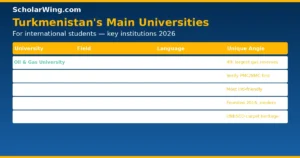
The institutions that genuinely serve international students include:
Magtymguly Turkmen State University — The oldest and largest, covering sciences, humanities, law, and education. Majority Turkmen and Russian-medium. Some English programs available.
Turkmen State Medical University (TSMU) — Founded 1931. Medical, dentistry, pharmacy programs. Tuition: approximately USD 2,000-3,000/year. Verify recognition with your home country’s medical authority before enrolling.
Yagshygeldi Kakayev International University of Oil and Gas — The most strategically unique institution. Turkmenistan holds the world’s 4th largest natural gas reserves (the South Yolotan-Osman field alone ranks among the world’s top 5 gas deposits). This university trains engineers and technicians for the energy sector. For students who want to build careers in Central Asian energy, this specialization has no equivalent in the region.
Oguz Han Engineering and Technology University — Founded 2016. STEM focus. Newer institution, modernizing curriculum.
International University of Humanities and Development (IUHD) — IUHD in Ashgabat is one of the few universities offering English-medium programs in Turkmenistan and provides limited scholarships for talented students. Small private university, more internationally oriented than the public institutions.
State Academy of Arts — Unique programs in traditional Turkmen arts: carpets (Turkmen carpets are UNESCO-recognized), ceramics, jewelry, painting, architecture.
Institute of Telecommunications and Informatics — IT and telecommunications programs.
Scholarship Pathways — Limited but Real
Unlike Kazakhstan (studyin.kz) or Croatia (April 10 deadline via a centralized portal), Turkmenistan’s international scholarship pathways are narrower and accessed primarily through bilateral government channels.
1. Turkmenistan State Quota Scholarship The Ministry of Education of Turkmenistan allocates a quota of fully funded scholarships each year for students from partner nations in Asia, the Middle East, and select CIS countries. These government scholarships allow students to study in Turkmenistan at minimal or no cost.
Access: Through your home country’s Ministry of Education or Ministry of Foreign Affairs. Contact your ministry directly — not Turkmenistan’s portal (which is minimal).
2. Turkey-Turkmenistan Bilateral Scholarship Through a bilateral education agreement, Turkmenistan and Turkey jointly fund scholarships for Turkmen and Turkish students to study in each other’s countries. Students from Turkey have the clearest bilateral pathway.
3. OIC Educational Agreements Turkmenistan participates in UNESCO Silk Road Programs and OIC educational agreements, offering scholarships for students from member states. Pakistan, Bangladesh, Nigeria, Egypt, and most Muslim-majority countries are OIC members, check with your Ministry of Higher Education whether Turkmenistan-specific OIC seats are currently allocated.
4. American Council Eurasian Regional Language Program (Fulbright-affiliated) The American Council offers an accredited study abroad course based in Ashgabat through the Eurasian Regional Language Program. Participants receive 15 hours of classroom instruction a week in a specific language, plus general information about culture, history, and literature. The immersive course also includes cultural trips, stays with a host family, and volunteer opportunities.
5. University Merit Support Several leading universities in Turkmenistan provide merit-based and need-based scholarships for international students. TSMU provides partial scholarships for international students studying medicine and healthcare. The Oil and Gas University offers merit scholarships for engineering students.
These are typically partial tuition discounts rather than full scholarships, but they reduce an already low tuition cost further.
Turkmen Language — A Rare Academic Specialization
For linguists, Central Asian researchers, and academics specializing in Turkic languages, Turkmenistan offers a genuinely scarce resource: immersive exposure to the Turkmen language in its natural environment.
Turkmen is a Turkic language spoken by approximately 10 million people. It is closely related to Turkish and Azerbaijani but distinct in vocabulary, grammar, and phonology. Very few universities outside Turkmenistan and Turkey offer serious Turkmen language instruction.
The American Council’s Eurasian Regional Language Program is specifically designed to serve this need. For US-funded academics, diplomats in training, or Central Asian studies researchers, Ashgabat is the optimal immersion environment for Turkmen language acquisition.
Practical Realities — What Life Is Actually Like in Turkmenistan
This section exists because most guides about studying in Turkmenistan omit the practical realities that significantly affect day-to-day student life.
Internet access: Turkmenistan has one of the world’s most restricted internet environments. Access is limited, monitored, and many international platforms are blocked or slow. VPN use is restricted. Students who rely on online tools for research, communication, or coursework should plan carefully for this constraint. This is not a minor inconvenience, it is a fundamental feature of studying in Turkmenistan.
Travel within the country: The government also has restrictions on what areas foreigners can travel in and their choice of transportation. Some regions require permits for foreigners. Plan any travel within Turkmenistan carefully and confirm requirements with your university’s international office.
Work prohibition: International students in Turkmenistan face limited work options as student visas do not permit employment, and post-study work opportunities are restricted. Budget without any expectation of income during study.
Post-study: Graduates can explore work options in sectors like education, mining, agriculture, and tourism. The government allows degree holders to apply for Temporary Resident Permits (TRP) for 6-12 months to seek employment. Oil and gas sector graduates have the strongest prospects in country.
Cost of Living in Turkmenistan — Very Low
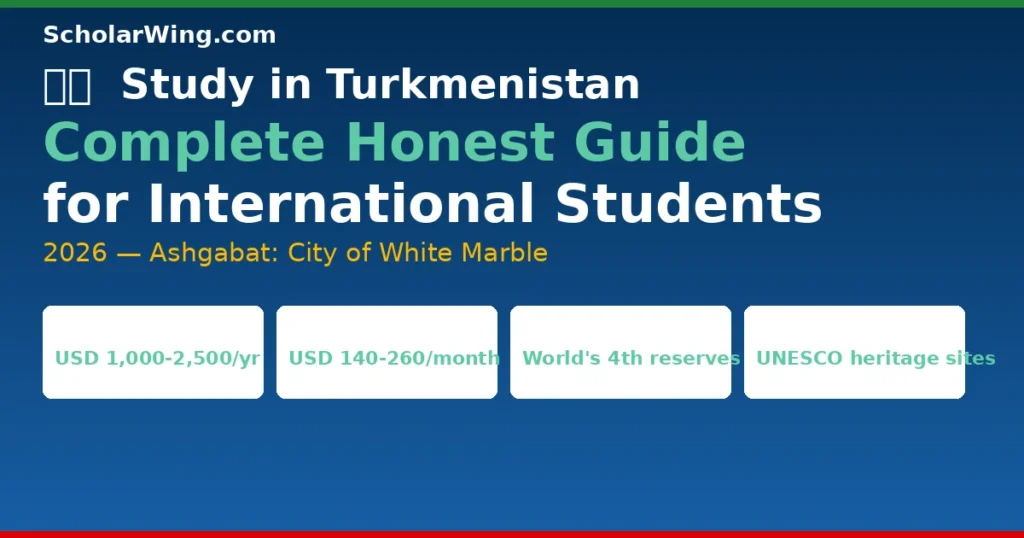
Tuition fees in public universities can be as low as USD 1,000-2,500/year. Dormitory accommodation and daily living expenses cost 50-60% less than in Europe.
Typical monthly costs in Ashgabat:
- Accommodation: USD 40-80/month (university dormitory)
- Food: USD 60-100/month (local food very cheap; some imported items expensive)
- Transportation: USD 10-20/month
- Personal expenses: USD 30-60/month
Total typical budget: USD 140-260/month
The cost of studying in Turkmenistan is genuinely among the lowest of any country. For self-funded students who can manage the practical constraints, the financial accessibility is real.

Student Visa for Turkmenistan
Prior to traveling to Turkmenistan, prospective students must receive a letter of invitation from the Government of Turkmenistan. This allows you to apply for a visa at the Embassy of Turkmenistan or at the Ashgabat Airport.
Process:
- Receive admission letter from your Turkmenistan university
- The university applies for a government-issued invitation letter on your behalf
- Use the invitation letter to apply for a student visa at the Turkmenistani Embassy in your home country
- On arrival, register with local authorities
Documents typically required:
- Valid passport (minimum 18 months validity — <cite index=”11-1″>18 months validity is required</cite>)
- University admission letter
- Academic transcripts (translated and notarized if required)
- Language proficiency proof (Turkmen, Russian, or English depending on program)
- For medical students: health certificate and HIV test results
Processing time: 2-4 weeks. Apply well in advance.
Important: Application deadlines are typically 2-3 months prior, but vary by university. Always confirm exact dates with your chosen university.
Why Turkmenistan — For the Right Student
1. Oil and Gas Sector Education Turkmenistan sits on the world’s 4th largest natural gas reserves. The specialized International University of Oil and Gas trains engineers and technicians for direct entry into Central Asia’s energy sector — a career pathway with genuine regional demand. No other country in this series offers this specific specialization at this proximity to real-world application.
2. Extremely Low Cost At USD 1,000-2,500/year tuition and USD 140-260/month living costs, Turkmenistan is among the most financially accessible study destinations globally. For self-funded students who prioritize cost minimization above other factors, the arithmetic is clear.
3. Safety and Stability Turkmenistan boasts low crime rates and political stability, ensuring a secure place to focus on studies. The welcoming atmosphere helps international students adapt quickly. In terms of personal safety, Turkmenistan is genuinely among the safest study environments in Central Asia.
4. Silk Road Heritage Turkmenistan opens a rare window onto Central Asia, blending the legacy of the Silk Road. Ancient sites including Merv (one of the world’s oldest and largest medieval cities), Nisa (Parthian capital), and Konye-Urgench (UNESCO World Heritage Site) are accessible from within the country.
5. Turkmen Language Immersion For the niche but real academic community studying Turkic languages, Central Asian literature, or regional affairs, Ashgabat is the only place in the world where genuine Turkmen immersion is possible.
Practical Tips
1. Confirm medical program recognition before committing As with Tajikistan, verify PMC, NMC, or your home country’s medical authority recognition for Turkmen State Medical University before enrolling. Recognition can change.
2. Contact your Ministry of Education for bilateral quota seats If you are from Turkey, Pakistan, Russia, or an OIC member country, contact your Ministry of Higher Education about Turkmenistan-specific bilateral scholarship quotas before paying full fees.
3. Budget for limited internet — bring offline resources Download research papers, textbooks, and essential tools before arrival. Plan your academic workflow for a low-bandwidth, restricted-access environment.
4. Verify travel permit requirements for your program’s fieldwork If your program involves fieldwork outside Ashgabat, confirm permit requirements with your university. Some regions require additional authorization for foreign nationals.
5. Oil and gas students — connect with the industry before arriving Research Turkmenistan’s major energy companies (Turkmengaz, Turkmennebit, TAPI project) and international operators working in the country before you enroll. Building professional connections before arrival significantly improves post-graduation prospects.
FAQ
Are Turkmenistani university degrees recognized internationally?
Recognition is limited compared to EU, UK, or major Asian universities. Degrees are more widely recognized within CIS and regional countries. Verify recognition with professional bodies or institutions in your home country before enrolling.
Does Turkmenistan have scholarships for international students?
Yes, but through narrow channels: state quota scholarships via bilateral agreements (Turkey, Russia, CIS, OIC members), university merit discounts, and the American Council Eurasian Regional Language Program for US students. Apply through your home Ministry of Education.
What is the internet situation in Turkmenistan?
Turkmenistan has one of the world’s most restricted internet environments. Many international platforms are blocked or significantly slowed. VPN use is restricted. Students should plan their academic workflow and personal communications for a highly constrained digital environment.
What is Turkmenistan’s best academic specialization for international students?
Energy sector education at the International University of Oil and Gas, given Turkmenistan’s position as the world’s 4th largest natural gas reserve holder. Medical education at Turkmen State Medical University is the second most common pathway for international students.
What is the cost of studying in Turkmenistan?
Tuition: USD 1,000-2,500/year at public universities. Total living costs: USD 140-260/month. One of the lowest-cost study environments globally.
ScholarWing’s Tools:
SOP Generator | Motivation Letter Generator | CV Builder | MOI Generator