
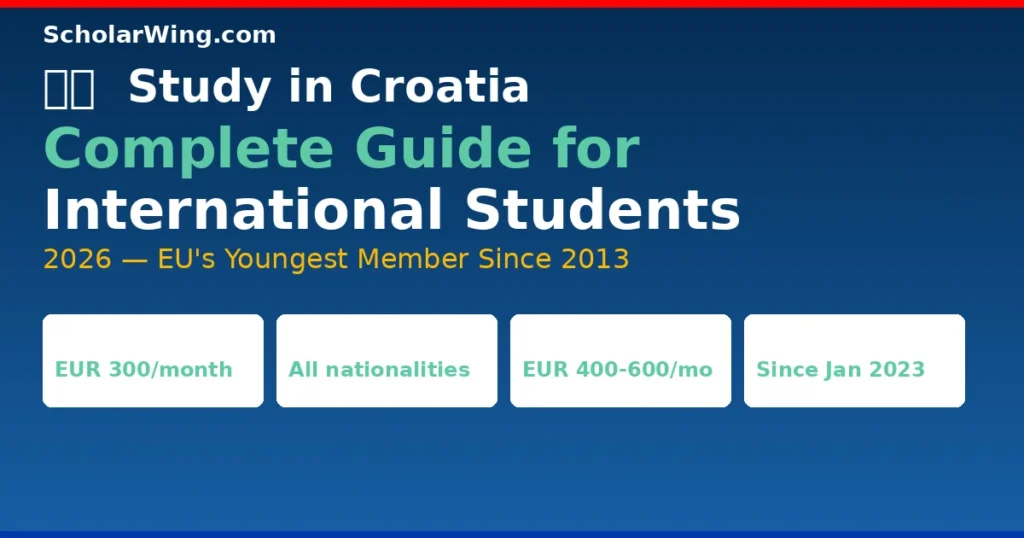
Croatia Is the EU’s Youngest Member — And One of Europe’s Most Overlooked Study Destinations
Croatia joined the European Union in 2013, making it the EU’s youngest member state. Its universities are fully EU-recognized. Its degrees carry the same academic standing as German, French, or Italian qualifications. And its cost of living is significantly lower than Western Europe, a typical student in Zagreb or Split lives on EUR 400-600/month.
Despite this, Croatia receives far fewer international scholarship applications than it deserves. The Croatian Government Bilateral Scholarship program has places available for students from around the world — and one of its two application pools is open to students of any nationality, regardless of whether their country has a bilateral agreement with Croatia.
This is the key fact most guides about Croatian scholarships don’t explain clearly: there are two completely different pools, with different eligibility rules. Understanding which pool applies to you determines whether you can apply at all.
The Croatian Government Bilateral Scholarship — Two Pools, Different Rules
The Ministry of Science, Education and Youth of the Republic of Croatia and the Agency for Mobility and EU Programs are offering Croatian Government Scholarships for the academic year 2026/2027 to foreign students, university teachers, scientists and researchers. The Bilateral Scholarships offer opportunities for study or research in any field of study during the granted mobility period at an accredited public Croatian higher education or research institute.
The scholarship operates through two completely distinct application pools with different eligibility:
Pool 1 — Countries With Bilateral Agreements
The Application Pool 1 is open to citizens of countries (and territories) that have a valid/effective educational co-operation program with Croatia or a bilateral agreement.
Countries with active bilateral agreements include: Belgium (Flanders), Bulgaria, China, Czech Republic, Germany (Bavaria), Greece, Hungary, Israel, Italy, Kosovo, North Macedonia, Montenegro, Poland, Portugal, Romania, Slovakia, Slovenia, Spain, Turkey, and others.
Important: Pakistan, most African nations, and most South Asian and Southeast Asian countries are NOT on Pool 1’s bilateral agreement list. If your country is not on the list, you cannot apply through Pool 1 but you may still be eligible through Pool 2.
Eight types of scholarship available in Pool 1:
- One semester study of Croatian language (4-5 months)
- Semester/partial Bachelor’s or Master’s studies (4-10 months)
- Full undergraduate (BA) or graduate (MA) studies
- Full postgraduate doctoral (PhD) programme (36 months)
- Partial doctoral studies or research (1-10 months)
- Postdoctoral studies and research (1-10 months)
- Short postdoctoral research visit (3-29 days)
- Summer seminar of Croatian language in Dubrovnik (August)
Pool 2 — Open to ALL Nationalities (Via Croatian Language Study)
This is the route most guides don’t explain and it is the most accessible pathway for students from countries not on Croatia’s bilateral agreement list.
The Application Pool 2 is open to international students who are currently studying (or learning) the Croatian language (or Slavic Studies) at universities outside of Croatia. Foreign students can apply regardless of whether or not their respective countries have a valid cooperation program or a bilateral agreement with Croatia.
The requirement: You must currently be studying Croatian language or Slavic Studies at a university outside Croatia, and you must be nominated by your Croatian language professor.
What Pool 2 offers:
- Scholarships for one-semester study (4-5 months) of Croatian language at the University of Zagreb (Croaticum) or the University of Rijeka
- Scholarships for a 2-week summer seminar of Croatian language and literature in Dubrovnik (August 2026)
Who this works for: Students from Pakistan, Nigeria, Ghana, Bangladesh, Egypt, any country not on the bilateral list who are enrolled in or can enroll in a Croatian language course at their home university. A growing number of universities in Asia, Africa, and the Middle East offer Slavic language programs or have connections to Croatian cultural institutions.
The strategic pathway: Enroll in Croatian language studies at your home university → build a relationship with a Croatian language professor → get nominated for Pool 2 → spend a semester in Croatia → build the academic relationships needed to apply for full degree programs.
Deadline: All candidates should apply before the 10th of April 2026. For the 2027-28 academic year, a similar April deadline will apply, watch mzom.gov.hr for the new cycle.
What the Croatian Government Scholarship Covers
This scholarship can be fully funded or partially funded, depending on the program. Undergraduate and Master’s students: about EUR 300 per month. This money is enough for basic living costs like food, rent, and transport in cities such as Zagreb, Split, and Rijeka.
Monthly stipend: EUR 300 for undergraduate and Master’s students Tuition: Covered for scholarship recipients at public Croatian institutions Accommodation: University dormitories available (not always guaranteed) Duration: Varies by scholarship type, from 2 weeks (summer seminar) to 36 months (full PhD)
Honest planning note: EUR 300/month is a basic stipend. Croatia’s cost of living is affordable by European standards, but EUR 300 alone may not cover all expenses in Zagreb without supplementation from savings or part-time work. Budget for EUR 400-600/month total for a comfortable student life.
Top Universities in Croatia for International Students
University of Zagreb — Croatia’s oldest and largest university, founded in 1669. Located in Croatia’s capital. Programs in medicine, engineering, law, business, humanities, and natural sciences. Home to Croaticum, the dedicated Croatian language school for international students. Offers merit scholarships for outstanding international applicants.
University of Rijeka — On Croatia’s Adriatic coast. Strong in science, technology, and medical research. International programs available in English. Beautiful coastal location, lower living costs than Zagreb.
University of Split — Croatia’s second-largest city. Strong in tourism, economics, engineering, and natural sciences. Dalmatian coast location provides unique Mediterranean lifestyle.
Josip Juraj Strossmayer University in Osijek — Eastern Croatia. Affordable even by Croatian standards. Strong in food science, agriculture, and civil engineering.
University of Dubrovnik — Smallest but uniquely positioned for maritime, tourism, and communications studies. Located in one of the world’s most beautiful UNESCO-heritage cities.
CEEPUS — Regional Exchange for Central and Eastern Europe
CEEPUS (Central European Exchange Programme for University Studies) is a regional exchange program that connects universities across Central and Eastern Europe and Croatian universities are active members.
Current CEEPUS member countries are Albania, Austria, Bosnia and Herzegovina, Bulgaria, Croatia, the Czech Republic, Hungary, Kosovo, Macedonia, Moldova, Montenegro, Poland, Romania, Slovakia, Slovenia and Serbia.
If you are from any of these countries and your university participates in CEEPUS, you can apply for exchange mobility to Croatian universities through this program, often with fewer steps than the bilateral government scholarship.
Apply through: Your home university’s international office, which coordinates with the CEEPUS network coordinator.
Erasmus+ at Croatian Universities
As an EU member since 2013, all Croatian universities participate in Erasmus+. For students already enrolled at universities with Erasmus+ partnerships with Croatian institutions, this is the simplest mobility route.
Erasmus+ mobility grants:
- Monthly grant for incoming students (amount depends on your country’s category)
- Tuition waiver during the exchange period
- Duration: 3-12 months for study, or internship period
How to apply: Through your home university’s International Office initiate the process 8-10 months before your planned exchange start. Ask your international office whether your university has Erasmus+ agreements with University of Zagreb, University of Rijeka, or University of Split.
Student Visa for Croatia
Non-EU international students need a Temporary Stay Permit for the Purpose of Study to study in Croatia for programs lasting more than 90 days.
Process:
- Receive admission letter from your Croatian university
- Apply for initial entry — EU nationals simply register their stay; non-EU nationals apply for a Temporary Stay Permit
- For non-EU students: submit Temporary Stay Permit application to Croatian Embassy in your home country, or within Croatia if you entered on a visa
Documents typically required:
- Valid passport
- University admission letter or scholarship offer
- Proof of accommodation
- Proof of sufficient funds or scholarship
- Health insurance
- Criminal record certificate
Processing time: 4-8 weeks. Start as early as possible after receiving your offer.
Work rights: Students can work part-time up to a certain number of hours per week. Part-time work is generally permitted for students with a valid Temporary Stay Permit, confirm current limits with the Croatian Embassy.
Post-study: Graduates can apply for residence permits to work in Croatia. EU membership means Croatian graduates also have EU mobility rights, they can apply for work in any EU member state.
Cost of Living in Croatia — Affordable by European Standards
Croatia is significantly cheaper than Western EU countries while offering a Mediterranean-quality lifestyle on the Adriatic coast.
Typical monthly costs:
- Accommodation: EUR 100-250/month (university dormitory) or EUR 200-400/month (private room/shared apartment)
- Food: EUR 150-250/month (local markets and restaurants affordable; supermarkets reasonable)
- Transportation: EUR 20-40/month (good public transport in Zagreb; smaller cities cheaper)
- Personal expenses: EUR 50-100/month
Total typical budget: EUR 400-600/month, comfortable for a student. The Croatian Government scholarship stipend of EUR 300/month covers the majority of this, particularly in smaller cities like Rijeka, Split, or Osijek.
Why Croatia for International Students?
1. EU-recognized degree at affordable cost Croatia is a full EU member. A degree from University of Zagreb carries the same EU-level recognition as a German or French university degree — but at a fraction of the cost and with substantially less competition for entry.
2. Adriatic coast lifestyle Croatia’s Adriatic coast is one of Europe’s most beautiful environments. Studying in Rijeka, Split, or Dubrovnik means living steps from the sea, in UNESCO-heritage cities, in a country with 1,200+ islands. This is a meaningful quality-of-life advantage over studying in a landlocked Central European city.
3. Growing English-medium options Croatian universities increasingly offer programs in English at postgraduate level. Medical programs, engineering programs, and business programs are available in English at University of Zagreb and University of Rijeka — without requiring Croatian language proficiency for the degree.
4. European travel hub Croatia borders Slovenia, Hungary, and Bosnia-Herzegovina and is a 1-2 hour flight from major European cities. For students who want to travel Europe during their studies, Croatia’s Schengen membership (since January 2023) facilitates free movement across the bloc.
5. Less competition than Germany or France Croatian universities and scholarship programs receive far fewer applications from non-European students than equivalent-quality German or French institutions. A strong applicant from Asia or Africa is more visible in the Croatian pool than in the DAAD or Erasmus Mundus pools.
Practical Tips for Applying to Croatia
1. Pool 2 is your route if your country has no bilateral agreement If you are from Pakistan, most African nations, or most Middle Eastern or South Asian countries not on Croatia’s bilateral list, Pool 2 is the only government scholarship pathway available to you. Enroll in Croatian language studies at your home university and build a relationship with a Croatian language instructor who can nominate you.
2. April 10 is the annual deadline — prepare by February The Croatian Government Scholarship deadline falls in early April. Given the documentation requirements (transcripts, motivation letter, recommendation from Croatian language professor for Pool 2), begin preparing in January-February.
3. University of Zagreb merit scholarships — apply simultaneously When applying to degree programs at University of Zagreb, ask the international office about merit-based scholarship consideration at the same time. These are awarded separately from government scholarships and can provide additional or alternative funding.
4. CEEPUS if you’re from the eligible region If you are from Albania, Bosnia and Herzegovina, Bulgaria, Hungary, Kosovo, North Macedonia, Montenegro, Moldova, Poland, Romania, Slovakia, or Slovenia, CEEPUS is a simpler pathway to Croatian universities than the bilateral government scholarship.
5. Erasmus+ is easiest if your home university has the partnership If your university has an existing Erasmus+ partnership with a Croatian university, Erasmus+ mobility is the simplest and fastest route handled through your home university’s International Office.
FAQ
Can students from Pakistan or African countries apply for Croatian government scholarships? Pool 1 (bilateral agreements) is not available for most Pakistani, African, or South Asian nationals because Croatia does not have active bilateral education agreements with these countries. Pool 2 is open to all nationalities but requires current enrollment in Croatian language or Slavic Studies at a university outside Croatia, plus a recommendation from a Croatian language professor.
What does the Croatian Government Scholarship cover?
Approximately EUR 300/month for undergraduate and Master’s students, plus tuition coverage at public Croatian institutions. Duration varies by scholarship type from 2 weeks (summer seminar) to 36 months (full PhD program).
When is the Croatian Government Scholarship deadline?
The deadline for the 2026-2027 academic year was April 10, 2026. For the 2027-2028 cycle, watch mzom.gov.hr for the new announcement, a similar April deadline is expected.
What is CEEPUS?
CEEPUS is the Central European Exchange Programme for University Studies — a regional academic mobility program covering Albania, Austria, Bosnia and Herzegovina, Bulgaria, Croatia, Czech Republic, Hungary, Kosovo, North Macedonia, Moldova, Montenegro, Poland, Romania, Slovakia, Slovenia, and Serbia. Students from these countries can apply for mobility to Croatian universities through their home university’s CEEPUS coordinator.
Does Croatia require IELTS for international students?
Requirements vary by program. English-medium programs at Croatian universities typically require IELTS or equivalent English proficiency. Croatian-language programs obviously require Croatian language proficiency instead. Erasmus+ exchange students typically follow their program’s standard language requirements.
When did Croatia join the EU and the Schengen Area?
Croatia joined the European Union in 2013 and became a full Schengen Area member in January 2023. This means Croatian residents can travel freely within 27 Schengen countries.